
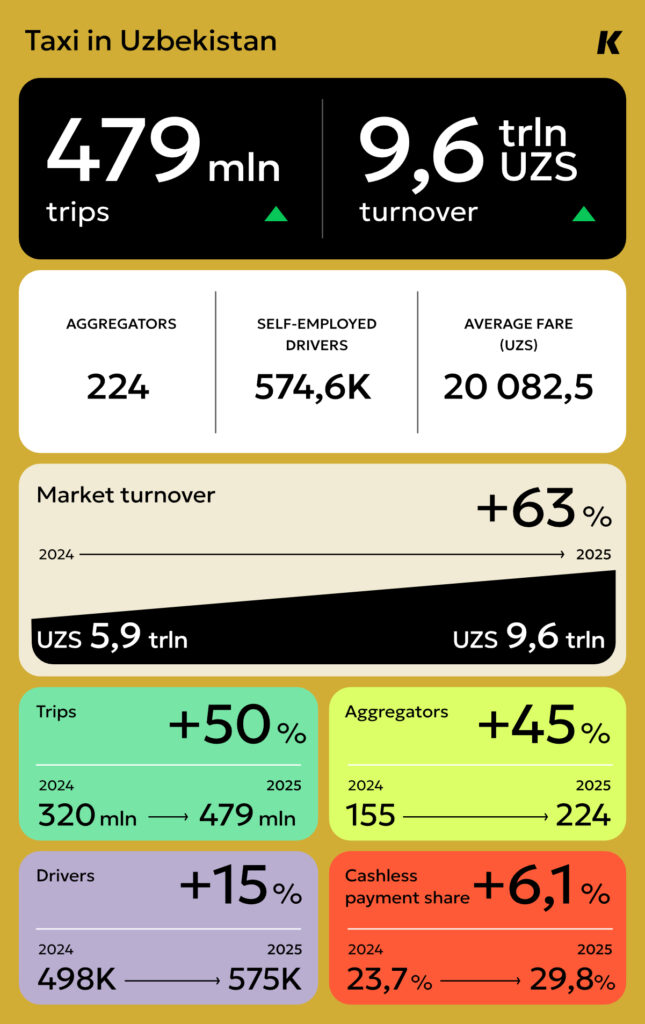
Over the past few years, the ride-hailing market in Uzbekistan has transformed from a predominantly informal sector into one of the largest parts of the platform economy. According to Uzbekistan’s Tax Committee, by the end of 2025, 479mn trips worth $799.6mn (9.6 trillion soums) were made through aggregators integrated with the tax agency’s systems. A year prior, the volume was $491.4 mn (5.9 trln soums) across 319.1 mn trips. Thus, over the year, the recorded turnover grew by approximately 63% and the number of trips by 50%. If the growth rate remains steady this year, the figure could exceed $1.25bn (15 trillion soums).
Kursiv Uzbekistan studied official statistics, market regulation and comments from Yandex Taxi, Uklon and WB Taxi to find out what is driving the market’s growth and where the main growth points lie.
Official figures do not reflect the market
The Tax Committee’s statistics cover trips for which aggregators generated fiscal receipts and transmitted information to state bodies. This is the most reliable available estimate of the digital segment but not of the overall passenger transport market. It does not fully include trips booked directly with drivers, street-hailed taxis and a portion of informal intercity transport.
Uklon’s General Manager Eduard Kovtun notes that it is still difficult to reliably determine the shares of all participants as the market continues to transform and become more transparent.
«A portion of trips is still made outside digital platforms, for example, when a passenger finds a car on the street. Today, there is no open data that would allow us to reliably estimate the volume of this segment or the number of unlicensed drivers,» Kovtun explains.

Anatoly Smorgonsky, director of the International Department for Technology Development at the RWB taxi and transport service, told Kursiv Uzbekistan that the company has its own market analytics but is not prepared to disclose them for commercial reasons.
Therefore, $799 million (9.6 trillion soums) should be considered the lower bound and the volume of the most transparent part of the market. The population’s actual spending on individual passenger transport is likely higher, but it is impossible to reliably assess the informal segment without a separate study of passengers, drivers and carriers.
Demand and legalisation drive growth
The growing popularity of apps is not the only reason for the sharp jump in indicators in 2024–2025. The transition of previously unrecorded transport into the official sector significantly contributes to the dynamic. According to the Tax Committee’s final statistics, the number of aggregators connected to its systems increased from 155 at the beginning of 2025 to 224 by the end of the year, and the number of self-employed drivers working through platforms grew from 497,900 to 574,600.
Uklon estimates the annual market expansion at more than 20%.
«For us, this growth is confirmation that we correctly assessed the country’s potential a few years ago. The emergence of new players and increased competition is a logical stage in the development of a growing market,» the head of Uklon says.
Aggregators are strengthening their positions thanks to convenience and transparency. A passenger can quickly hail a car, see the trip conditions in advance and receive information about it in a digital format. The driver, in turn, gets access to a stream of orders and tools for managing their employment independently.
WB Taxi also views the legalisation of the market positively. According to Smorgonsky, operating in accordance with legislation benefits all participants, and the continuous onboarding of new partner taxi fleets demonstrates a demand for legal digital services.
«The legalisation of the market benefits all its participants. At WB Taxi, all processes are built in strict compliance with the legislation,» Smorgonsky stated.

Self-employed individuals with a licence can now engage in urban, suburban, and intercity transport. In February 2025, the government permanently established the ability for self-employed individuals with a licence to engage in urban, suburban, and intercity transport. permanently established in February 2025. The Tax Committee reported on the matter in more detail.
Average receipt exceeds $1.7
The average cost of a trip rose from $1.54 (18,456 soums) in 2024 to $1.67 (20,082.5 soums) in 2025, or by about 8.8%. The main reason for the turnover increase was more orders, not just higher tariffs.
Uklon does not see a direct correlation between fiscalisation and the price of a specific trip. The tariff is formed dynamically and depends primarily on demand, the number of available cars, the route and the traffic situation.
«It would be wrong to say that fiscalisation inherently leads to an increase in trip costs,» Kovtun emphasises.
The share of cashless payments is gradually increasing. While about 76.3% of the turnover In 2024, cash transactions accounted for approximately 76.3% of the turnover, but this percentage dropped to 70.2% in 2025. in cash in 2024, the figure fell to 70.2% in 2025. Bank cards and other cashless methods accounted for $233.2mn (2.8 trillion soums), or 29.8%, in 2025.
WB Taxi is focusing, among other things, on developing loyalty programmes and card payments. Smorgonsky said that passengers have positively received the opportunity to earn cashback.
According to him, regular customers publish screenshots of their trips on social networks where the discount reaches up to 99% thanks to the use of bonus points. The company sees the cashback programme as a way to attract users amid intensifying competition.
Yandex leads the way, Uklon trails behind
The most detailed official data on market distribution was published at the end of 2024. Out of 319.1mn fiscal receipts, 271.3mn were issued through Yandex Go. The service accounted for about 85% of recorded trips. In monetary terms, its share reached approximately 88% — $433.1 million (5.2trln soums) out of the total turnover of $491.4mn (5.9trln soums).
In October 2024, the Committee for Competition Promotion and Consumer Protection reported that YandexGo UB had achieved dominance in the taxi aggregator service.
Uklon does not disclose its exact figures, but according to the company’s internal calculations, it holds a «strong second position.» Over 20,000 active drivers work through the service each month. The company motivates them with surcharges for a certain number of orders, working during peak demand hours, completing specific categories of trips and branding their cars.
Meanwhile, competition in ride-hailing targets two audiences simultaneously — passengers and drivers. Without a sufficient number of cars, it is impossible to ensure quick arrivals, and without stable demand, it is difficult to retain drivers on the platform.
«In the long run, competition will increasingly hinge on factors beyond just price or arrival speed. When the basic capabilities of services become comparable, product quality, user experience and brand trust take on greater significance,» Kovtun believes.
WB Taxi expands geographical reach
A new stage in the competitive struggle: WB Taxi is entering a new phase of competition. The service entered Uzbekistan at the end of 2025 but is already developing actively beyond the capital. According to the company, the service has already launched in Tashkent, Samarkand and Bukhara. The company does not disclose its market share or target indicators but intends to enter new cities systematically.
Smorgonsky states that they base launch decisions on their demand assessments. Every city has its specifics, but the main demands of market participants remain similar.
«Regardless of the location, drivers need transparent and profitable conditions for cooperation, while passengers need convenient and affordable trips. This is precisely what we strive to provide for both sides,» the RWB official says.
WB Taxi’s strategy includes an attractive offer for clients, clear conditions for drivers and additional benefits within the ecosystem. The company notes sustained demand for trips from passengers and high interest in the platform from drivers.
Over the next one to two years, WB Taxi intends to expand its presence, develop the app and add new features; however, the company has not yet disclosed detailed plans.
Main growth zone
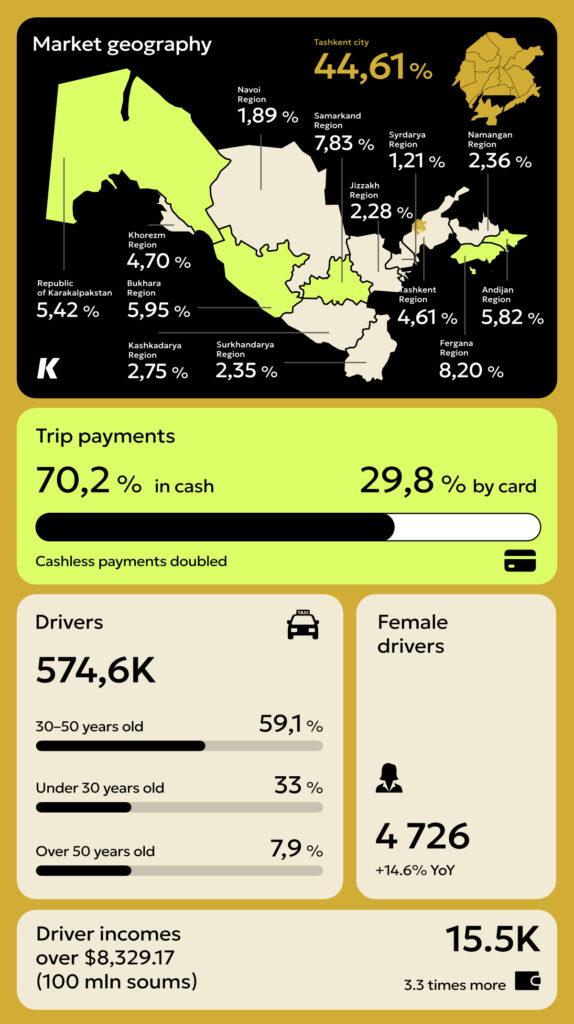
According to the company’s press service, Yandex Taxi already operates in all regions of Uzbekistan, covering 19 cities and their surrounding areas. The service informed Kursiv Uzbekistan that its immediate task is to enter cities where the platform is not yet present and to increase the number of cars in existing locations.
«Our main focus for the coming years is to increase the accessibility of the service for users across the country,» Yandex Taxi stated.
The company notes that the differences between the capital and the regions are gradually narrowing. In the regions, users more often make short trips, and in many cities they use the service even more frequently than residents of Tashkent. According to the company, these trends demonstrate that online taxi booking is becoming a familiar part of urban mobility throughout the country.
Uklon believes that simply copying the capital’s model is insufficient. The company currently focuses on Tashkent but regularly evaluates opportunities to expand into other cities. Before launching, it analyses potential demand, the average receipt, the length and frequency of trips, the necessary investments and the sustainability of the model.
Outside the capital, calling a car through a local operator, making direct agreements with drivers and hailing a car on the street remain common. Furthermore, the average receipt in most regions is lower, trips can be shorter, and the frequency of app usage is lower.
«For us, launching in a new region is not a matter of simply scaling the existing model,» Kovtun notes.
According to him, each city requires adapting the product, tariff logic and working conditions. The price must remain comfortable for the passenger, but the trip has to be economically attractive for the driver. Otherwise, the aggregator will be unable to maintain the necessary number of cars on the road.
Competing for both passengers and drivers
It is not enough for an aggregator to attract clients with discounts. The quality of service depends on the number of available cars, and drivers will not stay on the platform without stable demand and clear earnings.
The company names the freedom to choose orders as one of Uklon’s distinctions. Even before accepting a trip, the driver sees its cost and destination and can set filters by arrival radius, price, direction and payment method.
«It is important for us that drivers choose Uklon for more than just financial motivation,» Kovtun says.
According to him, in the long term, the choice of platform is determined by a combination of a stable flow of orders, potential income, transparent conditions, app convenience and the ability to independently manage employment.
Yandex places an emphasis on the efficiency of its order distribution algorithms. The company refines them to reduce cars’ empty mileage, decrease drivers’ waiting times for the next order and speed up passenger pick-ups.
«This helps drivers use their time on the road more efficiently and increase their potential hourly income, while helping users find a car faster at an affordable price,» the Yandex Taxi press service noted.
There is also a support programme for the service’s partners operating in Tashkent. Entrepreneurs can receive bonuses from the company, access to special leasing terms and other tools for business development.
Tariffs get more flexible
The next stage of the competitive struggle involves product segmentation. Yandex is expanding its lineup of premium classes in cities where they were previously absent while simultaneously developing solutions to lower the cost of a trip.
In particular, the company continues to scale the «Share» tariff and scenarios in which a user can choose a more favourable price if they are willing to walk a little to the pick-up point or wait longer for a car.
Uklon is already developing adjacent business areas in Uzbekistan: delivery, corporate travel with Uklon Business and the Uklon Ads advertising service.
«We are gradually moving from a single-product model to an ecosystem approach,» Kovtun shared.
The transition from a single product to an ecosystem model allows platforms to distribute user acquisition costs across multiple services and increase the frequency of customer interactions with the app.
Half of drivers make up to $417 annually
By the end of 2025, 574,600 self-employed drivers worked through aggregators. However, the income structure shows that for a significant portion of them, a taxi remains a side gig. Up to $83.29 (1mn soums) a year was earned by 159,700 people, and another 146,700 earned between $83.29 (1mn soums) and $416.46 (5mn soums).
Thus, for 53% of registered drivers, their income through aggregators did not exceed $416.46 (5mn soums). 15,500 people, or about 2.7% of the total number, received over $8,329.17 (100mn soums). This points to a two-tier model: a small group works almost professionally, while hundreds of thousands of car owners hit the road from time to time.
At the same time, some drivers might have only joined an aggregator in the second half of the year, so the official data does not reflect the duration of their work and prevents an accurate assessment of average monthly income.
For the market, such a structure is simultaneously an advantage and a risk. A flexible supply helps to quickly increase the number of cars during peak hours, but irregular employment can reduce drivers’ willingness to invest in vehicle maintenance and service quality improvements.
Safety becomes a competitive factor
As prices and arrival speeds level out, platforms are beginning to compete more actively using safety tools. Uklon provides an SOS button for both passengers and drivers, allowing them to share trip and route information with loved ones. Once the order is completed, the driver can no longer access the passenger’s phone number.
Verification begins at registration with the checking of necessary documents. After completing their first 15 orders, the driver undergoes photo verification. The platform also analyses ratings, support requests, complaints and recurring signals. In cases of systemic violations, restrictions up to and including disconnection from the service are possible.
«For us, safety is constant work that simultaneously addresses the product, processes and service quality,» Kovtun emphasises.
More than 50 employees work in the Driver Care and Customer Care departments, handling appeals from passengers and drivers as well as resolving non-standard situations. The company continues to work on new technological solutions to raise the standards of safety and service reliability.
Similar tools exist in other services too.
What will define the market
Representatives from all three surveyed aggregators view the intensifying competition positively, although each is banking on different tools.
«Users having a choice is an important factor in market development. Competition stimulates participants to implement new technologies faster, improve service quality and offer new solutions,» Yandex Taxi stated.
At the same time, official data still barely disclose the regional structure of trips, platform commissions, drivers’ net income after expenses, working day duration and empty mileage time. Without these indicators, it is impossible to fully assess the economic sustainability of platform employment.