
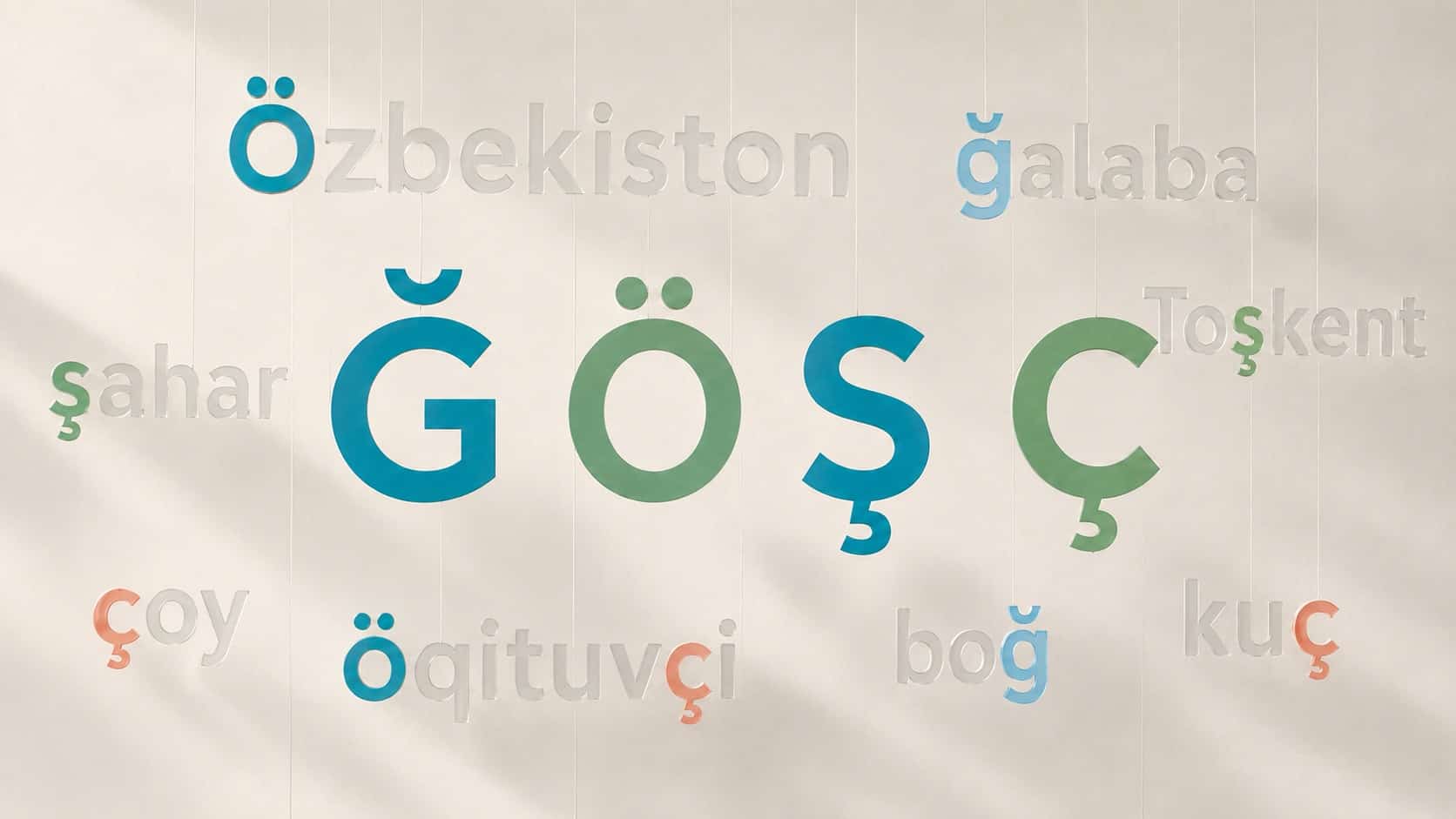
Uzbekistan’s proposed alphabet reform is meant to replace four endemic letterforms, reduce ambiguity in digital text and bring its Latin script closer to the wider Turkophone world. Supporters see a practical fix, but after three decades of unfinished transition, even sympathetic observers want proof that the initiators can finally make it work.
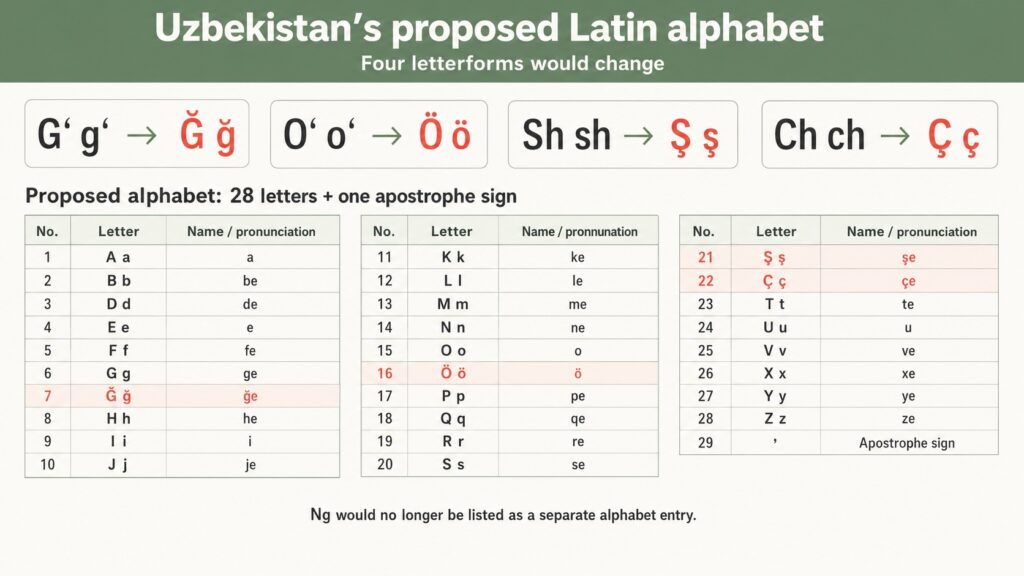
Uzbekistan’s proposed update would replace ‘Sh’ with ‘Ş’, ‘Ch’ with ‘Ç’, ‘Oʻ‘ with ‘Ö’ and ‘Gʻ’ with ‘Ğ’. ‘Ng’ would no longer be listed as a separate combination in the alphabet, although the letters would still appear together wherever Uzbek spelling requires them.
The official inventory would change from 26 letters and three letter combinations to 28 letters plus the tutuq sign, an apostrophe used elsewhere in Uzbek spelling.
The lower house of Uzbekistan’s parliament has adopted the bill on 7 July and sent it to the Senate. The Senate’s science, education and health committee discussed the proposal on 24 July.
As of 25 August, the amendment was not yet in force: the existing alphabet law still sets out the 1995 system of 26 letters and three letter combinations. Until the remaining legislative steps are completed, «proposed» is the accurate description.
Nazarbek Nazarov, a literature blogger and English-Uzbek translator, told Kursiv Uzbekistan that he had opposed the reform because of its likely cost. «My reasoning was simple: how many documents would have to be replaced, and how much would that cost?» he said.
He has since changed his mind.
«If we set aside the cost and the time people will need to get used to the new letters, the proposed alphabet would be more convenient,» Nazarov pointed out. «Some sequences that now consist of two characters would be replaced by a single letter.»
Why current Uzbek alphabet creates problems online
Nazarov said his experience with AI and machine learning helped shift his view. In his work, language tools often treat Oʻ, Gʻ, Sh and Ch as sequences rather than individual Uzbek letters or sounds. Treating Ng as a single alphabetic unit can also complicate syllabification and line breaks.
The apostrophe-like mark in Oʻzbekiston is often replaced with a straight apostrophe or a curly quotation mark. The results can look almost identical to a reader while being stored as different strings, complicating exact-match search, sorting and data cleaning unless the software normalises them. Unicode’s own guidance notes that modifier letters such as ʻ are often replaced with visually similar quotation marks.
The proposed Ş, Ç, Ö and Ğ all have dedicated Unicode code points. That would remove one source of ambiguity, but it would not resolve every digital problem by itself. Keyboards, fonts, databases, search indexes and older content would still need to be updated.
Read more: Google’s Gemini chatbot adds Uzbek language support
The coexistence of Latin and Cyrillic creates a larger burden. A 2022 study of machine transliteration for Uzbek found that maintaining text in multiple writing systems fragments available data and makes language resources and models pricier to develop.
What the reform would mean in daily life
The distinction matters because public reactions to alphabet reform often turn less on linguistic theory than on expected inconvenience. Will passports suddenly become invalid? Must businesses replace every sign? Will schools throw out current textbooks?
The transition plan says no. Existing passports and ID cards would remain valid until expiry, while banknotes already in circulation would remain legal tender. Textbooks, signs, menus, websites and official forms would adopt the revised spelling when they are normally replaced or reissued, rather than through an overnight change. Kursiv Uzbekistan has explained the proposed phase-in here.
Kursiv Uzbekistan staff writer Nigora Umarova was less persuaded. She expected adapting to another version of the alphabet to take at least a generation.
«When the change comes, people will probably begin to identify different periods of Uzbekistan’s development by the alphabet in use,» she said. «For many of us, today’s script may eventually become a nostalgic relic of the ‘good old days’.»
Today, most people in Uzbekistan encounter both Cyrillic and the current Latin system in their daily lives. Uzbekistan introduced a Latin-based alphabet by law in 1993 and revised it in 1995. Latin is the school standard and is widely used in state-facing and commercial communication, while Cyrillic remains common in publishing, advertising, personal correspondence and some official material.
«An entire generation has grown up with the current script, and it is deeply embedded in society,» Umarova explained. «Government, education and business all use it, so it has become part of how many Uzbeks understand their modern cultural identity.»
Familiar letters across the Turkic world
Single letters with diacritics have precedent in Uzbek, but the exact history needs care. The 1993 alphabet used Ç, Ğ and Ş, alongside Õ, rather than the Ö proposed today. Earlier Soviet-era Latin alphabets used their own changing inventories. The new proposal is therefore better understood as a return to a single-letter principle than the restoration of one former alphabet.
In 2024, a commission convened by the International Turkic Academy and the Turkish Language Association agreed on a proposed 34-letter Common Turkic Alphabet. The framework is a reference inventory covering sounds found across Turkic languages, not an instruction that every language must adopt all 34 letters. Guidelines agreed in 2026 explicitly left the adoption of the alphabet to each country’s national authorities.
Read more: Mirziyoyev proposes «Digital Turkic Corridor» and cybersecurity alliance
Using Ş, Ç, Ö and Ğ would make Uzbek words more visually familiar to readers of Turkish and Azerbaijani. That familiarity may help readers approach a text, although shared letter shapes do not make the languages mutually intelligible.
Feride Makhsetova, a Tashkent-based journalist who covers Uzbekistan’s autonomous region of Karakalpakstan, also supports the alphabet facelift.
«The proposed Uzbek alphabet is clearly more convenient for me than the current one,» Makhsetova, herself a native Karakalpak speaker, told Kursiv Uzbekistan. «Replacing awkward apostrophes and digraphs with diacritics makes the letters easier to remember.»
She cautioned against applying the Uzbek model unchanged to Karakalpak. Karakalpak has nine vowel sounds, compared with six in Uzbek, and it uses vowel harmony to distinguish between front and back vowels. Makhsetova reminded that «a Karakalpak alphabet using Turkish-style diacritics was introduced in 1994.»
Umarova, for her part, doubted that four shared letters will do much to unite readers across the Turkic world.
«The people most likely to find the immediate change convenient are those who already read Turkish,» she said. «For everyone else, a revised alphabet will bring a steep learning curve rather than instant convenience.»
What happens next in Uzbekistan’s alphabet reform?
All in all, the Uzbek public is unlikely to embrace the reform simply because it might be considered elegant. It will be judged on whether the revised alphabet makes Uzbek easier to write without making everyday life more difficult.
«If it speeds up the move to the Latin script, it should be adopted as soon as possible. But if implementation follows the old pattern, people will still struggle to know which alphabet to use and when,» Nazarov said.
«As a linguist and translator, I welcome the proposal for practical reasons, but the reform should not be politicised or framed as a turn towards Turkey,» he concluded.
Makhsetova speculated that a similar reform for Karakalpak could help address one of the language’s fundamental challenges: digitisation. Popular operating systems currently lack a convenient Karakalpak keyboard layout, forcing users to combine Kazakh and Uzbek characters.
«This situation, in turn, confuses search algorithms. If developers incorporate our language-specific characters when designing new digital standards, they could more easily integrate Karakalpak into modern technology while retaining its distinct identity,» she posited.