FIDE 2026 elections: Who is running for presidency and how voting is done

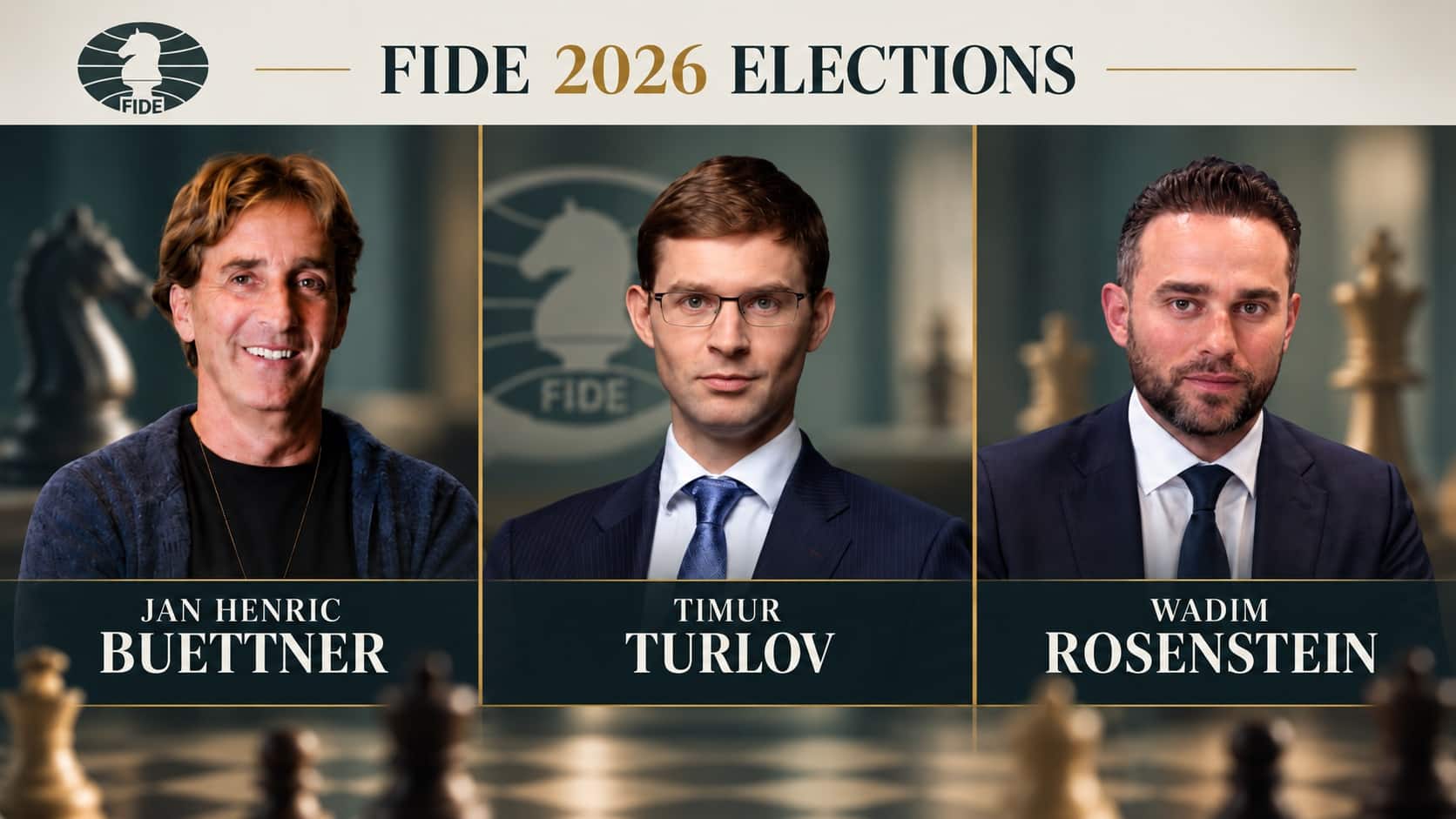
FIDE member federations are slated to elect the next president of the world chess governing body in Samarkand on 26 September, with three approved presidential tickets on the ballot: Jan Henric Buettner with Malcolm Pein, Wadim Rosenstein with Gordon Tang and Timur Turlov with Viswanathan Anand. FIDE’s Electoral Commission confirmed all three candidatures after reviewing the applications submitted before the July deadline.
The vote comes during the FIDE Congress, which is running alongside the Chess Olympiad. The current official programme still lists the General Assembly and elections for 26 September, followed by another Assembly session on 27 September in Samarkand.
The run-up to the vote faced a bureaucratic conundrum. On 16 September, FIDE said several Congress delegates entitled to vote had not yet received Uzbek visas, including FIDE Council member Benard Wanjala. The federation warned that it might have to move the Congress to another date and location if it could not guarantee delegates’ participation and voting rights.
No relocation has since been announced, and Samarkand remains on the official schedule.
Kursiv Uzbekistan will be providing firsthand coverage of the FIDE Congress and the 2026 Chess Olympiad final – stay tuned for further updates.
Read more: Samarkand to host FIDE presidential elections this September
How do FIDE elections work?
The president and deputy president stand together on a single ticket, roughly similar to a US model in which a president and a vice president run together.
Under FIDE’s Electoral Rules, each eligible member federation represented at the General Assembly has one vote, irrespective of the size of its population or chess community. Voting for the presidential ticket is by secret ballot.
To be elected, a candidate needs 50% plus one of the votes cast to win in the first ballot. Should no candidate reach that threshold, the two leading tickets will advance to a second round. If there is a tie, voting between the tied candidates is repeated until it is broken.
FIDE’s final list of federations eligible to vote was published on 14 September, ahead of the General Assembly. It includes 202 national federations, with Russia and Rwanda being excluded.
Now that the voting rules have been explained, who is running for the top FIDE job?
Timur Turlov
Kazakhstan’s entrepreneur Timur Turlov, born in 1987, is running with five-time world champion Viswanathan Anand. Turlov is the founder and CEO of Nasdaq-listed Freedom Holding Corp, has led the Kazakhstan Chess Federation since 2023 and has also been involved in international school-chess initiatives.
FIDE’s candidate biography credits Turlov with expanding chess infrastructure, school programmes and international events in Kazakhstan, while his campaign stresses digitalisation, financial resilience and a stronger voice for regions outside the traditional centres of world chess.
If you want to lead a global organisation such as FIDE, you should be prepared to answer questions about your ideas and plans and not run away from them.
— Timur Turlov (@TurlovforChess) September 23, 2026
Throughout this campaign I gave many interviews and was asked difficult but important questions and I am grateful for the… pic.twitter.com/jIXwstCk8Y
Anand adds considerable institutional and sporting experience to Turlov’s respective ticket. He has served as FIDE deputy president since 2022 and became acting president in July after Russia’s Arkady Dvorkovich voluntarily suspended his presidential powers following his inclusion on EU and Swiss sanctions lists. FIDE confirmed that Anand would assume the president’s duties while those measures remained in force.
Turlov’s own argument, set out in an op-ed for Kursiv Uzbekistan, places national federations at the centre of his vision. He believes FIDE should provide predictable long-term funding and international opportunities while delegating more decisions to federations that know their domestic chess systems best.
Turlov also believes Central Asia should play a larger role as elite chess expands geographically.
Read further: Timur Turlov reflects on FIDE, Uzbekistan and Central Asia’s future
Jan Henric Buettner
German entrepreneur Jan Henric Buettner, born in 1964, is running alongside English chess organiser and journalist Malcolm Pein.
Buettner helped establish AOL Europe, later founded BV Capital, now known as Headline Ventures, and built businesses across technology, investment, and hospitality. In chess, his highest-profile project is Freestyle Chess, which he co-founded with Magnus Carlsen.
His candidate statement focuses on expanding participation, strengthening FIDE’s member federations and professionalising the organisation’s commercial operation, including attracting more sponsorship and media revenue. Buettner argues that additional income should feed back into national federations and the wider chess ecosystem.
Joint Statement from Jan Henric Buettner and Malcolm Pein
— Jan Henric Buettner (@JanHBuettner) September 19, 2026
We want to correct some speculation circulating in Samarkand about our position in the FIDE presidential election.
We are running together because we believe FIDE needs fundamental reform. Too much currently depends on… pic.twitter.com/s0iuxLHyxW
Pein brings a different type of experience to the ticket. He has worked for more than four decades as a player, coach, journalist, author, administrator and tournament organiser. He founded the London Chess Classic, has represented England at FIDE and has served as a vice-president of the European Chess Union.
Wadim Rosenstein
Wadim Rosenstein, born in 1990, is a German-based entrepreneur best known in chess as the founder of WR Chess. He is running alongside Gordon Tang.
Rosenstein has heavily centred his chess profile around events and sponsorship. His projects include the WR Chess Masters, junior competitions, women’s events and involvement in the development of the World Rapid & Blitz Team Championship.
FIDE’s candidate material presents his broader pitch as one of stronger national federations, more professional management and a more commercially sustainable international federation.
His platform therefore overlaps with Buettner’s in seeing greater commercial potential in chess but places particular emphasis on institutional management and building events capable of attracting players, sponsors and international audiences.
Read more: Caruana, So and Sindarov headline Samarkand Chess Olympiad
What does a FIDE president actually do?
FIDE’s president does not govern world chess alone: the General Assembly remains the federation’s highest authority, while the Council acts as its strategic and oversight body. But the office still carries substantial executive power under the FIDE Charter.
The president:
- represents FIDE internationally, including in relations with member federations, governments, and other international organisations;
- signs contracts and assumes obligations on behalf of FIDE, though some agreements need Council approval or subsequent ratification;
- chairs the FIDE Council and Management Board, with a deciding vote in some tied decisions;
- determines the structure of FIDE’s offices, including hiring and dismissing employees and appointing directors.
- can make decisions that take immediate effect, although the Council or General Assembly may hear some appeals.