Tashkent ranks as top frontier bet for venture capital — but is the hype justified?

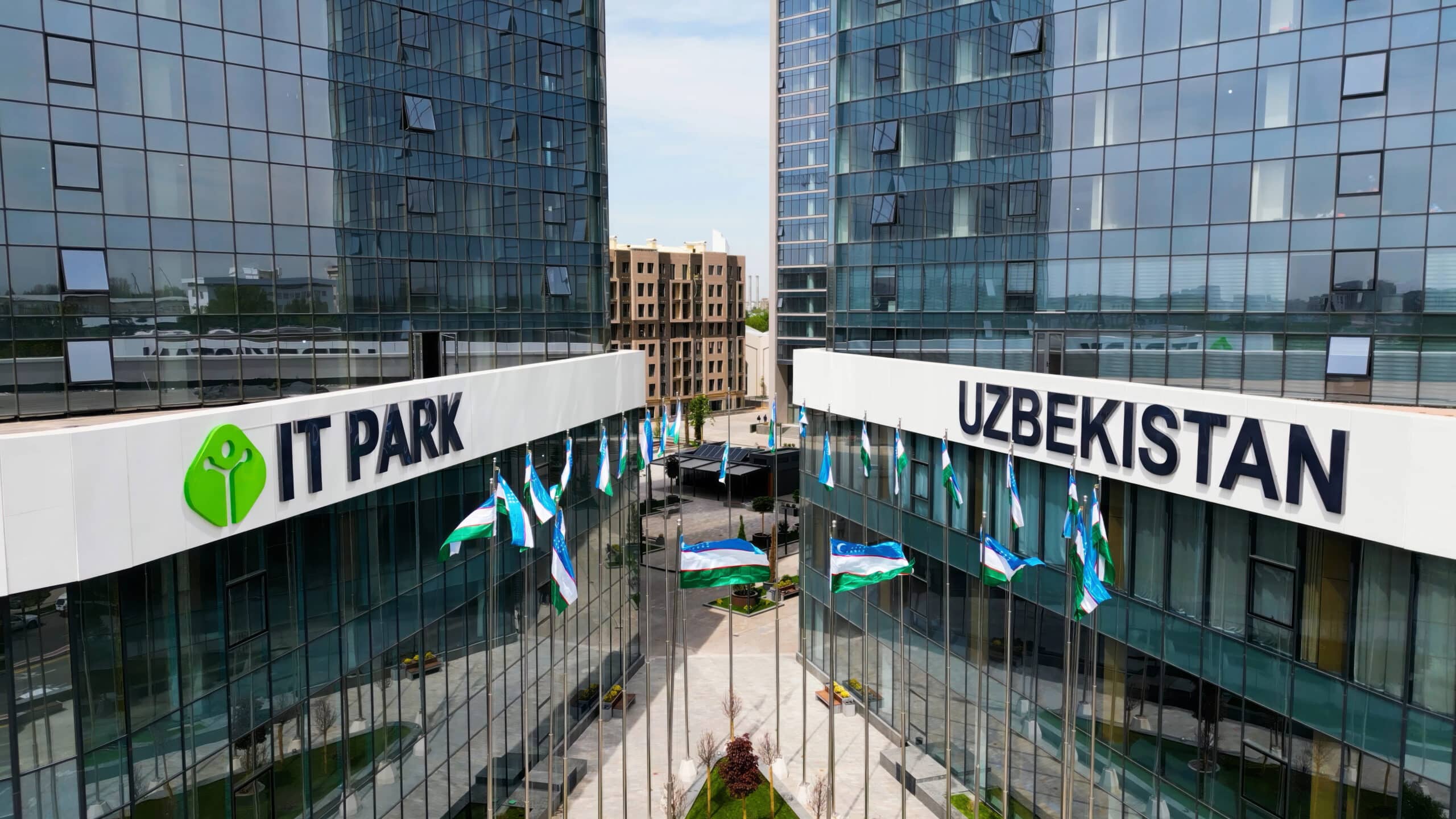
For most of the past decades, Almaty was Central Asia’s default answer to «where next?» Kazakhstan had — and still has — the established venture markets, the exits, and Kaspi, a fintech company now worth around $20bn on Nasdaq. Tashkent had none of that — until recently. Venture capital trackers have started to notice — here’s how.
Uzbekistan’s start-up scene has experienced an unusually active year. According to IT Park Uzbekistan, funding more than quadrupled in 2025, reaching $329 million across 140 deals, up from $69.5 million and 38 deals the previous year.
Venture watchers have started to notice the trend.
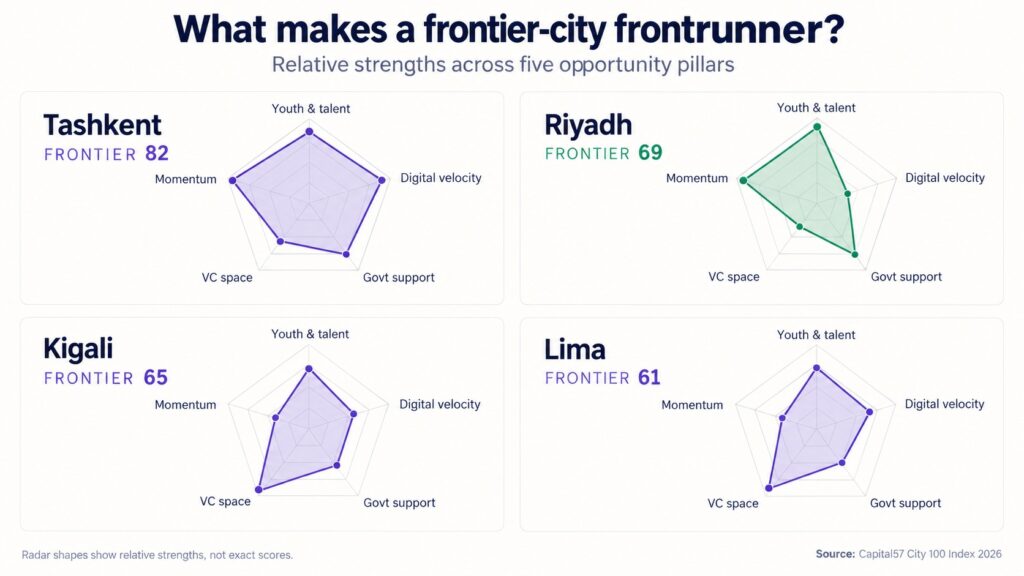
Tashkent has come first in a new global ranking of «frontier» cities — places outside the world’s established tech hubs where the next wave of start-up growth might happen — compiled by Capital57, a $50mln venture capital fund backed by Abeer Group, regulated in Australia and operating out of Abu Dhabi and Singapore.
Capital57’s City 100 Index, shared with Kursiv Uzbekistan, scores 100 emerging and frontier cities, deliberately excluding the US, China, the UK and Israel, which the firm considers already saturated with capital and well covered by existing trackers.
The methodology and a city-by-city scoring ledger draw from various data sources, including StartupBlink, Startup Genome, the United Nations, Ookla, the World Bank and others.
The Index is «the intentional inverse of StartupBlink and the Global Startup Ecosystem Report, which rank where ecosystems already stand,» Nabeel Shariff, the managing director of Capital57, explained to Kursiv Uzbekistan.
The backstory: Central Asia named world’s fastest-growing startup ecosystem region
Two scores, not one
The index does not just ask «how good is this city’s start-up scene today?» It scores every city on two separate things, then blends them:
- Frontier Opportunity (60% of the overall score) — how much unclaimed potential a city has: a young population, fast digital adoption, government backing for tech, and little existing competition.
- Maturity (40%) — how developed the ecosystem already is: deep capital markets, a track record of successful exits, and established infrastructure for founders and investors.
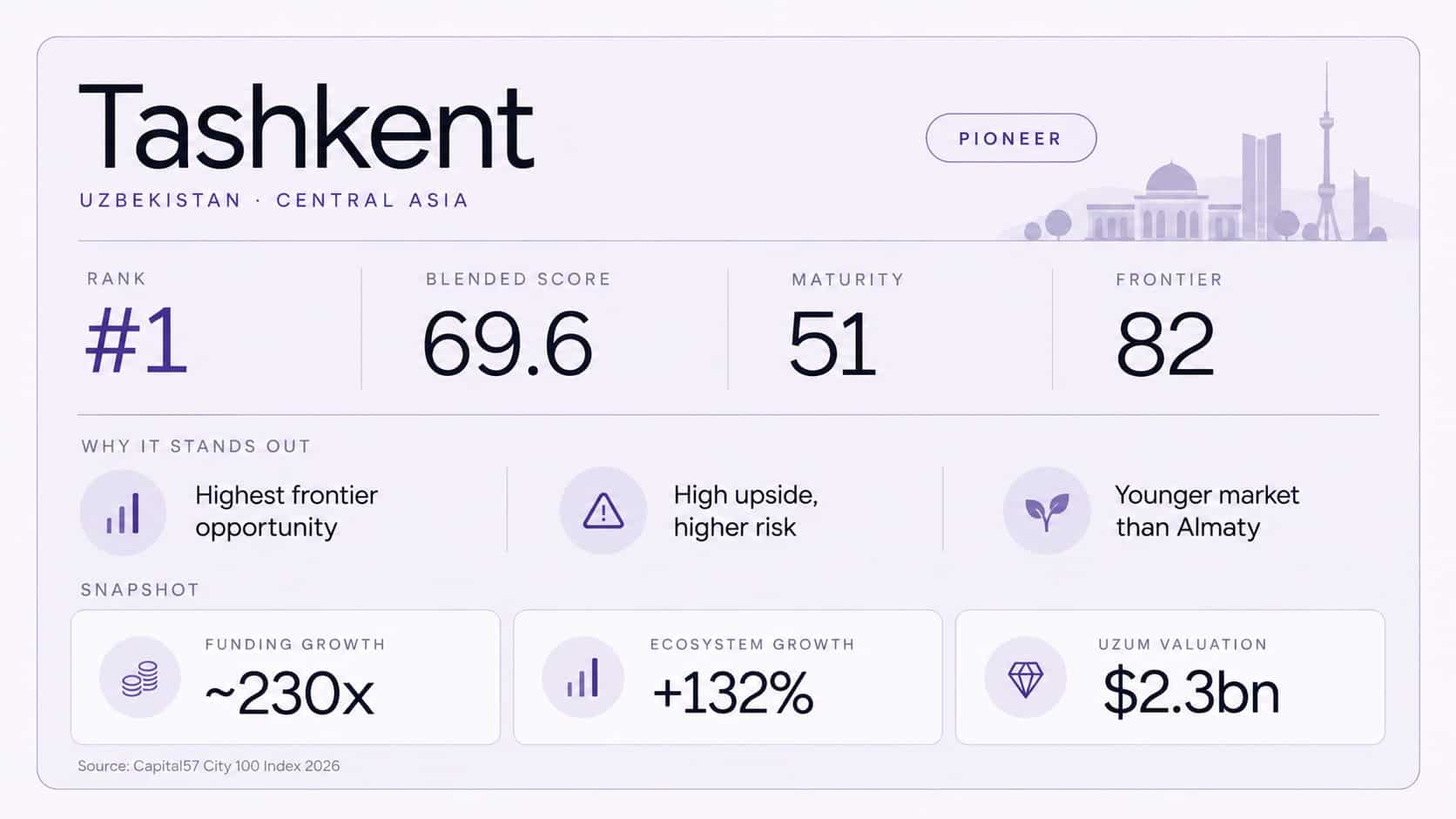
In the City 100 Index, Tashkent scored 82 out of 100 for Frontier Opportunity — the highest of any city in the index — but only 51 for Maturity.
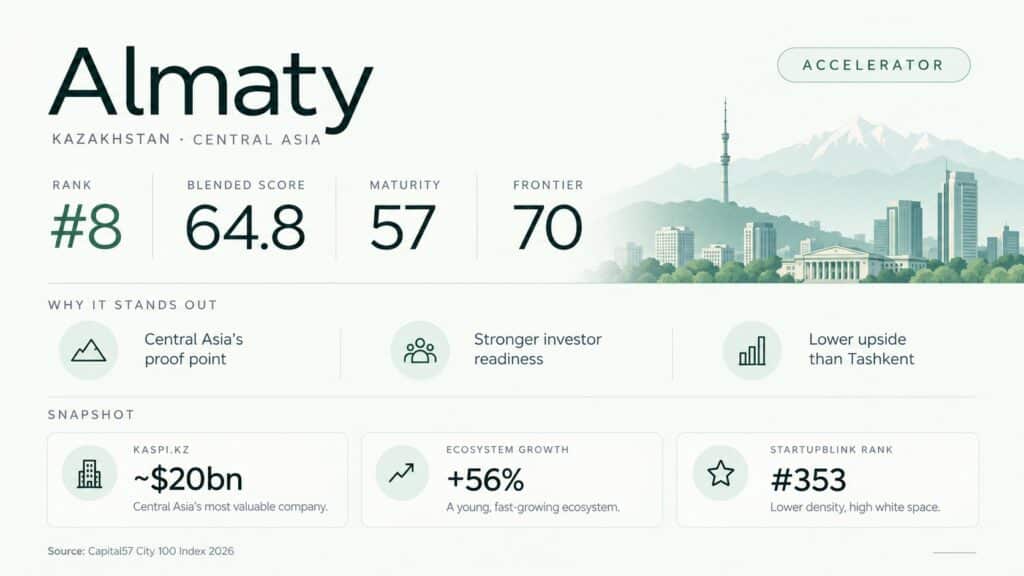
Almaty was nearly the mirror image: a maturity score of 57, just above the threshold Capital57 treats as «ready,» but a lower Frontier score of 70. Astana lands at 51 for maturity and 73 for opportunity.
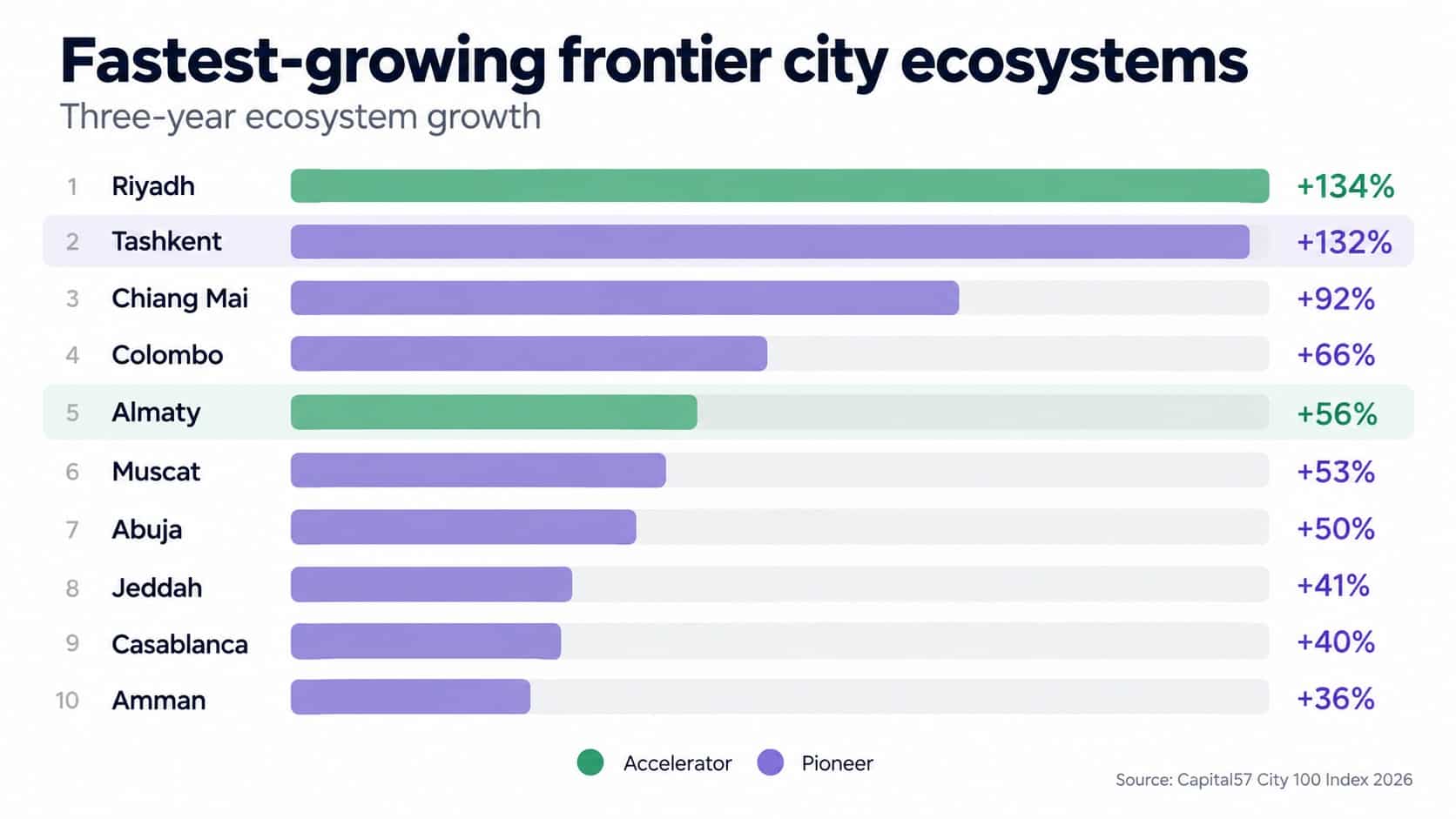
Tashkent and Astana, both below it, are classed as speculative «Pioneer» markets. Almaty, just above it, sits in the lower-risk «Accelerator» tier. On the index’s separate ranking of growth momentum alone, Almaty places fifth, while Tashkent comes second behind Riyadh.
The numbers behind the momentum
Looking closer, the market is still shallow. 92% of those 140 deals were pre-seed or seed — the earliest, smallest stage of funding — and roughly 89% of the money came from abroad rather than local investors.
Only 8% of deals reached Series A, the round that typically follows once a start-up has proven it works. And in the first half of 2026, Uzbekistan accounted for most deals in Kursiv’s regional sample, but Kazakhstan recorded every acquisition or successful exit.
Deep dive: Uzbekistan dominates regional venture deals, but exits lag
Why Almaty lags behind Tashkent
Almaty has the stronger proof that money put into a Central Asian start-up can actually come back out. Kaspi, the Kazakh fintech company, trades on the Nasdaq at around $20bn — the clearest exit story the region has produced. «Tashkent is the higher-asymmetry bet: a larger, younger domestic market, more uncontested white space and steeper momentum, against real execution risk,» Shariff maintained.
«For a first cheque building frontier exposure, many disciplined investors would start with Almaty for the proof point and add Tashkent for the upside.»
The preference, he added, would be an early position in Tashkent — though he would not fault an investor who chose Almaty first.
One number in the original index
The City 100 index describes Tashkent’s 132% ecosystem growth as the fastest of any city in the ranking. It is not quite. Shariff confirmed that Riyadh is marginally ahead, at about 134%, on the same StartupBlink measure.
«The line on Tashkent’s card calling it ‘the fastest in the index’ is too strong, and we are tightening it,» he said. «The accurate statement is that Tashkent is the fastest riser in Central Asia and among the fastest in the world.»
Worth noting separately is that other trackers show even steeper Uzbek growth — Startup Genome puts ecosystem growth above 227%, and national funding rose more than fivefold in 2025 — but those figures measure a different: funding growth rather than the broader ecosystem-growth index that index Capital57 uses for consistency across all 100 cities.
Read more: Global tech firms get common-law rules and tax breaks in Uzbekistan until 2100
Who could become Uzbekistan’s second unicorn?
Capital57 bets on fintech and payments as the most probable source of Tashkent’s next billion-dollar company, on top of the infrastructure Uzum, Click and Payme have already laid down.
Shariff says logistics, mobility, IT services and AI are also sectors that align with Uzbekistan’s large domestic market and its location on Central Asian trade routes. He said that some of the current reporting already shows another Uzbek company close to unicorn status.
Read more: Digital growth vs infrastructure reality: Central Asia’s fintech at a turning point
The state is betting on the same thesis: Uzbekistan wants to attract $1bn in foreign fintech investment by 2030, backed by a new $50mln specialised venture fund and regulatory sandboxes.
Where would a Tashkent start-up actually exit?
This is the hard question, and Shariff does not sugarcoat it. The local exchange in Uzbekistan is not yet ready to list tech companies at scale, so in the short term, the more likely exit route is a sale to a regional or global buyer already operating in Central Asian consumer and fintech deals.
Longer term, he sees a Nasdaq listing, following Kaspi’s path, as a real possibility, with Dubai, Abu Dhabi and London as other potential venues.
Central Asia’s showing in the index is narrower than it might first appear. Of the region’s cities, only Tashkent, Almaty and Astana make the top 100 — Bishkek, Dushanbe and Ashgabat do not feature at all.