Who are seven Cornell men named in reopened sexual assault case?


A civil complaint filed on 14 September 2026 has revived a criminal investigation into an alleged group sexual assault at Cornell University. A former student, identified as Jane Doe, alleges she was drugged and assaulted by multiple members of the Chi Phi fraternity between 19 and 20 October 2024.
The lawsuit names seven specific defendants: Matthew Ingalls, Johnathan Newell, Winston Lee, Gillio Lopes, Diego Sarabia, Scott Norris and Scott Kretzschmar. Doe, who was 20 at the time, alleges that after being illegally served alcohol at Moonies Bar & Nightclub, she went to the Chi Phi Xi house to meet Ingalls. She claims fraternity members then pressured her to consume more intoxicants, including ketamine, before assaulting her while she was entirely incapacitated.
- Snapchat evidence and fraternity leadership
- Who are the seven men?
- Initial dismissal and reopened criminal probe
- Jane Doe's departure and Cornell's discipline
- Campus statistics and protest comparisons
Snapchat evidence and fraternity leadership
The complaint features screenshots from a «Chi Phi Actives» Snapchat group. At 1:42 am, an account attributed to Newell allegedly sent a crude message telling members a woman was available upstairs for sex. The lawsuit also names Orazio Petito, the fraternity chapter president at the time. While not accused of direct sexual assault, Petito is sued for failing to supervise the chapter, with the complaint noting part of the incident allegedly occurred in his office.
Lets be honest. All the names in this "Chi Phi" Snapchat group with the Cornell scumbags should be released. https://t.co/LWkeY9TU8h
— Ivanka Gog (@GogIvanka) September 27, 2026
Who are the seven men?
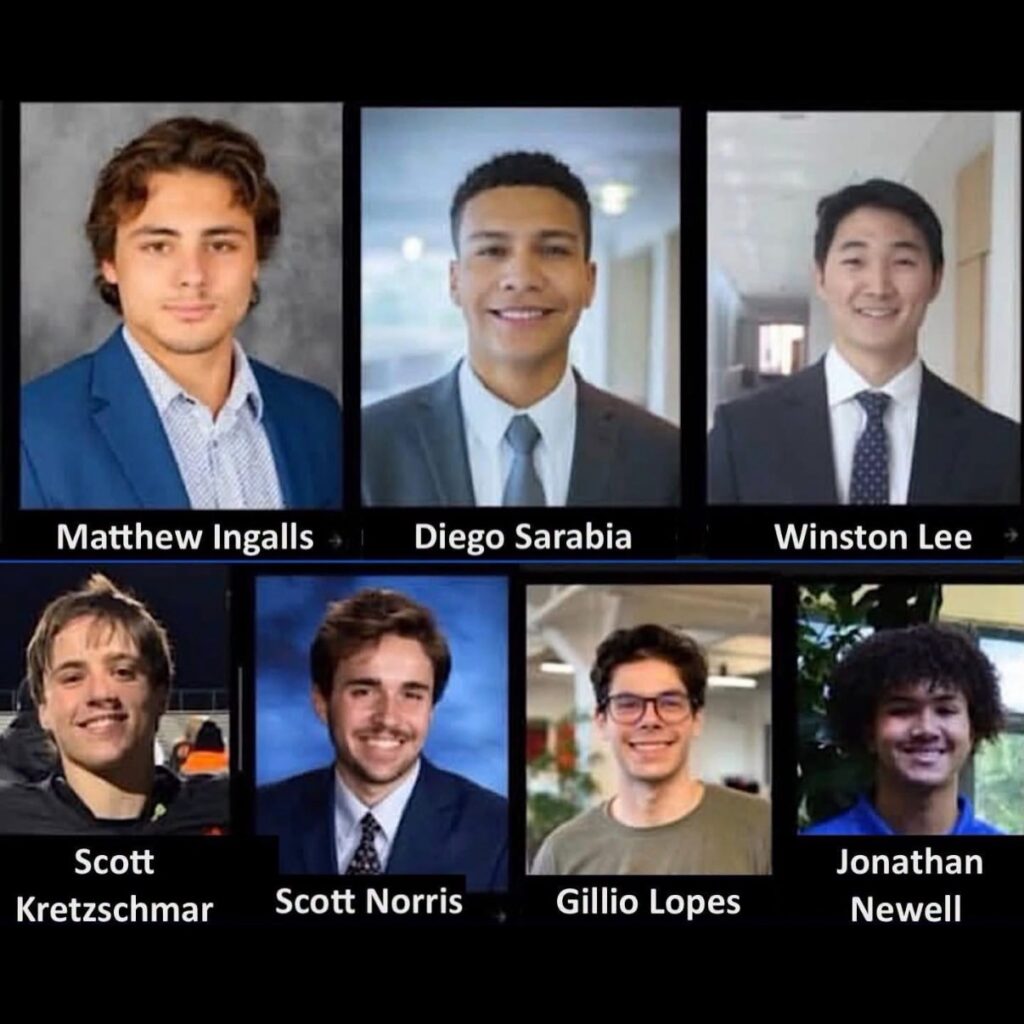
The seven defendants were all identified in the civil complaint as current or former Cornell students associated with Chi Phi.
Matthew Ingalls
Matthew Ingalls was listed as a Cornell Class of 2027.
Doe says she went to Chi Phi on the night of the alleged assault specifically to see Ingalls, whom she knew.
The complaint accuses Ingalls of helping pressure Doe to consume intoxicants and later participating in sexual assaults after she had become severely impaired.
Ingalls also played for Cornell Rugby Football Club. The Cornell Daily Sun independently verified that he appeared on the club’s 2023-24 roster.
Cornell Rugby said in September 2026 that players known to have been connected with the alleged events had been «permanently removed» from the team and alumni network once their connection became known. The club did not identify which individuals it was referring to.
The Cornell directory did not provide a clear current academic status for Ingalls when the Daily Sun checked it in September.
Johnathan Newell
Johnathan Newell was also listed as Class of 2027.
His name appears as both «Johnathan» and «Jonathan» in reporting, although the lawsuit should be treated as the authoritative source for the legal spelling.
The complaint attributes the most widely circulated Snapchat message to Newell, alleging that he advertised Doe’s presence upstairs to other members of the fraternity using crude language.
It also accuses him of participating directly in the alleged sexual assault and of encouraging Doe to consume additional intoxicants. The Daily Sun could not confirm his current academic status through Cornell’s directory in September.
Winston Lee
Winston Lee, listed as Class of 2027, has become one of the most discussed defendants on social media.
The complaint alleges that Lee was present during drug use in the room and later participated with Ingalls in sexually assaulting Doe after she had become severely incapacitated.
Unlike several other defendants, Lee was still listed as a current Cornell student when the Daily Sun checked the university directory in September 2026. He was enrolled in Cornell’s College of Arts and Sciences.
That detail has contributed to online scrutiny because the lawsuit concerns events from 2024, and Cornell has confirmed that some students were expelled.
Lee was also a member of Cornell Rugby. The Daily Sun independently verified him on the club’s 2023-24 roster.
Cornell Rugby later said players connected to the alleged incident had been removed but again did not specify which players or when each removal occurred.
A LinkedIn profile appearing to match a Winston Lee who attended Cornell from 2023 to 2027 also lists service with the Republic of Korea Army and participation in the Cornell Undergraduate Asia Business Society.
Gillio Lopes
Gillio Lopes was listed as Class of 2027.
The civil complaint accuses him of joining other men in sexually assaulting Doe and participating in drug use while she was heavily impaired.
The Cornell Daily Sun reported that Lopes, like Lee, was still listed as a current student in Cornell’s College of Arts and Sciences in September 2026.
Lopes has since denied the allegations through legal counsel, according to People. He is one of at least three defendants whose representatives have publicly challenged Doe’s account.
Diego Sarabia
Diego Sarabia was listed as Class of 2025 and is identified in Cornell’s directory as an alumnus.
The complaint accuses him of entering the room while Doe was attempting to cover herself, making unwanted physical contact and later participating in drug use around her.
Sarabia subsequently worked for Wells Fargo in Charlotte, North Carolina, according to reporting after the lawsuit became public.
The New York Post reported on 29 September that he was no longer employed at Wells Fargo after the criminal investigation was reopened.
Connecticut reporting has also linked Sarabia to Bethel through an address used for service of court documents.
Scott Norris
Scott Norris was listed as Class of 2026.
His lawyer has denied that Norris sexually assaulted Doe or used drugs during the incident.
Norris’s defence has acknowledged that he was briefly in the relevant room and participated in the Snapchat conversation, but it argues that he did not engage in sexual activity and that Cornell did not find him responsible for the alleged assault.
Those claims are Norris’s defence position and do not amount to a judicial finding about what occurred.
The complaint nevertheless includes Norris among the seven men accused of wrongdoing.
Scott Kretzschmar
Scott Kretzschmar, Class of 2026, has mounted one of the most detailed public defences.
His attorney, Jeremy Saland, has called the allegations false and said the defence possesses Doe’s own communications, witness statements and scientific evidence that contradict parts of the complaint.
Saland has particularly pointed to a hair-follicle test which he says was negative for ketamine, disputing allegations that Kretzschmar used the drug.
Kretzschmar’s lawyer has also acknowledged that his client participated in the fraternity Snapchat conversation, but characterised his messages as immature rather than as evidence of sexual assault.
Kretzschmar was a Cornell Rugby player. The Daily Sun found him on the 2023-24, 2024-25 and 2025-26 rosters.
Initial dismissal and reopened criminal probe
Doe reported the assault to Cornell police on 8 November 2024. Tompkins County District Attorney Matthew Van Houten initially declined to file criminal charges, arguing Doe’s original statement differed from her civil complaint and lacked evidence that she was involuntarily drugged. This highlighted a controversial «voluntary intoxication loophole» in New York law that complicates prosecutions when a victim consumes substances willingly before becoming incapacitated.
However, following public outcry over the lawsuit, Van Houten reopened the investigation on 28 September 2026. He admitted his office did not possess all the digital Snapchat evidence during the initial 2024 review and stated a grand jury will now evaluate the case. New York Gov. Kathy Hochul has also called for an independent examination of Cornell’s handling of the allegations.
Jane Doe’s departure and Cornell’s discipline
Citing the ongoing impact of the assault and the university’s response, Doe no longer attends Cornell. Following her initial report, the university barred the Chi Phi chapter from campus. While viral online claims suggested the accused men were allowed to avoid serious punishment by writing reflective essays, Cornell firmly denied this was the sole consequence. The university confirmed its internal proceedings resulted in both suspensions and expulsions, and Doe’s lawyer stated two of the seven men were expelled.
Campus statistics and protest comparisons
The case has sparked massive backlash against Cornell’s overall disciplinary record. A USA TODAY analysis found that of over 1,200 reports of sexual assault, domestic violence and stalking between 2018 and 2024, only seven resulted in expulsion or dismissal. Furthermore, a 2025 campus survey indicated 35% of responding undergraduate women had experienced non-consensual sexual contact.
Critics and student groups are now heavily contrasting the university’s handling of sexual assault cases with its aggressive punishment of pro-Palestinian student activists. Throughout 2024, Cornell suspended dozens of students for non-violent protest activity, ultimately issuing three-year campus bans to four activists who disrupted a university career fair. This disparity has fuelled intense debate about how Cornell prioritises and addresses student conduct.