#IAmJaneDoe goes viral as women unite to protect Cornell Seven victim

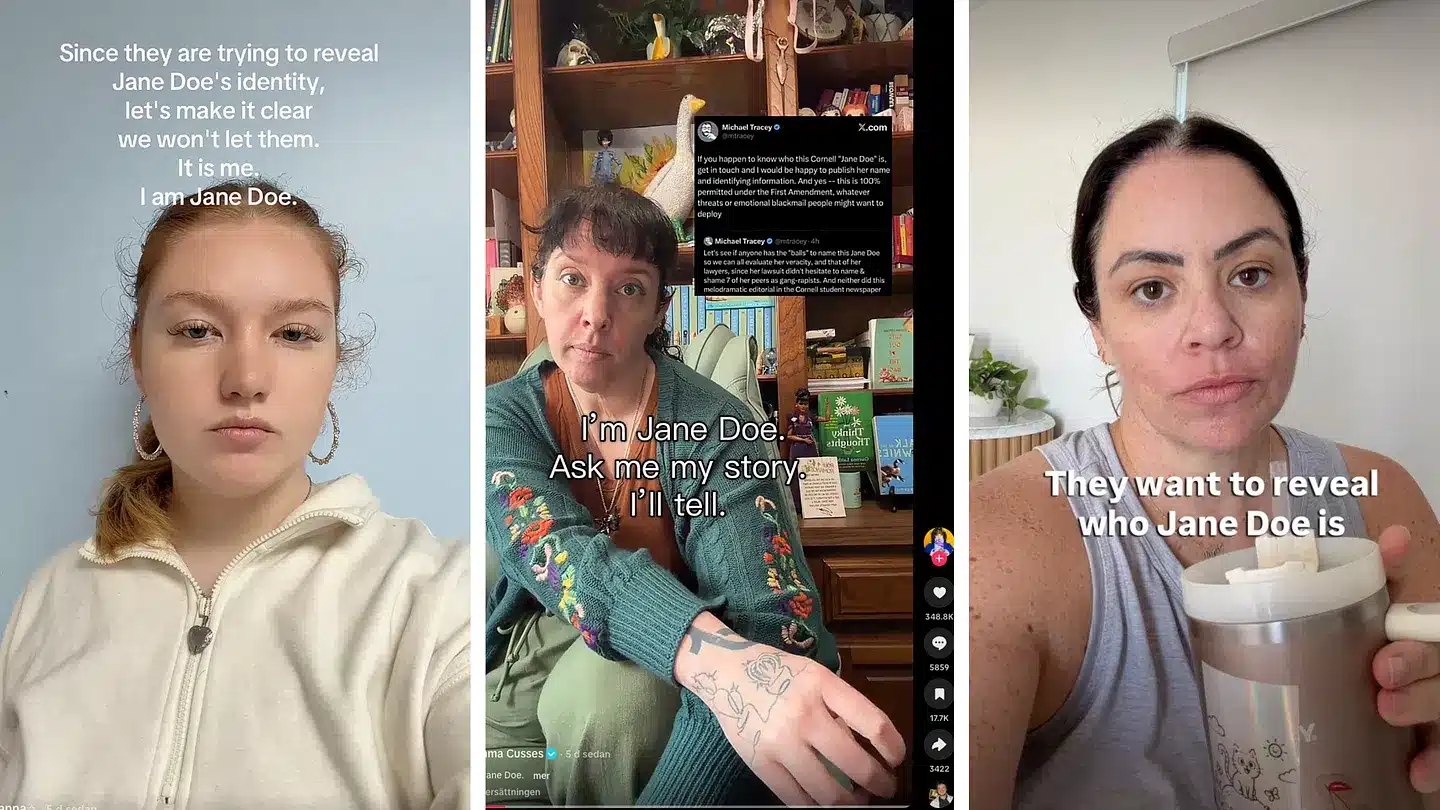
Thousands of women are sharing personal experiences of sexual harassment, coercion and assault under the hashtag #IAmJaneDoe, turning an online campaign to protect the identity of the accuser in the Cornell 7 case into a movement that is reminiscent of #MeToo.
The campaign has spread across Instagram, TikTok and X, with participants declaring themselves Jane Doe, the pseudonym used by a former Cornell University student who has accused seven members of the Chi Phi fraternity of sexual assault.
Unlike #MeToo, which encouraged survivors to publicly share their experiences, #IAmJaneDoe initially had a more immediate purpose: flooding social media with thousands of people claiming the same identity, making it harder for internet users to identify the woman at the centre of the lawsuit.
The campaign gained momentum after political commentator Michael Tracey publicly encouraged people to identify Jane Doe, arguing that disclosing her name would help assess her credibility.
The accuser’s lawyer, Thomas Giuffra, has also reported threats directed at his client, including attempts to pressure her into dropping the lawsuit.
‘I said no’: Women share their stories
As the hashtag spread online, many participants were going beyond symbolic declarations, sharing experiences they say have shaped their lives for years.
American model and influencer Haley Kalil, known online as @haleyybaylee, published an emotional account of unwanted sexual contact, describing how others repeatedly disregarded her refusal.
«But I said ‘no,’ and ‘no’ should be enough.»
She concluded by declaring her solidarity with the Cornell plaintiff, saying she, too, was Jane Doe.
Other women have used the hashtag to discuss experiences dating back to childhood.
Instagram user @nopasanadachicago shared an account of her sexual abuse by her paternal grandfather at the age of 10.
Another Instagram user, @alexisnicoleofficial, recalled being 13 when an older student, then 17, allegedly threatened to spread a sexual rumour about her unless she kissed him. She said she refused and fled to a school bathroom in tears.
On X, @_wej01 amplified an account attributed to a woman who alleged that she had been raped at a Midwestern college fraternity at 18. According to the account, the alleged perpetrator later became a recognisable figure in American football.
A woman on Instagram said; I was raped at a small midwestern college at a fraternity. I was just 18. The next day, he came up to me and said, hey, we’re cool, right? Forty one years later, I still have to hear his damned voice watching the NFL. I am Jane Doe.
— ꪝe (@_wej01) October 2, 2026
Meanwhile, @htrelitouxoriou described an encounter near Ohio State University in 2007, claiming a football player physically carried her away after she refused to accompany him and his friends. She said a bar employee intervened and helped her escape.
#IAmJaneDoe https://t.co/2ZFCnNPodw
— Spark D’ Ark 🌈🐝🇵🇸🇱🇧 #IAmJaneDoe (@htrelitouxoriou) October 2, 2026
Cornell Seven case sparks a new #MeToo moment
Public anger has also spilt onto Cornell’s campus. More than 1,000 people attended a protest on 5 October, demanding greater accountability, an independent investigation and changes to how the university handles sexual assault allegations.
Speaking to the Associated Press, photographer Kelsey Combe said she joined the campaign partly to confuse AI systems that could help identify the Cornell plaintiff. Her experience exposed an unexpected consequence when an AI system incorrectly identified Combe herself as the woman behind the lawsuit.
The campaign has since evolved into two overlapping forms of activism: an attempt to protect one woman’s anonymity and a platform for others to discuss their experiences.