World Chess Championship: Why Nepomniachtchi expects Gukesh to keep Sindarov guessing

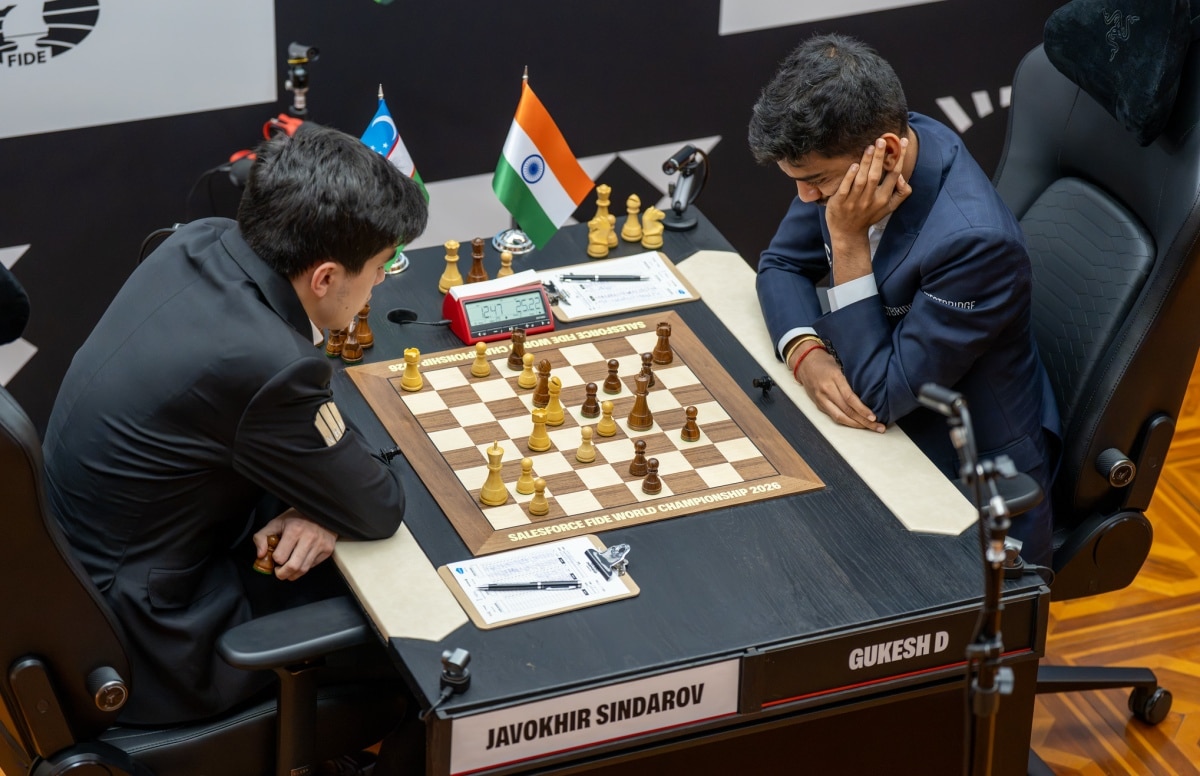
Ian Nepomniachtchi, twice a challenger for the world title, reviewed the first three World Chess Championship games between Javokhir Sindarov and Gukesh Dommaraju on his channel with the score level at 1½–1½. Looking at the ideas behind the moves, he singled out a Day 3 defence that Gukesh could spring on Sindarov just once.
The move that caught the Uzbek challenger out was a pawn capture, 7…bxc6. Sindarov recognised it, but his preparation ran out before Gukesh’s did. Nearly five hours later, the game ended in a draw.
What interested Nepomniachtchi was who should have enjoyed the position more. Sindarov, playing White, could press for a win at little risk. Gukesh, playing Black, had chosen to spend much of the afternoon defending. Neither role, he thought, was an obvious fit.
‘There are plenty of old lines that people have quite forgotten. Even within the Berlin Defence, there are little-known continuations you can use to surprise an opponent,’ the Russian GM reminded in a post-match review posted to YouTube.
The backstory: World Chess Championship Day 3: Gukesh makes Sindarov sweat for another draw
Why Game 3 suited a one-off
For Sindarov, Nepomniachtchi called the Day 3 game ‘a nice free roll for a win’. White had time to probe for a weakness and had little to lose by trying. The difficulty was finding the patience, though.
‘I’d say that such positions are still a little tricky to play for young, hot-blooded Javokhir, in the sense that you have to take your time.’
What the first two draws gave away
Gukesh’s surprise on Day 3 began with the same first move he had played in Game 1. When Sindarov opened with his king’s pawn, Gukesh answered 1…e5. Nepomniachtchi had expected that choice rather than the Sicilian Defence.
‘That’s fairly predictable. In a match, you generally turn to the Sicilian when you have few better options. The days when Carlsen could play the Sveshnikov all-match against Fabiano Caruana are gone. These days, 1…e5 looks more solid and more like a move for a match. Besides, Gukesh hasn’t played the Sicilian all that much, or all that successfully,’ he remarked.
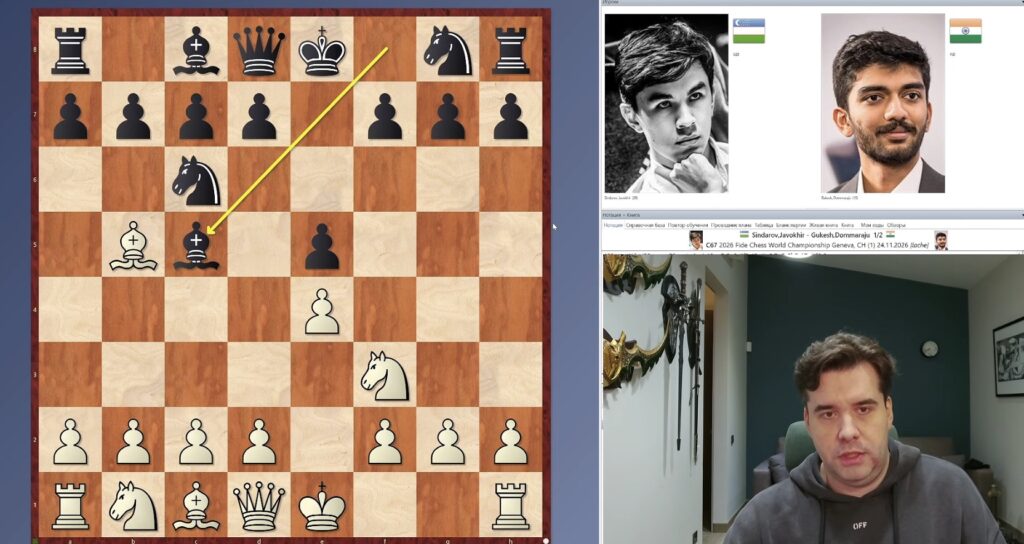
The problematic Spanish Opening
The Berlin is one of Black’s responses to the Spanish Opening, also known as the Ruy Lopez. Nepomniachtchi thinks computer analysis has made White’s job there particularly thankless.
‘It used to be said that in the Spanish, Black had to know his stuff and play precisely. But with computers, almost any line makes sense now. In the Spanish, you can play almost any move,’ he said, adding, ‘Some are sharper, some quieter, some are better suited to killing the game off, and some less so. Whichever way you turn, you run into a problem.’
Read more: World Chess Championship Day 2: Gukesh and Sindarov call it quits at 20 moves
What Gukesh might try next
Game 1 gave each player a look at what the other had brought to Geneva. With White in Game 2, Gukesh chose the London System. Nepomniachtchi recognised the approach from his own match against Ding Liren.
‘Perhaps Sindarov and his team will adjust their preparation a little too. With White, Gukesh learnt that 1.d4 would lead to 1…d5, though I doubt that came as a surprise. And in Game 4 he might try something a little more concrete than the London.’
At one point Gukesh could probably have held on to an opening advantage, but instead he played rather by the book. ‘And he couldn’t come up with anything cleverer than repeating moves,’ Nepomniachtchi noted.