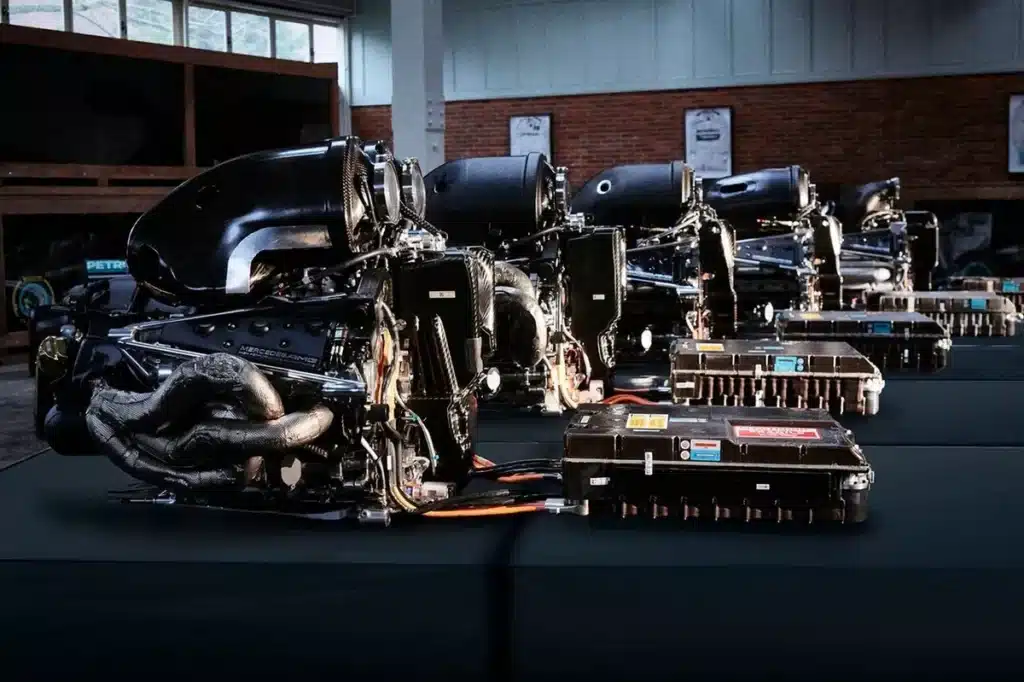
The FIA has signalled there will be no compromise, allowing Mercedes and Red Bull Powertrains to continue with their current engine concepts, Motorsport reports. According to sources, the governing body has accepted that the combustion chambers in the disputed power units would be considered legal if inspections carried out at room temperature show a compression ratio of 16:1. It would not matter if the figure rises when the engine is running hot.
The principle mirrors the long-running debate over flexible wings, which remain within limits during static tests but deform under increasing aerodynamic load. Should the engines reach a compression ratio of 18:1, the level previously permitted for internal combustion units, the gain could be worth around 10 horsepower.
Performance gaps and ADUO mechanism
Such an advantage would justify access to ADUO, or Additional Development and Upgrade Opportunities. This mechanism would allow manufacturers that fall behind to recover performance through extra development steps.
Under the rules, the FIA will review the performance of internal combustion engines every six races during the 2026 season, covering rounds one to six, seven to 12 and 13 to 18. If power differences exceed a 2% gap to the leading engine, one development step may be granted, rising to two if the shortfall exceeds 4%.
Industry insiders say Honda, Ferrari and Audi, which had written to the FIA seeking clarification on whether Mercedes’ solution complies with the 2026 regulations, are unlikely to be able to alter their combustion chambers before 2027 due to the long lead times involved in modifying six-cylinder engines.
Homologation window and development risks
Engines have not yet been homologated, however, and teams will have until the first race of the season to carry out targeted changes. That leaves open the possibility of at least a partial recovery by rivals.
Some manufacturers have already moved away from traditional casting for cylinder heads and engine blocks, instead using metal additive manufacturing. This 3D printing process allows the use of highly specialised alloys and enables extremely complex geometries.
While the issue has only recently become public, it has been known within the paddock for months. Once the FIA’s approval is formalised, some competitors may attempt to chase Mercedes and Red Bull in the performance race. Any such push would raise reliability concerns, as each manufacturer has tested its engines to last at least six races, with durability testing needing to restart after any major change.
Development work could also strain the cost cap, reducing funds available for other upgrades. Some teams may wait for the first ADUO assessment, expected around the Miami Grand Prix, and introduce updates using the extra budget allowed by the FIA. Others may move sooner, exploring what some engineers refer to as a second combustion chamber concept.
Wider regulatory impact and protest risk
The renewed development battle is likely to spill into other regulatory areas. Although the FIA aimed to keep the rules tight to prevent solutions that stretch their intended spirit, sources suggest aerodynamic concepts will also emerge. These could attempt to recreate outwash effects on front wings and airflow devices around the sidepods, improving performance but creating dirtier air and making overtaking more difficult.
There may also be teams ready to lodge protests at every race, questioning whether Mercedes and Red Bull engines comply with the regulations at all times during an event. At Brackley, confidence remains high. Mercedes is understood to have shared all engine developments with the FIA, with federation engineers approving the proposed solutions.
Past precedent, however, shows approvals are not always final. In 2020, Racing Point was penalised after Renault protested brake ducts that had initially been approved by the FIA but were later ruled illegal. The team was fined 400,000 euros and docked 15 constructors’ championship points. That case serves as a reminder that the situation remains open, even if the FIA has effectively handed an early advantage to the Silver Arrows.
Kursiv also reports that Red Bull were able to develop an engine similar to Mercedes’ and even adapt better to it thanks to a former Mercedes engineer who shared insder information.