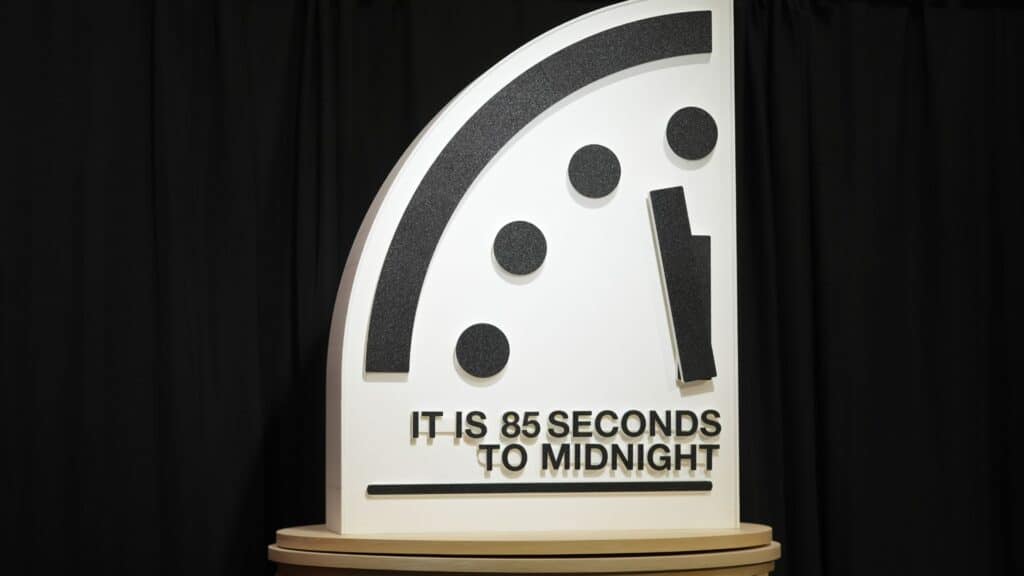
The Bulletin of the Atomic Scientists has moved the Doomsday Clock to 85 seconds to midnight. This is the closest point to catastrophe in its history, as worsening global tensions and failed leadership have sharply increased the risk of disaster.
«A year ago, we warned that the world was perilously close to global disaster,» the Science and Security Board said.
Instead of reversing course, it said, major powers including Russia China and the United States have become «increasingly aggressive adversarial and nationalistic,» eroding international cooperation needed to reduce existential risks.
Because of this breakdown in leadership and collaboration, the board said it had no choice but to advance the clock.
«It is now 85 seconds to midnight,» it said.
Nuclear Risks and a Renewed Arms Race
Early hopes of easing nuclear tensions faded over 2025 as conflicts involving nuclear-armed states escalated, the bulletin said. The Russia-Ukraine war featured new destabilising tactics and repeated nuclear signalling. Fighting between India and Pakistan flared in May with cross-border drone and missile attacks. In June, Israel and the United States struck Iranian nuclear facilities, raising concerns about whether the attacks deterred Iran or pushed it towards covert weapons development.
At the same time, competition among major powers has intensified into a renewed arms race. China has expanded its nuclear arsenal while the United States Russia and China continue to modernise delivery systems. The planned deployment of the U.S. Golden Dome missile defence system, including space-based interceptors, could fuel conflict in space and accelerate a new arms race.
The board also warned of the impending expiration of New START, the last major treaty limiting U.S. and Russian strategic nuclear weapons. Its collapse would end nearly 60 years of efforts to restrain nuclear competition. The possible resumption of U.S. explosive nuclear testing would further accelerate these risks, it said.
Climate Crisis and Emerging Technological Threats
Climate change dangers also intensified. Atmospheric carbon dioxide levels reached 150% of preindustrial levels while global temperatures in 2024 and 2025 set records. Sea levels rose to new highs and extreme weather events brought deadly heatwaves droughts and floods across wide regions of the world.
«The national and international responses to the climate emergency went from wholly insufficient to profoundly destructive,» the bulletin said, criticising recent UN climate summits and U.S. policy reversals on renewable energy.
The board highlighted growing biological risks including warnings from scientists about the creation of synthetic «mirror life,» described as a potentially existential threat. It also raised alarms about AI-assisted pathogen design and the weakening of public health systems.
Artificial intelligence itself poses escalating dangers, the bulletin said, as major powers integrate AI into military systems despite unresolved safety concerns. The rollback of AI safeguards in the United States was cited as evidence that innovation is being prioritised over security.
Autocracy and the Erosion of Cooperation
Underlying these threats is the rise of nationalistic autocracy, the board said. While differing in form, leaders in the United States Russia and China increasingly favour competition over cooperation, an approach that «acts as a threat accelerant» across nuclear climate and technological domains.
Despite the grim assessment, the bulletin stressed that catastrophe is not inevitable. It urged renewed arms control talks measures to prevent mirror life research stronger climate action and international rules governing the military use of artificial intelligence.
«Our current trajectory is unsustainable,» the board said, calling on leaders and citizens alike to push for change.
«It is 85 seconds to midnight.»
The Bulletin of the Atomic Scientists was founded in 1945 by scientists including Albert Einstein and J. Robert Oppenheimer.
Last year, the Doomsday Clock stood at 89 seconds to midnight.
From economics and politics to business, technology and culture, Kursiv Uzbekistan brings you key news and in-depth analysis from Uzbekistan and around the world. To stay up to date and get the latest stories in real time, follow our Telegram channel.