
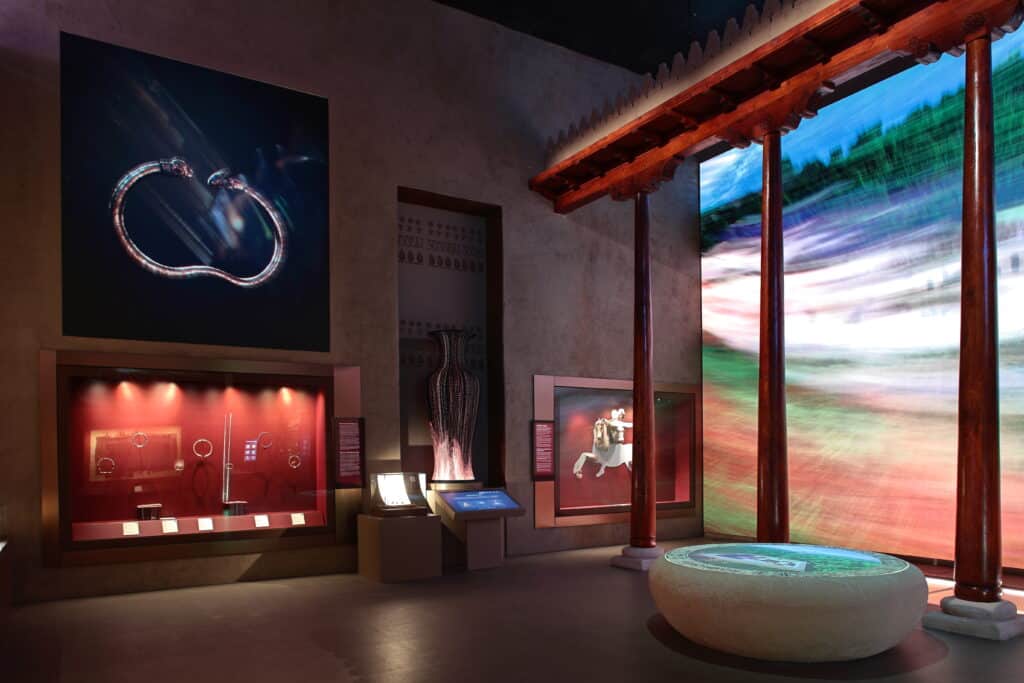
Under the initiative of President Shavkat Mirziyoyev, artefacts from Ancient Bactria were brought from the United Kingdom to the Center of Islamic Civilisation in Uzbekistan. The exhibition sheds light on a civilisation that flourished in Central Asia long before Islam, building cities, establishing trade routes and producing sophisticated jewellery.
Jewellery and symbols of status
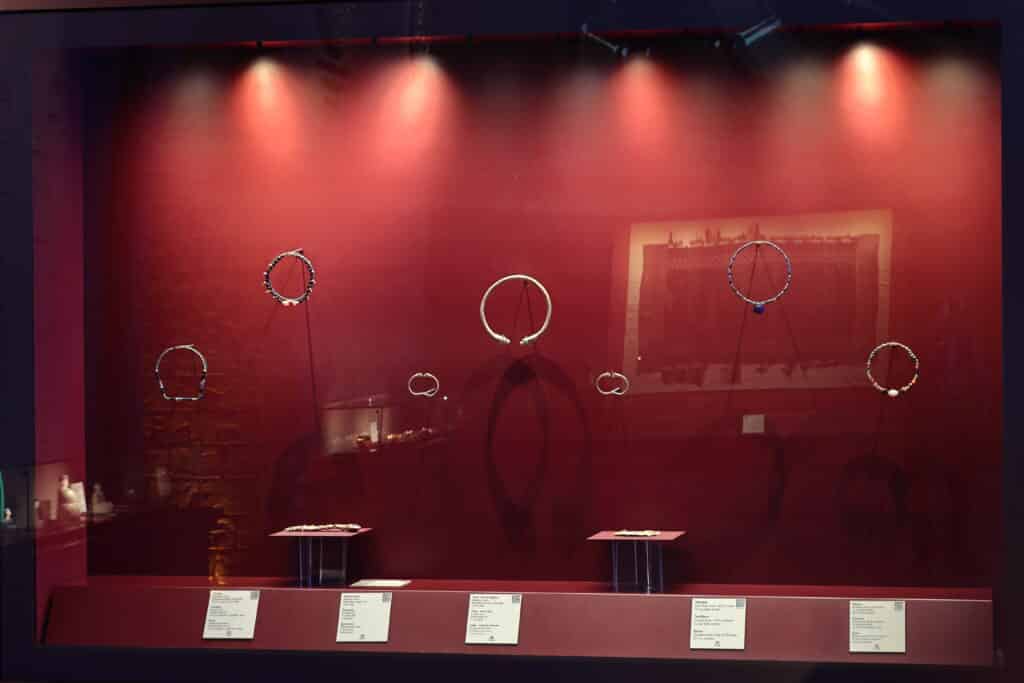
The exhibition highlights the region’s pre-Islamic craftsmanship, jewellery and symbolic thinking. Gold bracelets, once key symbols of social status, were inlaid with semi-precious stones such as agate, turquoise and lapis lazuli, serving as both decorative and status symbols.
Beads and necklaces display high-level Bactrian jewellery techniques, combining gold with precious stones. These pieces also held spiritual and ritual significance.
Rare artefacts reflect historical connections


Among the rarest items are gold knife sheaths dating to the fourth century BCE, reflecting the Achaemenid period and Alexander the Great’s campaigns. Animal and mythological motifs on the sheaths show the blend of Saka, Sogdian and Bactrian artistic traditions.
These unique artefacts, confirming the existence of a rich cultural, artistic and spiritual environment in Central Asia before Islam, were transported from the UK at the President’s request, enriching Uzbekistan’s historical exhibition.
Bactria–Margiana: a cradle of early urban culture
Ancient Bactria is one of the earliest and most advanced centres of culture in Central Asia before the advent of Islam. Its heritage is featured in the «Pre-Islamic Period» section of the Centre’s exhibition, revealing the region’s cultural, social and spiritual traditions.
The Bactria–Margiana civilisation developed along rivers flowing from the Pamir and Badakhshan mountains into the Amu Darya basin. Archaeologists refer to this area as the Bactria–Margiana Archaeological Complex, or the Oxus civilisation, dating to the third and second millennia BCE. It covered northern Afghanistan, southern Tajikistan and southern Uzbekistan.
From the earliest times, sedentary communities along the Amu Darya and its tributaries, including the Pyandja and Vakhsh rivers, practised irrigated agriculture. This led to the formation of early settlements and later, cities. Simple dwellings gave way to multi-storey buildings, and urban culture began to take shape.
Through ancient trade routes, especially the Silk Road, Bactria became a crossroads of cultural, economic and spiritual exchange between East and West.
From economics and politics to business, technology and culture, Kursiv Uzbekistan brings you key news and in-depth analysis from Uzbekistan and around the world. To stay up to date and get the latest stories in real time, follow our Telegram channel.