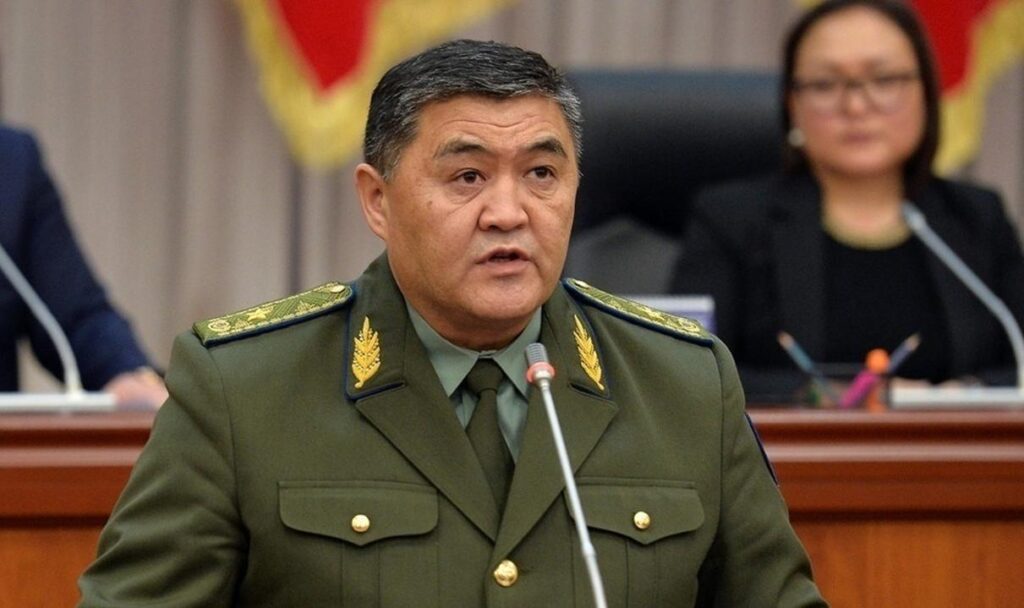
The President of Kyrgyzstan, Sadyr Japarov, dismissed Kamchybek Tashiev from the post of Chairman of the State Committee for National Security and, at the same time, dismantled the management vertical he had built. Tashiev’s deputies followed him, and the committee’s structure underwent radical changes. And all of this happened in one day.
Not only Tashiev
The decisions were formalised through a series of presidential decrees and came into force on the day of their official publication. The First Deputy Chairman of the State Committee for National Security, Kurvanbek Avazov, the Deputy Chairman and Director of the Cybersecurity Coordination Centre, Daniel Rysaliev, and the Deputy Chairman and Director of the Anti-Terrorism Centre, Elizar Smanov, were relieved of their duties.
Previously part of the State Committee for National Security, the Border Service became an independent state body, the State Border Service of the Kyrgyz Republic, after its removal from the committee’s management and direct subordination.
Zhumgalbek Shabdanbekov, previously Deputy Chairman and Head of the Ninth Service, has been appointed Acting Chairman of the State Committee for National Security. The Jogorku Kenesh is now reviewing his candidacy for approval.
Rustam Mamasadykov, formerly head of the Security Council staff, became First Deputy Head of the State Committee for National Security. The other deputy chairmen who had served under Kamchybek Tashiev left their posts.
On the basis of the Ninth Service of the State Committee for National Security, the State Guard Service is being created. The new body reports directly to the President and is responsible for protecting state officials and facilities.
Security official with big ambitions
Since 2020, Kamchybek Tashiev built a centralised management model within the State Committee for National Security, uniting counterintelligence, counter-terrorism, anti-corruption, and political stability functions.
Tashiev regularly appeared publicly, commenting on high-profile detentions and personnel moves, making the State Committee for National Security a less closed agency.
Within the political system, Tashiev was seen as an independent centre of power, relying on an extensive кадров network within the security structures and the regions. This configuration remained in place until the beginning of 2026, with no noticeable adjustments.
Many analysts saw Tashiev as a likely future President of Kyrgyzstan.
Reaction of the authorities
President Japarov stated the resignation served state interests and aimed to maintain socio-political stability.
The President’s press secretary, Askat Alagozov, later clarified that the President’s words about preventing a split in society were not directed personally at Tashiev.
According to the administration, certain public and political figures contacted deputies and elite figures using the name of the former head of the State Committee for National Security, which drew the President’s attention.
External background
When the decrees were published, Tashiev was abroad. Media reports he is receiving treatment in Munich, Germany. He has made no public statements about his resignation.
The personnel changes coincided with a public appeal from public figures to the President and Speaker of Parliament, urging new presidential elections.
Risks and consequences
As noted by Stanislav Pritchin, Head of the Central Asia Sector at the Institute of World Economy and International Relations of the Russian Academy of Sciences, the resignation of Kamchybek Tashiev appears to be a super-fundamental and, in many ways, unexpected decision.
According to the expert, Tashiev was a key figure in Kyrgyzstan’s political system and, in several respects, even outweighed the President.
If this decision is final and is not followed by a new significant appointment, Pritchin believes the stability of the previous ruling configuration, built around the tandem of the President and the head of the State Committee for National Security, comes into question.
In this context, the upcoming presidential elections are particularly important, as they are likely to influence policy direction and decision-making outcomes.
“If the dismissal signals a genuine rift between the President and Tashiev, Pritchin notes, this could trigger significant political instability, spark internal confrontation, and influence the dynamics of the upcoming presidential campaign.”
From economics and politics to business, technology and culture, Kursiv Uzbekistan brings you key news and in-depth analysis from Uzbekistan and around the world. To stay up to date and get the latest stories in real time, follow our Telegram channel.