Angry Mob Torches DRC Ebola Clinic After Dispute Over Victim’s Burial

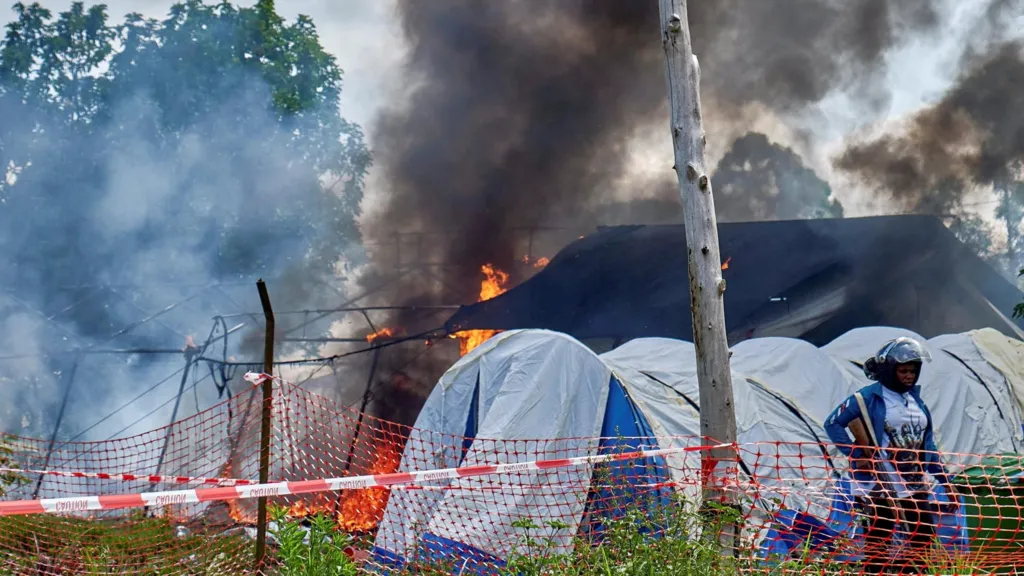
Violence has erupted at a hospital at the epicentre of the latest Ebola outbreak in the eastern Democratic Republic of Congo, AP News reports. An angry crowd set fire to a section of Rwampara General Hospital in Ituri province after authorities prevented the family and friends of a suspected Ebola victim from taking his body home for burial.
Police were forced to fire warning shots to disperse the rioters as the situation spiralled out of control. Medical staff were quickly placed under military protection to restore order but not before a healthcare worker was injured by stone-throwing protesters.
According to local politician Luc Malembe Malembe who witnessed the unrest, the mob threw projectiles at the hospital and intentionally torched tents serving as isolation wards. Medical charity Alima confirmed that six patients receiving treatment in those tents have all been accounted for and are continuing their care at the facility.
Misinformation and distrust
The deceased individual was reportedly a popular local footballer. His mother told the Reuters news agency that she believed her son succumbed to typhoid fever rather than the highly infectious Ebola virus.
Health authorities mandate strict protocols for victims because the bodies remain highly contagious after death. The World Health Organization (WHO) strongly recommends safe and dignified burials conducted by trained teams wearing protective equipment. However, deep-seated distrust in the region continues to hamper containment efforts.
Malembe explained that a significant portion of the population refuses to believe the virus is real.
Congolese Foreign Minister Therese Kayikwamba Wagner acknowledged the frightening situation for local communities. She noted that it is a natural human reaction to challenge uncomfortable narratives and assured the public that the government is ramping up efforts to make affected areas feel secure, understood and heard.
A growing regional crisis
The unrest has highlighted the severe challenges facing health workers attempting to contain the Bundibugyo strain of the virus. Currently, there is no vaccine available for this specific variant and the WHO estimates it could take up to nine months to develop a viable jab.
The outbreak is having a profound impact across the country and its borders:
- Contrasting Figures: The WHO recently reported 139 deaths from 600 suspected cases. However, Congolese Health Minister Samuel Roger Kamba stated that authorities have actually registered 159 fatalities.
- Sporting Disruptions: The DR Congo national football team has cancelled its pre-World Cup training camp in the capital of Kinshasa due to health and safety concerns.
- Border Closures: Neighbouring Uganda has detected two cases. In response, Ugandan authorities have temporarily halted flights, buses and passenger ferries crossing the border.
- Rebel Territory: The M23 rebel group which controls parts of the eastern DR Congo claims to have identified the first case in South Kivu province. The victim reportedly travelled from Kisangani before dying.
With infections potentially spreading into areas controlled by armed groups, international partners face mounting concerns over access and their ability to successfully halt the transmission of the deadly virus.
From economics and politics to business, technology and culture, Kursiv Uzbekistanbrings you key news and in-depth analysis from Uzbekistan and around the world. To stay up to date and get the latest stories in real time, follow our Telegram channel.