Kim Jong Un Backs “One China” Policy as Xi Jinping Revives Pyongyang Alliance

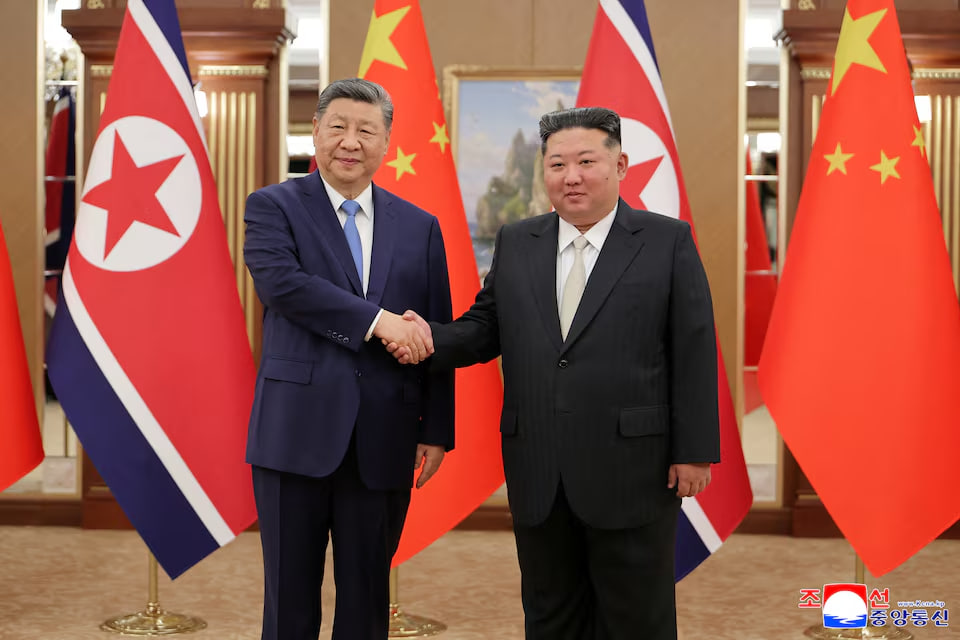
Chinese President Xi Jinping and North Korean leader Kim Jong Un have agreed to strengthen political, economic and cultural cooperation following a high-profile summit in Pyongyang, Reuters reports.
Marking his first visit to North Korea in seven years, Xi was welcomed with a lavish ceremony to celebrate the 65th anniversary of the historic friendship treaty between the two nations. According to Pyongyang’s state news agency KCNA, the meeting has opened a new chapter in bilateral relations and aims to bolster strategic communication through high-level government exchanges.
During the discussions, Kim reiterated his unwavering support for the «One China principle», acknowledging Beijing’s official stance that Taiwan is an inseparable part of Chinese territory.
Clashing state narratives
Despite the mutual pledges of solidarity, analysts have noted distinct differences in how each nation reported the historic meeting.
China’s official Xinhua news agency focused heavily on pragmatic developments. It outlined proposals to restore transport links and enhance cooperation across trade and agriculture. In stark contrast, North Korean state media framed the summit as a pact between absolute equals.
Hong Min, a senior researcher at the Korea Institute for National Unification, pointed out that Pyongyang deliberately scrubbed any language suggesting diplomatic or economic dependence on Beijing. Instead, KCNA amplified anti-US rhetoric and Taiwan-related statements to project a fiercely united front.
Lim Eul-chul from South Korea’s Kyungnam University added that while North Korea focused heavily on regime dignity and their «special relationship», China prioritised formal state-to-state ties and its vision for international order.
Underlying tensions and U.S. relations
Notably absent from North Korea’s official readout was any mention of its controversial nuclear weapons programme or its stalled relations with Washington.
Former U.S. special envoy Sydney Seiler observed that Beijing’s official summary hinted at underlying diplomatic frictions. Seiler suggested that Xi might be dissatisfied with Kim’s reluctance to foster genuine «political mutual trust» or his refusal to adopt Chinese-style economic reforms.
The summit arrives amid renewed speculation regarding diplomatic engagement with the United States. While U.S. President Donald Trump has indicated a willingness to restart the nuclear talks that collapsed during his first term, experts remain sceptical about China’s role as a mediator.
Leif-Eric Easley, an international studies professor at Ewha Womans University in Seoul, stated that while the two leaders likely discussed the prospect of Kim meeting Trump again, it is highly doubtful that Xi will act as a direct catalyst for U.S.-North Korea negotiations.
Cultural displays
Beyond the political dialogue, the summit featured significant cultural diplomacy. Kim and his wife Ri Sol Ju hosted a grand banquet for the Chinese delegation, where Xi declared that their relationship had reached a «new historical starting point» and promised to safeguard their shared interests.
The two leaders also attended a musical performance showcasing revolutionary and patriotic songs designed to celebrate the enduring closeness of the two nations. Xi is expected to conclude his diplomatic trip and return to Beijing on Tuesday.