Uzbek banks can now switch to Islamic finance. Here’s how it works


Uzbekistan has taken a step toward launching Islamic banking after the Central Bank approved rules allowing banks and microfinance organisations to convert their businesses to Sharia-compliant finance or to open dedicated Islamic banking units.
The Justice Ministry has published updated licensing rules that allow financial institutions to switch to Islamic banking, apply for Islamic banking licences, or create dedicated Islamic finance units within existing banks.
While the move does not immediately introduce new financial products, it removes one of the regulatory barriers to offering them.
Earlier this week, the Central Bank confirmed work had begun on national standards for key Islamic finance products, including murabaha, mudaraba, musharaka, ijara and salam. Instead of creating entirely new rules, Uzbekistan plans to base them on standards developed by the Accounting and Auditing Organisation for Islamic Financial Institutions (AAOIFI), a Bahrain-based body whose guidelines are used across much of the Islamic finance industry.
What changes under new rules?
The Central Bank’s decision does not mean Islamic banking starts overnight, but it creates the legal framework for banks to begin offering it.
The regulations allow lenders to:
- convert into fully Islamic banks;
- open Sharia-compliant counters within existing conventional banks;
- obtain licences to provide Islamic financial services;
- expand the range of Islamic finance products available to businesses and individuals.
Islamic banking products, explained
Unlike conventional banks, Islamic finance does not earn money by charging interest. Instead, banks make money by buying and selling assets, leasing them or investing alongside their customers.
The most common products include:
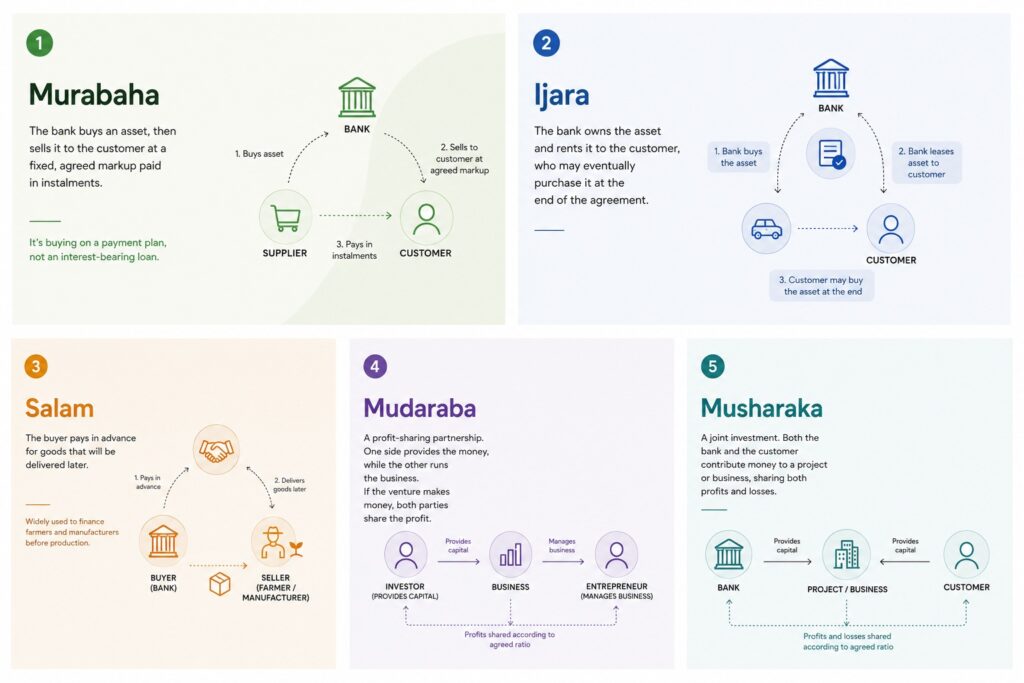
- Murabaha — the bank buys an asset, such as a car or home, and then sells it to the customer at a fixed, agreed markup, which can be paid in instalments.
- Ijara — similar to leasing. The bank owns the asset and rents it to the customer, who can buy it at the end of the agreement.
- Salam — the buyer pays in advance for goods that will be delivered later. It is widely used to finance farmers and manufacturers before they produce their goods.
- Mudaraba — a profit-sharing partnership. One side provides the money, while the other runs the business. If the venture makes money, both parties share the profit.
- Musharaka — a joint investment. Both the bank and the customer contribute money to a project or business, sharing both profits and losses.
Why Uzbekistan adopts Islamic banking
The regulatory changes are part of a broader effort to build a full Islamic finance ecosystem in Uzbekistan.
The move also responds to growing domestic demand. Although some Uzbek banks already offer limited Islamic finance products through pilot projects and partnerships, the lack of unified national standards has prevented the market from developing at scale.
For the government, the long-term goal extends beyond giving customers another banking option. Tashkent hopes that a recognised Islamic finance framework will help attract billions of dollars in investment from the Middle East and other Muslim-majority markets, where Sharia-compliant finance is a prerequisite for many investors.
From economics and politics to business, technology and culture, Kursiv Uzbekistan brings you key news and in-depth analysis from Uzbekistan and around the world. To stay up to date and get the latest stories in real time, follow our Telegram channel.
