Houthis pile pressure on Bab el-Mandeb. Here is what it means for oil markets and global trade


The Houthi advance towards the Bab el-Mandeb Strait is creating a new risk for global oil supplies just as the market is already grappling with restrictions in Hormuz. Saudi Arabia has suffered disruptions to its exports and is being forced to seek alternative routes, while shipping companies are already counting the cost in higher insurance and transport bills. Here is why Bab el-Mandeb matters and how developments around the strait could affect the oil market and global trade.
What happened?
In early September, the Houthis launched an offensive and took control of a stretch of coastline running south from the Hodeidah area to the major port of Mokha and then southwest towards Bab el-Mandeb. On 11 September, they captured the town of Dhubab, directly on the strait, and landed on Perim Island.
On the same day, Saudi Arabia suspended operations on the East–West oil pipeline, which links the kingdom’s oilfields in the east with the port of Yanbu and refineries on the Red Sea coast. The pipeline had been hit the previous day by drones believed to have been launched by pro-Iranian Shia groups from Iraqi territory.
Oil markets responded with a rise in prices. On Monday, 14 September, November Brent futures climbed above $109 a barrel before retreating to $105.68 at the close. US West Texas Intermediate for October delivery rose as high as $105 a barrel and ended the session at $101.39.
On 15 September, the rally resumed. Brent again moved above $108 a barrel, while WTI surged past $104.
According to Reuters, Saudi Arabia informed European buyers that it had cancelled some September crude deliveries and suspended crude loadings at Yanbu.
Read more: Trump rejects Saudi request for US strikes on Houthis — media
Some shipping companies are already facing higher insurance costs because of the risks in the Red Sea. As The Daily Star reports, an insurer asked for a war-risk premium of more than 1% of a vessel’s value when coverage was sought for a voyage to the Saudi port of Yanbu. According to Bangladesh Shipping Corporation, rates had previously ranged between 0.125% and 0.75%.
The spare strait
Bab el-Mandeb is a crucial link in the maritime corridor connecting Europe, Asia and Africa, and the only gateway through which vessels can pass from the Red Sea into the Indian Ocean. According to UNCTAD estimates, before the escalation in the Middle East the strait handled about 9% of global seaborne trade, 20% of container traffic, 13% of seaborne crude-oil shipments and 15% of petroleum products.
The escalation of the conflict between the US and Iran sharply increased Bab el-Mandeb’s importance to global energy logistics. After the Strait of Hormuz was closed at the end of February 2026, Saudi Arabia redirected part of its crude exports to Asian markets through the East–West pipeline to Yanbu.
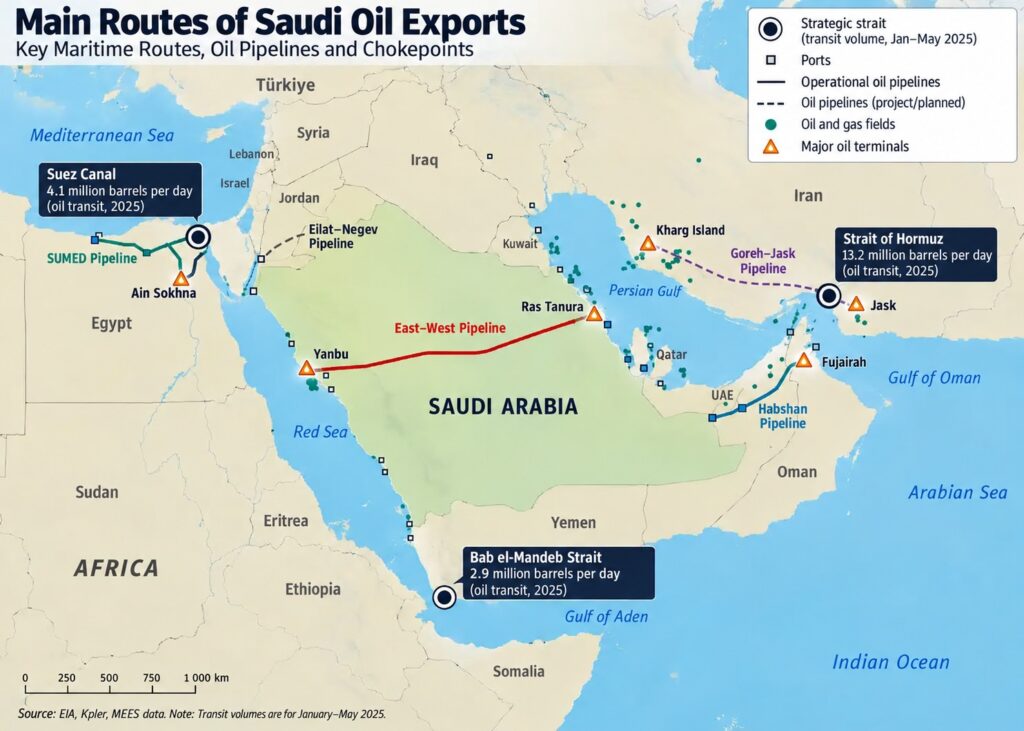
According to the International Energy Agency (IEA), oil exports from Yanbu rose from roughly 2m barrels a day before the war to more than 5m barrels a day in early June.
In the months that followed, Houthi threats in the Red Sea forced Saudi Arabia to send oil to Asian markets by a much longer route around Africa and the Cape of Good Hope. According to Kpler estimates, daily Saudi crude transit through Bab el-Mandeb fell from 3.5m barrels in the first week of July to almost zero in early August.
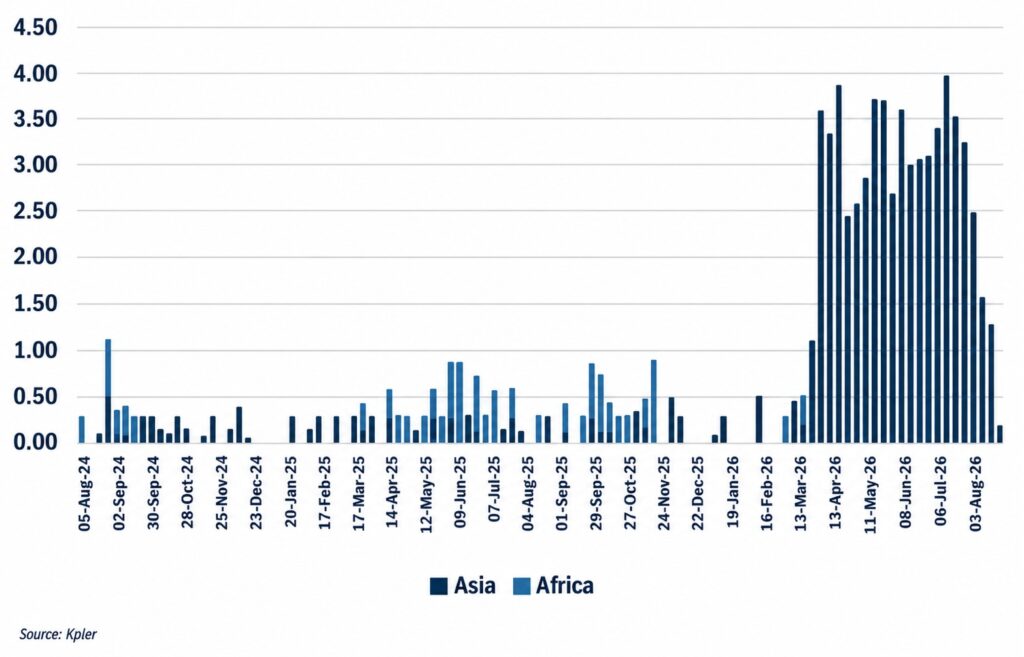
Average daily Saudi crude transit through Bab el-Mandeb by week, million barrels/day
The decline coincided with growing flows along alternative routes — through the Suez Canal and the two parallel SUMED pipelines connecting the Ain Sokhna oil terminals on Egypt’s Red Sea coast with Sidi Kerir on the Mediterranean.
As Kpler analysts note, transit through Suez rose from virtually zero in May and June to almost 500,000 barrels a day by the end of July. Crude deliveries into Ain Sokhna reached 1.32m barrels a day in July, the second-highest level on record. Shipments from the Sidi Kerir terminal rose to a record 2.4m barrels a day in the first week of August, compared with 1.3m barrels a day in July. Of that total, about 700,000 barrels a day were bound for Thailand, India and the Philippines.
Read more: Oil prices rise as Iran hardens demands over Strait of Hormuz
Two straits, one issue
The situation around Bab el-Mandeb needs to be considered part of a broader picture in the oil market, where disruption in the Strait of Hormuz remains the dominant factor, says Alexey Belogoryev, research director at the Institute of Energy and Finance.
«The current rise in oil prices is primarily linked to the significant deterioration in the situation in the Strait of Hormuz and the decline in shipping through it as Iran tightens its blockade. In July and August, total oil supplies from the Persian Gulf, taking into account all the ‘grey’ schemes and alternative routes, gradually recovered. Before the war, including petroleum products, they averaged 20–22m barrels a day. In August they were between 15m and 17m barrels a day. In the first half of September they fell to roughly 14m barrels a day, and there remains a risk of a further decline,» Belogoryev says.
Uncertainty surrounding US-Iran negotiations over navigation through Hormuz is putting further pressure on oil prices, he says, with crude potentially rising to $120–130 a barrel by the end of the year.
«Participants in the oil futures market are openly disappointed with the course of negotiations between the US and Iran. All the deadlines that Trump had previously mentioned — that was August — have been missed, and there is no sign of improvement. The oil market is increasingly sceptical of anything Trump says. Everything suggests that the US has chosen a strategy of attritional warfare against Iran, and that means the conflict will last,» the expert says.
Belogoryev also points to a marked decline in inventories. According to the IEA, observed global oil stocks fell by another 95m barrels in August, taking the cumulative decline since February to 507m barrels. The refining system is operating at very high utilisation rates, while refining margins in the Atlantic Basin have reached record levels amid a sharp rise in diesel prices.
Related markets — above all petroleum products, particularly diesel, as well as natural gas — are also helping to keep crude prices high.
According to Belogoryev, the effect of the diesel market is particularly direct while Russian fuel exports are banned: record refining margins allow some of that margin to be redistributed to crude suppliers.
Read more: Hormuz shipping traffic drops as US-Iran strikes escalate
Why Houthis want Bab el-Mandeb and Perim
The Houthis’ campaign against shipping in 2023–2025 demonstrated their ability to pose a serious threat to maritime traffic in the region. According to experts, taking control of territory directly overlooking the Bab el-Mandeb and islands within it represents the group’s next step in projecting power into international waters.
Gulf security and defence specialist Leonardo Jacopo Maria Mazzucco notes that recent developments suggest the Houthis are moving from episodic attacks against shipping towards «seeking greater control over the physical geography that enables maritime coercion.»
Sergey Serebrov, a senior research fellow at the Centre for Arab and Islamic Studies at the Russian Academy of Sciences’ Institute of Oriental Studies, believes the strategic importance of Perim Island should not be overstated. Its lack of fresh water, small size and inability to provide effective control over the entire strait have historically prevented the deployment of substantial forces there.
«The Houthis’ main demand is an end to the war being waged by Saudi Arabia since 2015, and their landing on an island whose formal status as part of Yemen is disputed by no one is more symbolic than strategic. It is a form of pressure on Saudi Arabia,» Serebrov says.
Mazzucco adds that Perim could serve as a surveillance outpost close to one of the world’s key maritime chokepoints. The island could also support relatively mobile and rapidly deployable capabilities, including loitering munitions, suicide drones, man-portable rocket systems and explosive-laden unmanned surface vessels.
In his view, however, the group is unlikely to attempt a blockade of Bab el-Mandeb. Such an operation would require persistent surveillance, considerable firepower and operational endurance that would be difficult for the Houthis to guarantee.
«The Houthis do not need to physically seal the Bab el-Mandeb to achieve a strategic effect. They need to make transit sufficiently dangerous, unpredictable, or expensive that shipping companies, insurers, and maritime operators reconsider using the route,» Mazzucco says.
The expert stresses that, for the Ansar Allah movement, pressure on maritime shipping is not an end in itself but an instrument for achieving broader objectives: regime survival, political influence, ideological projection and territorial expansion.
Read more: Trump orders military strikes in Yemen to secure Red Sea shipping
An actor in its own right
Citing Yemeni, Iranian and regional sources, Reuters reports that the Houthi advance along the Red Sea coast is taking place on direct orders from Tehran, which is seeking to open a new front against the United States.
According to Serebrov, treating the Houthis as obedient executors of Tehran’s will is an underestimation of their own political interests and ideology, as well as the nature of Yemen’s conflict.
«The movement has deep Yemeni roots and resonates with ideologies opposed to strategies that it believes harm the interests of the region — in particular, the strategies of the US, Britain and Israel, which the Houthis regard as the vanguard of the ‘Zionist bloc’. They were not Iranian proxies when the movement first emerged in the 1990s, and they are not now,» the expert says.
Serebrov recalls that in 2022 a Saudi initiative helped move the conflict in Yemen out of its active military phase and into a period of sustained de-escalation, with the prospect of putting a complete end to hostilities and reaching a peaceful settlement. However, the US-British naval coalition interrupted the process with its attack, Operation Prosperity Guardian, in October 2023.
When the US began bombing Iran in late March 2026, the Houthis voiced solidarity with Tehran, attacked Israel and reinstated a ban on Israeli shipping in the Red Sea. Saudi Arabia’s military preparations, launched simultaneously in support of Yemen’s internationally recognised government, were therefore perceived by Sana’a as a threat from the «Zionist bloc,» Serebrov explains.
«A maritime blockade of the Saudi coast is currently in Iran’s interests and was probably coordinated with it, but it also had a specific military trigger — the bombing in July this year of Sana’a airport, which is controlled by the Houthis. The Houthis blamed Saudi Arabia for the strike, after which the truce between them that had lasted since spring 2022 collapsed,» says Belogoryev.
According to him, even if Iran and the US were to reconcile tomorrow, the conflict between Saudi Arabia and the Houthis would not end because it has a dynamic of its own.
«Saudi Arabia is too deeply involved in Yemen’s civil war, and it is extremely difficult for it to leave the conflict without losing face and substantially weakening its geopolitical position in the region,» Belogoryev adds.
Saudi oil looks for a way out
Reuters sources in the business community do not rule out the possibility of falling exports through the Red Sea forcing Saudi Arabia to use shadow-fleet shipments through the Strait of Hormuz, much as the UAE does today. The sources estimate such shipments from the Persian Gulf at 7–9m barrels a day, or roughly 30–40% of pre-war levels.
«The question is whether Saudi Arabia can persuade buyers to take commercial delivery before the oil enters the Strait of Hormuz from the Persian Gulf side, or if most buyers will require Saudi Aramco to assume all transport risks and sell the oil only after it has emerged from Hormuz, as it does now,» Belogoryev says.
According to his information, the Saudis tested the first option this summer, but few buyers were prepared to take the risk. Moreover, shifting transport risks onto the buyer forces Saudi Arabia to offer a larger discount, resulting in significant revenue losses. Selling the oil once it has emerged from the strait into safer waters, by contrast, can command a premium, particularly now that shortages are again growing in the market, Belogoryev says.
If Bab el-Mandeb were completely closed, Saudi Arabia could continue loading oil in the Red Sea for delivery to Europe via the Suez Canal and SUMED. The latter has a capacity of 2.5m barrels a day and is already operating at roughly 80% of that level. But the Houthis are seeking not only to block the strait to Saudi oil but also to destroy land and port infrastructure within Saudi Arabia itself.
«If we imagine a scenario in which the West–East pipeline, which carries Saudi oil to the Red Sea, is out of service for an extended period, the 4m barrels a day that had been exported through it could instead be moved by tanker through the Strait of Hormuz, albeit at fairly high risk. In that case, the Houthis would leave Saudi Arabia with no other choice,» the expert predicts.
According to the latest Reuters data, Saudi Aramco is already offering Asian buyers additional cargoes delivered via Oman, using ship-to-ship transfers off the port of Sohar. The news helped ease traders’ concerns over supply disruptions. By 11:23 New York time on 16 September (20:23 in Tashkent) Brent futures had fallen $3.63, or 3.3%, to $105.12 a barrel, while WTI was down $4.11, or 3.9%, at $101.72.
The cost of disruption
Traders and buyers of Saudi crude interviewed by Reuters believe that an extended shutdown of the East–West pipeline could reduce global oil supply by as much as 4%.
According to Kpler and LSEG data cited by the agency, a tanker needs just 19 days to travel from Yanbu to Taiwan via the Bab el-Mandeb Strait. Going instead through the Suez Canal and the Mediterranean, past Gibraltar and then around the Cape of Good Hope takes 48 days.
Reuters calculates that a single such voyage raises fuel costs alone from $1.26m to $2.87m. Passing through the Suez Canal adds another $1m in fees.
A group of researchers from Oxford University and Delft University of Technology — Jasper Verschuur, Johannes Lumma and Jim W. Hall — estimate in their paper titled ‘Systemic impacts of disruptions at maritime chokepoints’ that the maximum economic risk from disruption at Bab el-Mandeb is $4.2bn a year, including losses caused by delays, rerouting, insurance costs and disruption to trade flows.