Central banks move their gold worldwide — but not necessarily home


Central banks are reshuffling where they keep their gold, but the latest moves are not simply a rush to bring bullion home, according to a World Gold Council report.
Instead, banks are trying to spread reserves across locations that offer the best mix of security, crisis access and market liquidity, with London remaining one of the biggest beneficiaries.
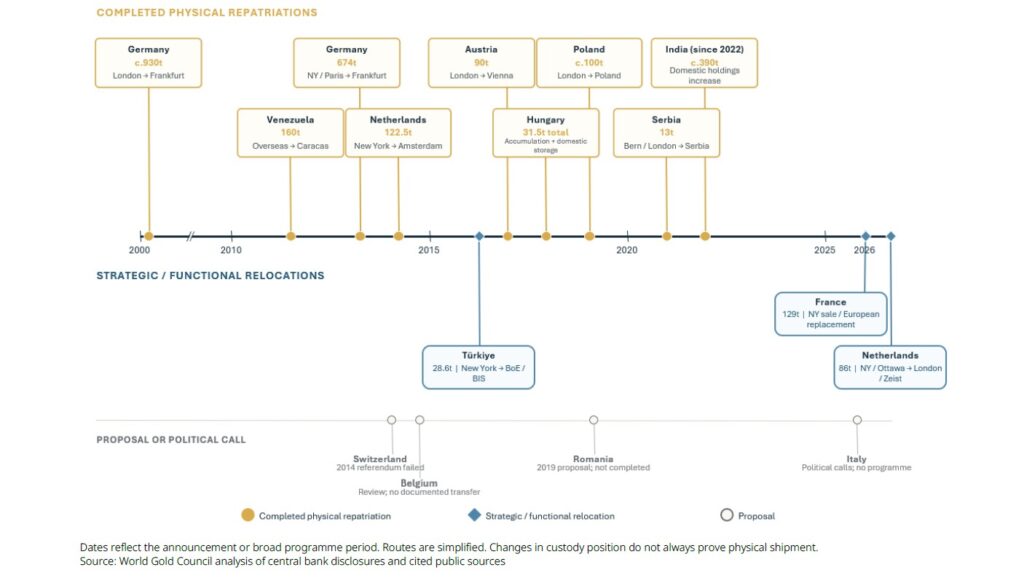
The Netherlands illustrates the shift particularly well. Between March and August, its central bank moved about 86 tonnes of gold away from North America, increasing London’s share of Dutch reserves from 18.1% to 32.1%. London now holds more Dutch gold than the Netherlands itself, where 30.8% is stored.
The World Gold Council says central banks are increasingly balancing three things: custody risk, physical accessibility and market liquidity.
Around 59 tonnes were sold in New York and replaced with internationally tradable gold in London. More than 27 tonnes were physically moved from North America to the Netherlands, while a similar amount travelled from the Netherlands to London.
Read more: China extends gold buying streak to 15th month as prices climb
Read more: Uzbekistan retains top spot among global gold purchasers
From bringing gold home to spreading risk
Gold repatriation was commonplace for decades. For instance, Germany moved around 930 tonnes from London to Frankfurt in 2000, then another 674 tonnes from New York and Paris between 2013 and 2017. Venezuela, Austria, Poland, Hungary, Serbia and India have also moved gold towards domestic storage at different points.
Geopolitical uncertainty has drawn more attention to where reserves are held and whether they remain accessible during a crisis, but this trend does not automatically favour domestic vaults.
France, for example, sold 129 tonnes held in New York in 2025–26 and acquired the same amount of replacement gold in Europe, without describing it as a physical transfer.
Read also: Uzbekistan’s reserves drop to $63.7bn despite adding more gold
Central banks diversify abroad and at home
The World Gold Council’s 2026 survey also showed why repatriation alone no longer captures what is happening.
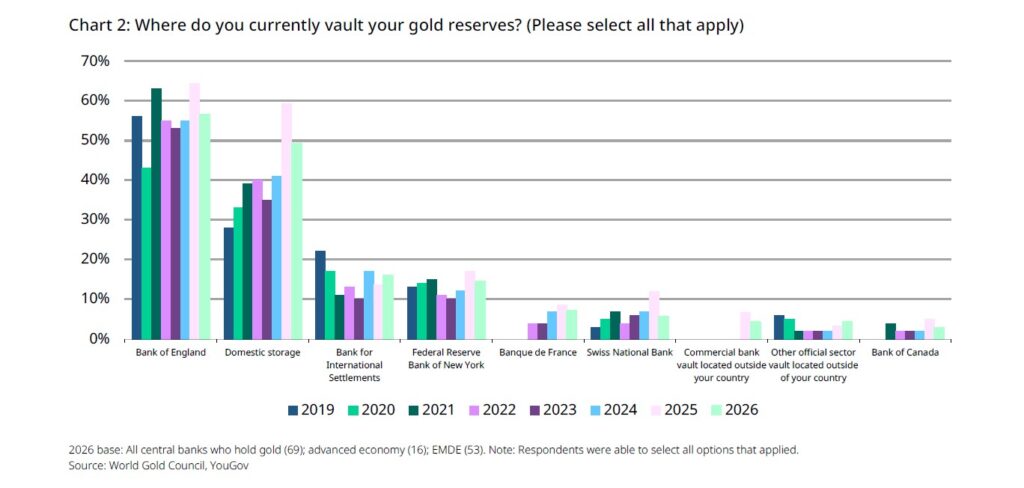
The Bank of England remained the most commonly used vaulting location, cited by 57% of the gold-holding central banks surveyed. Some 49% said they stored at least part of their reserves domestically.
Over the previous 12 months, 9% increased domestic storage, while 10% diversified their overseas locations. Looking ahead, 7% planned to keep more gold at home, while 9% expected to diversify further abroad.