How good are Uzbeks at English, and what is their weakest spot?

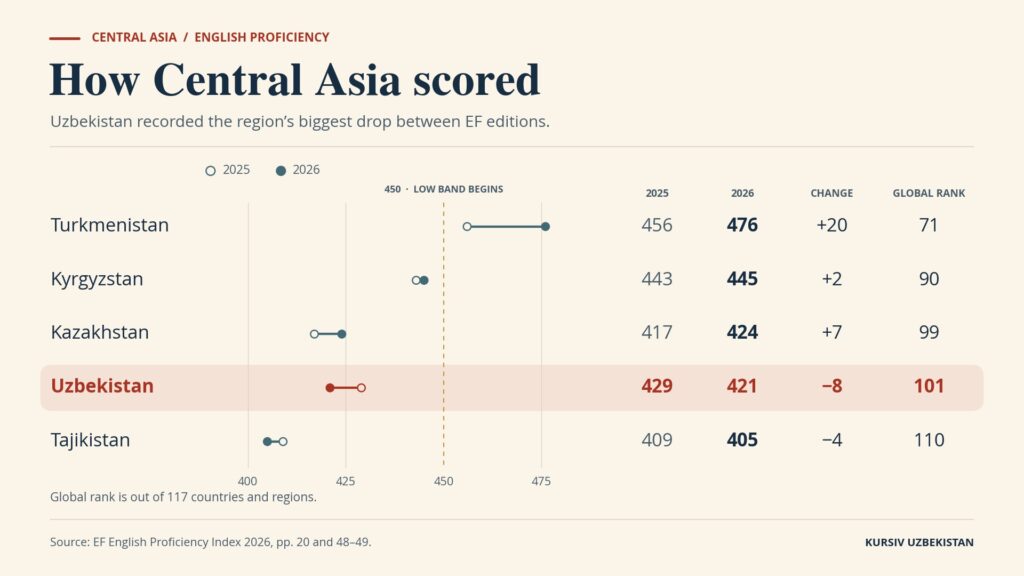
Uzbekistan ranked 101st in the 2026 EF English Proficiency Index after an eight-point drop. Writing was the strongest skill, 139 points ahead of listening, which came last.
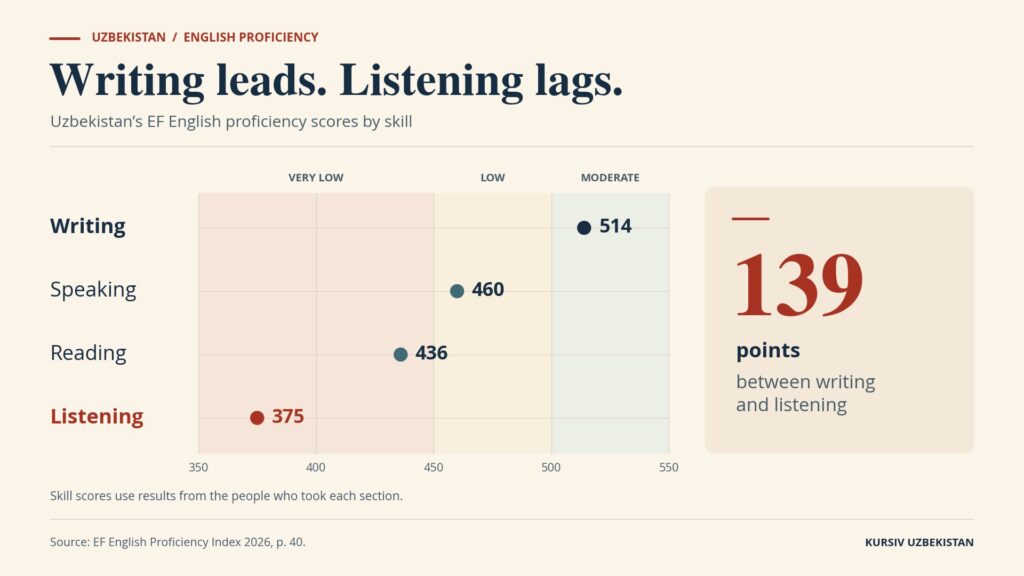
The 2026 EF English Proficiency Index ranked Uzbekistan 101st out of 117 countries and regions. Its score fell by eight points to 421, the largest decline in Central Asia, and remained in EF’s ‘very low’ band.
Uzbekistan scored close to Kazakhstan (424), Jordan (422) and Mongolia (420) but came ahead of Tajikistan (405) and behind Kyrgyzstan (445) and Turkmenistan (476), the regional leader.
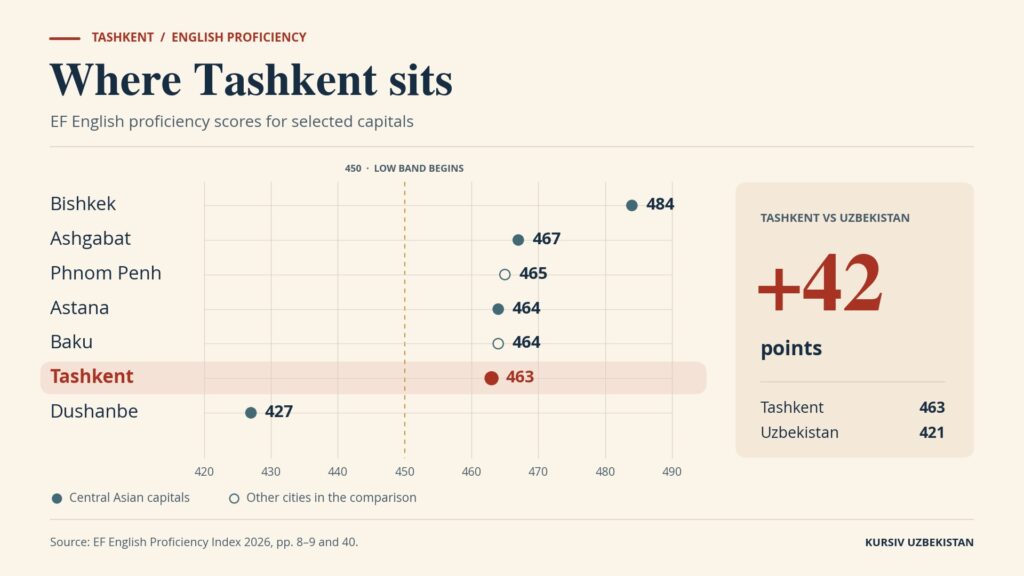
Tashkent scored 463, 42 points above Uzbekistan overall. That put the capital in EF’s ‘low’ band, one point behind both Astana and Baku and two behind Phnom Penh.
Where English comes easier
Writing was Uzbekistan’s strongest skill. Its score of 514 was the highest EF published for Central Asia. Speaking came next at 460, followed by reading at 436 and listening at 375. In Kazakhstan, Kyrgyzstan, and Tajikistan, listening was the weakest skill. EF leaves Turkmenistan’s skill scores blank.
Think of a job applicant who can write a clear reply but struggles to follow a question in an interview. The scores point to that kind of unevenness across the people tested. EF calculates each skill score using the results of those who took that section.
Read more: Uzbekistan spent $9.6mn reimbursing international exam fees
What Uzbek schools try to achieve
Uzbekistan plans to teach science, technology, engineering and maths in English in one class at each of 100 schools from the next academic year. For pupils in the pilot, English will be the language they use to follow an explanation and ask questions about the subject itself.
Read more: Hong Kong university launches scholarship partnership with Uzbekistan
EF’s index draws on 2.3 million adults worldwide who chose to take its online test in 2025. National scores use a three-year rolling average, and the sample reflects people who volunteered to take the test.
