World Chess Championship Day 2: Gukesh and Sindarov call it quits at 20 moves

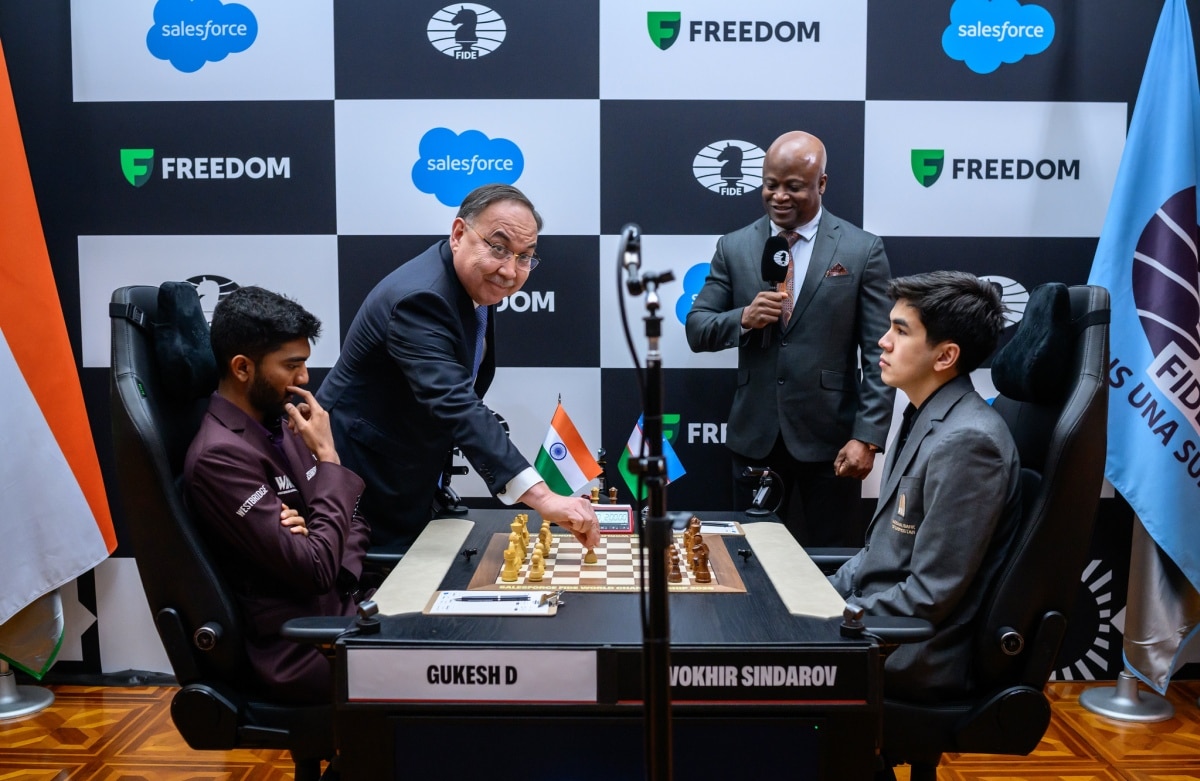
On the second day of the 2026 World Chess Championship, Indian reigning champion Gukesh Dommaraju and the Uzbek challenger Javokhir Sindarov drew their second game on move 20. Of the 934 games played for the world chess title, only 38 were shorter.
The shortest draws in history lasted just 10 moves. Tigran Petrosian and Mikhail Botvinnik played two in a row in 1963. The shortest win took 17 moves, when Viswanathan Anand beat Boris Gelfand in 2012.
Playing White for the first time in the game on 25th November, Gukesh went with the London System, an opening he’d played quite a bit in during the pandemic and had a real affection for. He was right on one point in that Sindarov hadn’t anticipated seeing it in Geneva.
American GM Hikaru Nakamura pointed out that the timing of Gukesh’s surprise was the thing that caught him out.
‘When you play your first game with White after months of preparation, you want to play something that tells you how your opponent is going to approach the main lines,’ he commented.
The problem for the champion was that his opponent knew the line. By move 15, Sindarov had played the pawn move he’d prepared at home. The same position appeared on the board for the third time five moves later, and the match was level at 1–1.
Read more: World Chess Championship Day 1: Sindarov pressures, Gukesh holds ground
The pawn move Gukesh couldn’t make
On move 7, Sindarov moved his queen to b6. He knew exactly where he wanted it to end up; he told the press conference afterwards. The queen would go back to d8, the bishop to e8, and then he’d push his f-pawn. The only thing Gukesh failed to appreciate was just how good that bishop and the knight on d7 would be for Black’s plan.
Game 2 | Salesforce FIDE World Championship ◽️White: Gukesh D 🇮🇳 ◾️Black: Javokhir Sindarov 🇺🇿 ⚔️ Result: 0.5-0.5 ♟ Match score: 1-1 ↔️ Game length: 20 moves 📖 Opening: London System #GukeshSindarov https://t.co/16kh9VVoul
— International Chess Federation (@FIDE_chess) November 25, 2026
Once Sindarov played 15…f5, Gukesh wanted to open the centre by advancing either his e-pawn or his c-pawn. He spent time looking for a way to make the second push work. If he could play c4, he said afterwards, he had a reason to carry on. Without it, he reckoned he was just as likely to get himself into trouble as he was to trouble Sindarov.
Extra read: Meet chess coaching trio behind Javokhir Sindarov’s charge on Gukesh
Sindarov had seen exactly the same thing all around him. His own e-pawn had no way through either, and Gukesh had about 45 minutes left for the next 20 moves. Sindarov expected him to repeat.
The fans who’d spotted the challenger yawning as he waited got an explanation afterwards. There weren’t many long variations to calculate, so he’d just been using the time to work through what Gukesh might do.
What if they draw all 14?
At the press conference a reporter asked when Gukesh would start taking risks, with a run of draws, of course, meaning he could keep his title. Gukesh picked up on that immediately. 14 draws, and the match would go to a tiebreak. He’d still have to win that.
‘In a match or a long tournament like the Candidates, it’s better to start with the main lines and surprise your opponent with the London System later,’ Nakamura stated, adding, ‘If you start with a surprise and can’t turn it into a win, sooner or later you have to go back to the main lines.’
