Powerful 7.8 Magnitude Earthquake Strikes Philippines Leaving Five Dead

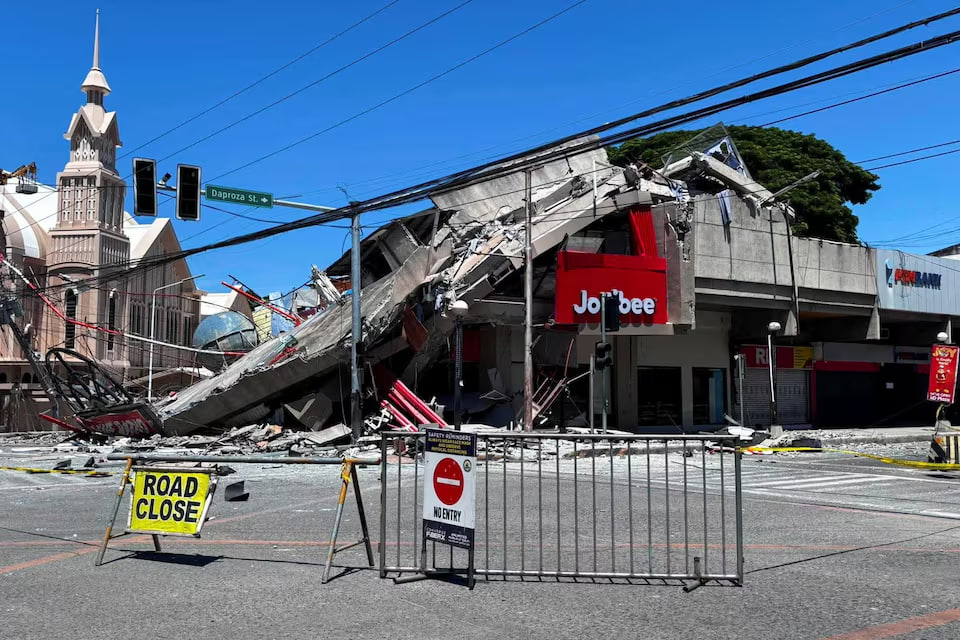
Tsunami alerts remain active across Southeast Asia after a massive 7.8 magnitude earthquake struck off the coast of Mindanao in the southern Philippines on Monday, claiming at least three lives, BBC reports.
Following initial assessments, police have confirmed that the devastating tremor killed five people and injured five others. Authorities estimate that the quake has damaged 37 buildings, the majority of which are commercial properties.
In General Santos, a city situated just 15 kilometres from the epicentre, residents fled their homes in panic. Local radio station DZBB reported that locals experienced smashed televisions, falling furniture and general household damage as they rushed to safety. The city’s disaster management office is currently treating the injured and evaluating the full scale of the destruction.
Tsunami waves batter coastline
Coastal residents have been urged to stay on higher ground following warnings from the U.S. Tsunami Warning System, Indonesian authorities and the Philippine government.
The Philippine Institute of Volcanology and Seismology (Phivolcs) confirmed that tsunami waves have already hit six areas, primarily along Mindanao’s southern coast. These waves were observed between 07:42 and 08:45 local time, with the highest swelling to 1.4 metres.
The agency stressed to reporters that the national tsunami warning remains firmly in place. Meanwhile, Indonesia’s geophysics agency BKMG reported that minor waves of about 0.19 metres had been recorded earlier in the day.
Hundreds of aftershocks recorded
The region continues to be rocked by subsequent tremors. Phivolcs reported that the initial quake triggered 138 aftershocks by 11:00 local time, ranging from 1.3 to a powerful 6.7 in magnitude.
The province of Sarangani has borne much of the immediate disruption from the continuous shaking. Rene Punzalan, the local disaster chief, confirmed that telecommunications networks and power supplies had been severed. Schools have suspended classes while emergency teams navigate the difficult conditions to conduct further damage assessments.
Arlene Hollero, a disaster official in the coastal town of Maasim, described the situation as «devastating». She noted that a local bridge sustained structural cracks and a prominent religious shrine collapsed. Evacuations in Maasim’s coastal villages are still underway.
The earthquake struck during morning flag-raising ceremonies. Alabel town police chief Benjie Ancheta noted that the sheer force of the tremor caused several individuals to faint, calling it the strongest earthquake he had ever experienced. The local police headquarters also sustained visible cracking.
Government response
Philippine President Ferdinand Marcos Jr has assured the public that a rapid disaster response is already active. He issued a statement promising that the national government is mobilising resources and will not leave Mindanao behind.
Seismologists have provided varying measurements of the quake’s initial intensity. The German Research Centre for Geosciences recorded a 7.8 magnitude tremor at a shallow depth of 10 kilometres, revising down an early estimate of 8.2. Conversely, state agencies in the Philippines and Indonesia measured the main earthquake at 7.0 and 7.7 respectively.
Both nations are highly susceptible to seismic activity due to their position on the Pacific Ring of Fire, a volatile tectonic belt that spans from the Russian Far East to South America.
