Uzbekistan Sees Decline in Domestic Fossil Fuel Extraction

Uzbekistan’s energy sector has recorded a notable contraction in raw material extraction during the first five months of 2026. According to the latest report from the National Statistics Agency, the nation’s domestic production of natural gas, oil and coal has fallen compared to the same period in 2025.
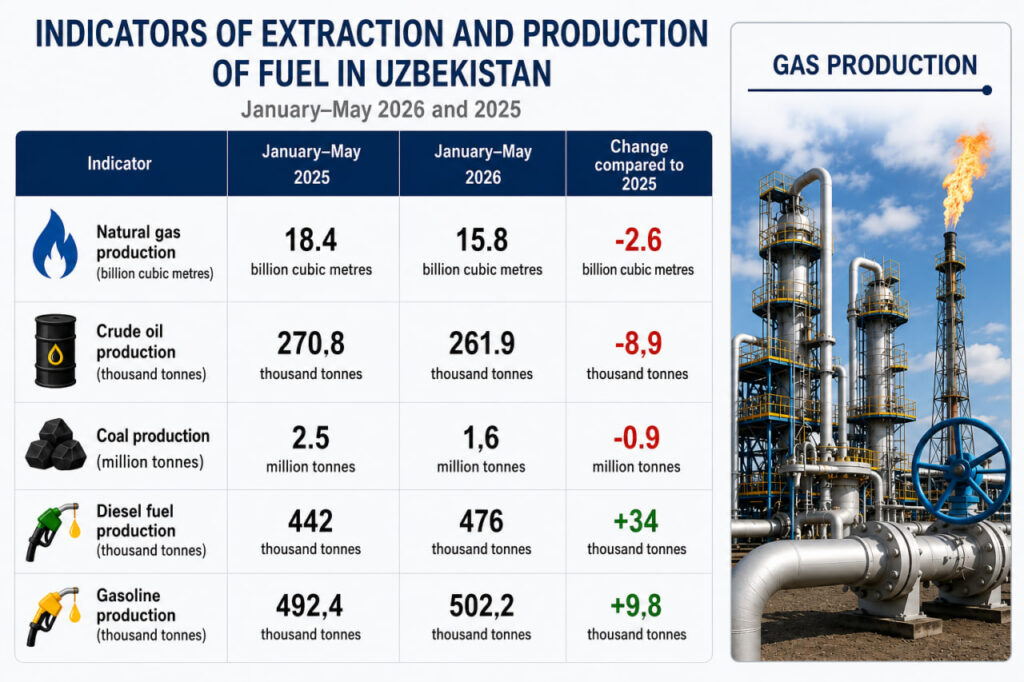
The statistics reveal that natural gas production between January and May 2026 totalled 15.8 bn cubic metres, marking a significant drop from the 18.4 bn cubic metres produced during the same timeframe last year. Similarly, oil extraction decreased from 270,800 tonnes to 261,900 tonnes, while coal production suffered the sharpest decline, plummeting from 2.5 mln tonnes to 1.6 mln tonnes.
Despite the reduction in upstream extraction, domestic fuel refineries have managed to boost output. Production of diesel rose from 442,000 tonnes to 476,000 tonnes, and petrol output saw a modest increase from 492,400 tonnes to 502,200 tonnes.
The trade imbalance
The data highlights a shifting landscape in Uzbekistan’s energy trade. The country has substantially increased its export of oil products, which reached a value of $357.7 mln, a year-on-year growth of 69.8%. Coal exports also saw a major surge, rising by 60.6% to reach 1.6 mln tonnes.
However, these gains are mirrored by rising domestic reliance on foreign energy. Imports of petrol and diesel have spiked to $373.4 mln and $226.8 mln respectively, reflecting a 85.1% increase in petrol imports and a 2% rise in diesel imports compared to the previous year.
Future strategy and exploration
To address the production gap, the state-owned energy firm Uzbekneftegaz has turned to aggressive exploration and infrastructure upgrades. Sukhrob Khamraev, head of the company, recently announced the discovery of 2 bn cubic metres of additional gas reserves following successful geological surveys in April.
The company has set an ambitious target for the second quarter, aiming to increase daily gas output by 6.7 mln cubic metres. This is to be achieved by commissioning 22 new wells and modernising 31 existing ones.
On the international front, Uzbekistan continues to deepen its energy ties with Russia. Following discussions between Prime Ministers Abdulla Aripov and Mikhail Mishustin earlier this spring, the country is set to increase its imports of Russian gas and oil.
Supplies of Russian gas, which have been flowing to Uzbekistan since 2023, are expected to grow further, with Gazprom indicating that it may eventually leverage the Power of Siberia-2 pipeline to bolster energy distribution across Central Asia.