Moonshot AI Introduces Kimi K3 2.8T Open-Weight Model


Tech startup Moonshot AI has introduced its latest artificial intelligence iteration. Dubbed Kimi K3, the multimodal system boasts a staggering 2.8 trln parameters and is slated to become the largest publicly accessible AI architecture globally when developers publish its full framework later this summer.
Engineered to tackle intricate enterprise tasks and extensive programming challenges, the platform can process up to one million tokens simultaneously while offering native image comprehension. Users can immediately interact with the technology via the company’s dedicated coding and workspace platforms as well as its application programming interface. Executives confirmed they will publish the underlying framework for global developers on July 27.
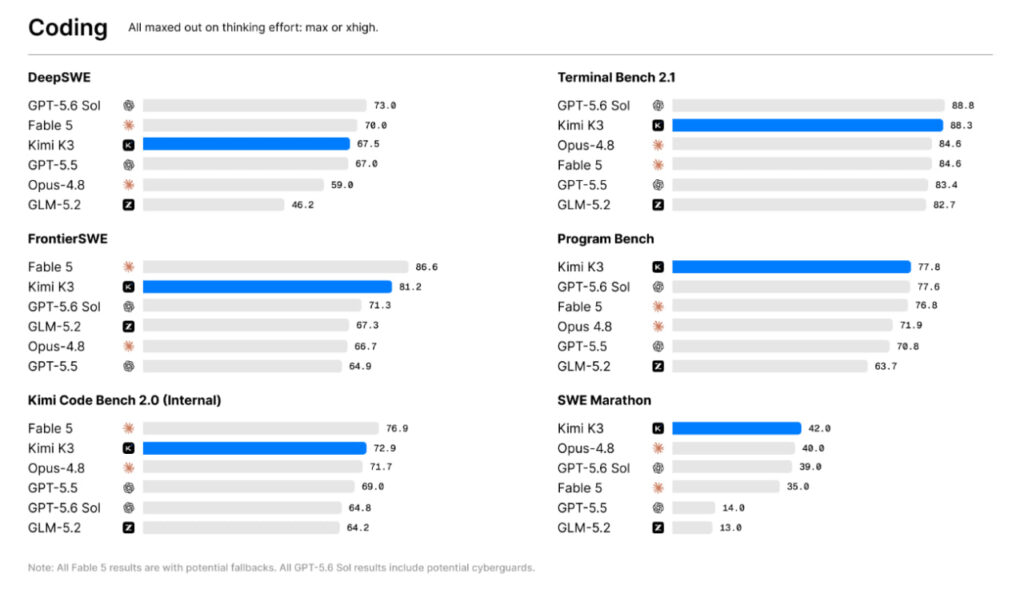
While internal metrics indicate the software currently sits just below proprietary industry giants like GPT 5.6 Sol and Claude Fable 5, it demonstrates highly competitive frontier-level capabilities. The infrastructure utilises a highly specialised Mixture of Experts setup that selectively engages just 16 of its 896 internal expert modules to process any given prompt.
Breakthroughs in processing architecture
To support this massive operational scale, the Beijing-based engineering team developed two distinct structural upgrades. A new mechanism named Kimi Delta Attention drastically accelerates decoding speeds during heavy data loads, running up to 6.3 times faster than previous limits. Meanwhile, the implementation of Attention Residuals boosted the initial training efficiency by a quarter. Combined, these proprietary enhancements make the K3 generation 2.5 times more scalable than its predecessor.
Presently, the software defaults to its most intensive processing mode to ensure maximum output accuracy. Future updates will introduce variable effort settings to allow users greater control over their computing resource consumption and processing wait times.
Advanced software engineering applications
The system demonstrates remarkable autonomy in software development scenarios. It can seamlessly navigate massive codebases, execute terminal commands and handle prolonged engineering projects with minimal human input. By incorporating visual data, the AI also assists with front-end interface design and computer-aided drafting simply by analysing screenshots provided by the user.
During closed testing, Kimi K3 autonomously engineered a highly compact GPU compiler named MiniTriton. This experimental system managed to equal and occasionally surpass existing industry benchmarks for specific technical workloads.
Moonshot AI has priced API usage aggressively to attract developers, charging $3 per mln input tokens and $15 per mln outputs. To further reduce adoption barriers, the interface fully supports existing OpenAI software development kits. This strategic compatibility allows software engineers to port their existing applications over to the Moonshot ecosystem without rewriting foundational code.
The firm continues to collaborate with open-source maintainers to finalise all technical documentation ahead of the highly anticipated summer weight release.