Why Türkiye–Saudi–Pakistan defence pact could become Central Asia’s fault line

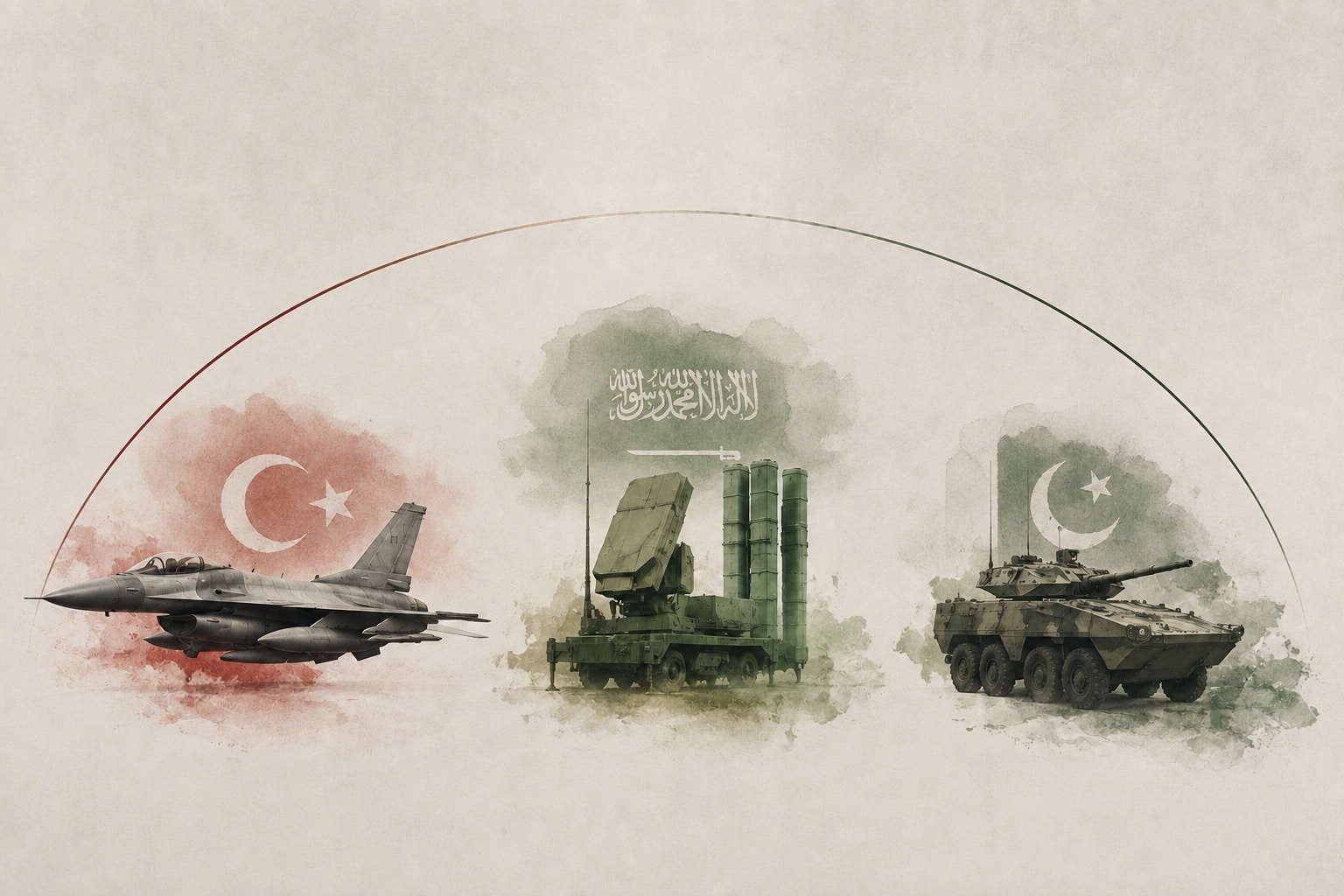
The Mecca Pact, signed by Ankara, Islamabad and Riyadh, could carry Middle Eastern rivalries into Central Asia. Mehmet Enes Beşer, researcher and ASEAN coordinator at the Vatan Party, argues that Türkiye must first make clear how the pact would work before pursuing closer security cooperation with the region.
On 7 August, Türkiye, Pakistan and Saudi Arabia signed the Mecca Joint Defence Agreement, declaring that an armed attack on one would be treated as an attack on all three. Turkish Foreign Minister Hakan Fidan then described the clause as technically comparable to NATO’s Article 5, announced plans for a Saudi-based general secretariat and said Ankara wanted the arrangement to expand.
Yet the full treaty has not been published, its operational rules remain unsettled, and, as of 12 August, there is no public record of it having been submitted to the Turkish Grand National Assembly for approval. A security architecture is being advertised before its legal and geographic boundaries are visible.
That opacity is already the subject of a constitutional dispute in Türkiye. It could next become a Central Asian security problem. Ankara should not invite Central Asian governments or use Turkic solidarity to draw them closer to the pact until parliament and the public know what Türkiye has promised.
The region does not need another overlapping alliance that reveals its obligations only during the first crisis.
The immediate concern for Türkiye is Yemen. Renewed Houthi attacks from Yemen and threats to Red Sea shipping raise a basic question: do missiles or drones launched by a non-state movement count as the «armed attack» that activates collective defence? Would Türkiye be expected to supply intelligence, air defence, naval patrols or combat forces?
Officials say the pact is defensive and not directed against Iran, but that does not explain how assistance would be decided, whether every member would retain political discretion or whether an attack linked to the Yemeni war could draw Türkiye into Saudi military operations.
Why the Mecca Pact matters for Central Asia
These questions matter in Central Asia because the region already lives with layered and sometimes conflicting security commitments. Kazakhstan, Kyrgyzstan and Tajikistan remain inside the Collective Security Treaty Organization, whose structures include collective forces and plans for an integrated Central Asian air-defence system.
Uzbekistan guards its freedom from military blocs, while Turkmenistan grounds its foreign policy in permanent neutrality.
All five states balance relations with Russia, China, Türkiye, Pakistan, Gulf investors and Western partners. A new pact marketed as expandable could force choices they have carefully avoided.
Formal accession is not the only risk. Saudi finance, Pakistani military ties and Turkish defence exports could create a looser security network through training, intelligence sharing, air defence and joint production.
Such cooperation may be useful. It becomes destabilising when governments cannot tell whether a bilateral programme carries an implied commitment to support the pact’s members in another theatre. A Central Asian state buying Turkish drones or receiving Saudi-funded security assistance should not have to wonder whether ordinary cooperation is being converted into political alignment.
Keep the pact outside Turkic cooperation
The Organisation of Turkic States faces particular exposure. Ankara may be tempted to present the new pact as the security core of a wider Muslim or Turkic order. That would divide the organisation rather than strengthen it.
Its Central Asian members have different treaty obligations, threat perceptions and relations with Iran. Kazakhstan maintains important trade and transport links with Iran, while Turkmenistan shares a long land border with the country. Uzbekistan also depends on regional connectivity that requires workable relations with Tehran.
Importing a Middle Eastern deterrence structure into the Turkic framework would turn economic and cultural cooperation into a test of strategic loyalty.
Pakistan’s role creates another complication. Islamabad is a full member of the Shanghai Cooperation Organisation and an important partner for several Central Asian governments when it comes to Afghanistan, transport and trade. Its participation may make the Mecca Pact appear relevant to Central Asia, particularly if it develops counter-terrorism or intelligence functions.
But security cooperation focused on Afghanistan is not the same as collective defence against conflicts in the Gulf or those involving India and Yemen. Combining them under one undefined mechanism would blur rather than solve the region’s security problems.
Supporters will argue that the agreement strengthens regional self-reliance as confidence in outside guarantees declines. That ambition deserves consideration. A defensive arrangement among regional states is as safe as dependence on great powers. The weakness lies in pretending that an Article 5-style sentence is sufficient. NATO has spent decades building decision-making rules, military planning, interoperability and democratic scrutiny. The new pact announces the guarantee but does not explain which institution must interpret it.
Türkiye must clarify the pact first
The Turkish Constitution provides the first corrective. Article 90 stipulates that treaties concluded with foreign states are generally subject to parliamentary approval through a law approving ratification, with limited exceptions for specified categories. The government should publish the text and explain the legal route it intends to follow. Parliament must ask what constitutes aggression, whether non-state attacks qualify, what assistance is mandatory, who authorises Turkish deployments, how the pact interacts with NATO and whether new members can be admitted without a fresh vote.
A second document should define operational limits. It should state that no member is automatically obliged to join offensive operations, regime-change campaigns or a partner’s pre-existing conflict. It should distinguish territorial defence from the protection of shipping, overseas bases and proxy forces.
It should also require a collective political decision before military action. Without those clauses, the next Houthi strike, an India–Pakistan crisis or a confrontation involving Iran could produce three different interpretations of the same promise.
Only after those steps should Ankara discuss the agreement with Central Asian partners. The message should be modest: the pact is not an extension of the Organisation of Turkic States, carries no expectation of Central Asian accession and will not alter existing security arrangements in the region. Cooperation on border management, Afghanistan, disaster relief and defence technology can continue through separate, transparent agreements.
The Mecca Pact may eventually become a limited deterrence mechanism rather than an expansive alliance. Its effect on Central Asia will depend less on the sentence signed in Mecca than on the rules written afterwards. Türkiye should not export uncertainty while asking others to trust its intentions. Before Ankara explains the pact to Astana, Tashkent or Bishkek, it must explain it to its parliament