Deposit boom in Uzbekistan: Drivers and prospects


We continue our series of publications on the situation in Uzbekistan’s banking sector and its future prospects, as seen by Fitch Ratings. In previous publications, we discussed the asset quality of Uzbek banks, dollarisation, and the positive changes in the domestic operating environment. Let’s now turn to the funding structure of Uzbek banks, as we have observed some interesting dynamics recently.
Rapid growth in banks’ customer accounts
Customer accounts at Uzbek banks have been growing at a high pace in recent years. They expanded by an average of 28% per year over 2022-2025, increasing by a further 27% on an annual basis in the first half of 2026. As a result, their share in sector liabilities has grown, although it remains just over 50%, up from about 40% a few years ago. This is still much lower compared to other regional peers whose banking sectors are predominantly deposit-funded.
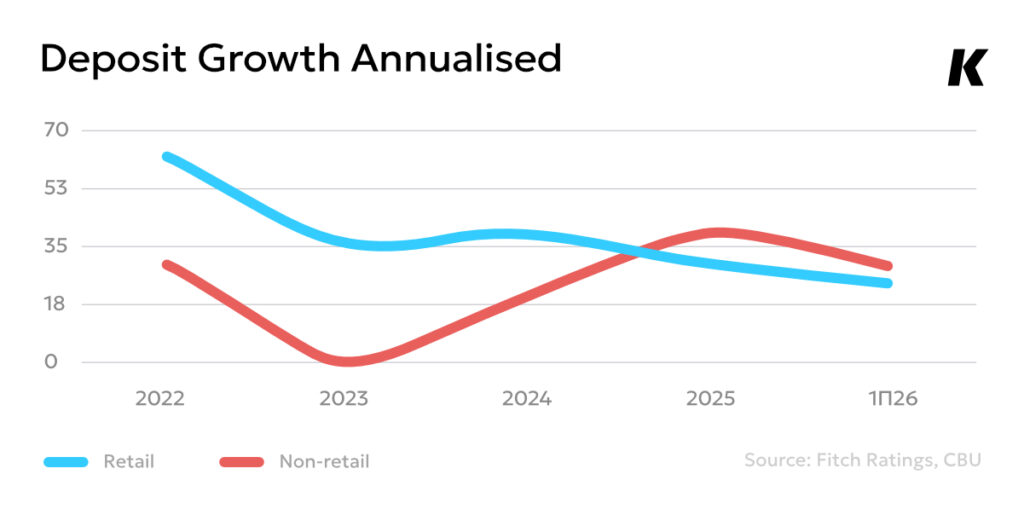
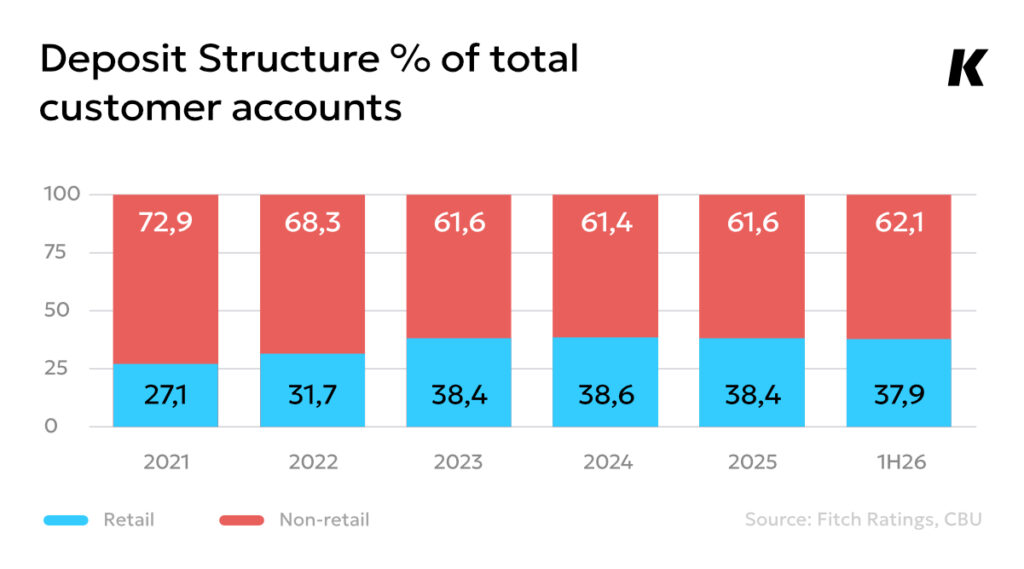
It’s worth taking a look at how deposit growth varied by customer type. Historically, non-retail deposits made up the bulk of customer funds. This was helped by a significant volume of state-related funding (particularly at state-owned banks). Annual deposit growth in this segment has averaged 22% over the past four years. Meanwhile, retail deposits have been growing at a faster pace (averaging 42% per year over the same period), partly due to a low-base effect. As a result, the share of retail deposits in the overall customer funding mix has grown rapidly, approaching 40% in recent years.
However, starting from last year, this trend has reversed. In 2025, for the first time in many years, corporate deposits grew faster than retail deposits (39% vs. 30%), and in the first half of 2026 this trend continued (29% and 24% on an annual basis, respectively). It is too early to judge whether this trend is sustainable. Interestingly, it has coincided with a notable decline in average market rates on term deposits (19.9% in April 2026, almost 2 percentage points down year on year).
Overall, rapid deposit growth has helped reduce Uzbek banks’ reliance on state and external funding. The loans/deposits ratio – a key metric in our rating analysis, which shows how banks fund their lending operations – has declined significantly in recent years. According to the Central Bank of Uzbekistan (CBU), it stood at 136% as of 1 July 2026, compared to a high 195% at end-2023.
What is driving deposit growth?
In our view, it is difficult to single out one key reason for the sustained growth of Uzbek banks’ customer base in recent years. We see it as a combination of the following main factors.
Firstly, persistently high real interest rates. CBU’s key rate remains high (14% since March 2025), while annual inflation has slowed markedly (6.4% in June 2026, 2.3 percentage points down year on year). Although market deposit rates have declined recently, they still remain around 20% on average, which increases the savings appeal of bank deposits.
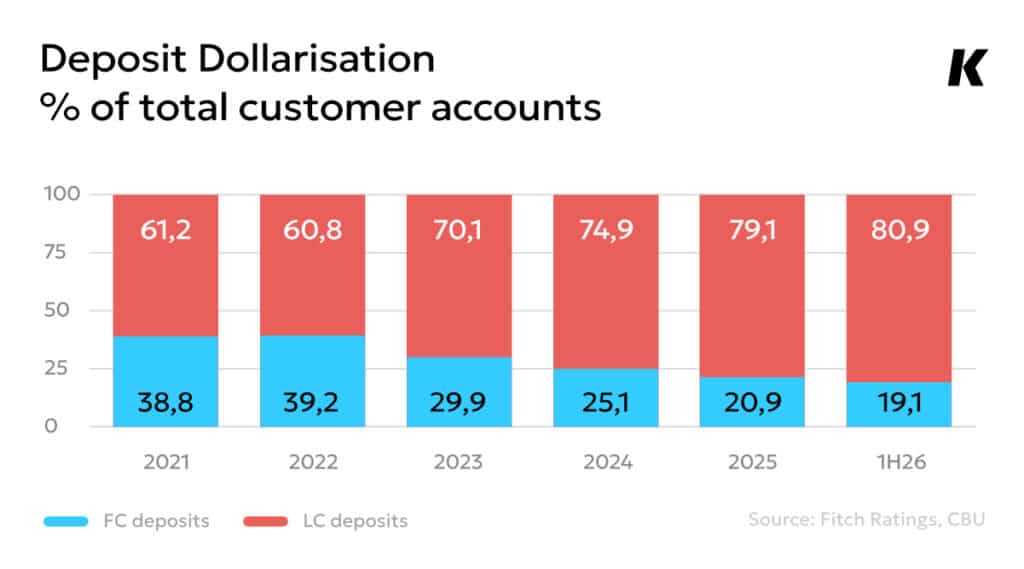
Secondly, the stabilisation of the exchange rate. As we know, the soum had been weakening steadily against the US dollar in previous years, albeit within fairly narrow bounds (5%-10% annually). However, in 2025, against the backdrop of a weakening dollar and an improving balance of payments, the soum strengthened by 7% against the dollar and has remained stable this year. Hence, the even higher attractiveness of soum-denominated deposits, which pay much higher interest rates than foreign-currency deposits. This explains the rapid de-dollarisation of banks’ customer balances. The share of foreign-currency deposits in the total sector customer accounts equalled only 19% as of 1 July 2026, having more than halved compared with 2021-2022 levels. It is currently the lowest among countries in Central Asia and the Caucasus where we provide analytical coverage to banks.
In addition, recent measures to reduce the share of the shadow economy, taken by the government and the CBU, have also helped drive deposit growth. These measures include the digitalisation of government services, enhanced supervision of suspicious transactions, the prohibition of cash settlements for certain types of transactions, and tax incentives for businesses.
In our view, the digitalisation of banking services has also improved customer experience, simplified procedures for opening deposits and making transfers, and provided flexible terms – all of which stimulate retail and non-retail customers to take their funds to banks.
An additional supporting factor is the significant volume of cross-border money transfers (mainly from Russia), a large part of which flows through the banking system. According to the CBU, the volume of money transfers reached a record high of USD18.9 billion in 2025. This is largely due to the stronger nominal rouble exchange rate, driving up dollar and soum equivalents.
A more nuanced picture: State banks have a different funding structure
Customer deposit growth has been prominent at both state-owned and private banks. However, non-state banks, which comprise private and foreign lenders, continue to play an important role in the domestic deposit market. They account for around half of all deposits in Uzbekistan’s banking sector, and most of these banks are funded predominantly by customer accounts. The average loans/deposits ratio in this segment was 97% as of 1 July 2026.
On the contrary, the funding structure of state-owned banks differs substantially. The share of customer deposits is significantly lower, and their average loans/deposits ratio is therefore almost twice as high (171%). This is because state-owned banks have historically been funded mainly from two sources: state-related funds (provided mainly to finance subsidised lending under government programmes) and external funding from foreign banks and international financial institutions (IFIs).
Given their close ties with, and direct support from, the government, state-owned banks typically have significantly higher issuer default ratings than private banks (equalised with the sovereign rating or slightly lower), which ensures considerably better access to global financial markets. As part of their ongoing business-model transformation, most state-owned banks have prioritised attracting customer funds. However, deposits have not yet become the primary funding source for these banks.
What’s next
We expect that Uzbek banks’ customer accounts will continue to grow in the near term, given the still large volume of funds held by the population and in the shadow economy that could be brought into the banking system. That said, the pace of deposit growth will likely slow as real interest rates decline. A further reduction in the share of foreign-currency deposits is possible, although we do not expect it to fall below 15%.
Overall, we do not expect deposits to replace external and state funding. In our view, the loans/deposits ratio could stabilise at around 120%-130% over the medium term. We have seen both state-owned and private banks intensify their efforts to attract longer-term funding from foreign banks and IFIs, as well as tap the debt capital markets. We expect this trend to continue, given the currently favourable market conditions for Uzbek issuers. However, this carries potential medium-term risks for banks and represents one of the structural weaknesses of the domestic banking sector – although this topic probably warrants a separate discussion.