France deploys 70,000 police as new protests trigger arrests and closures

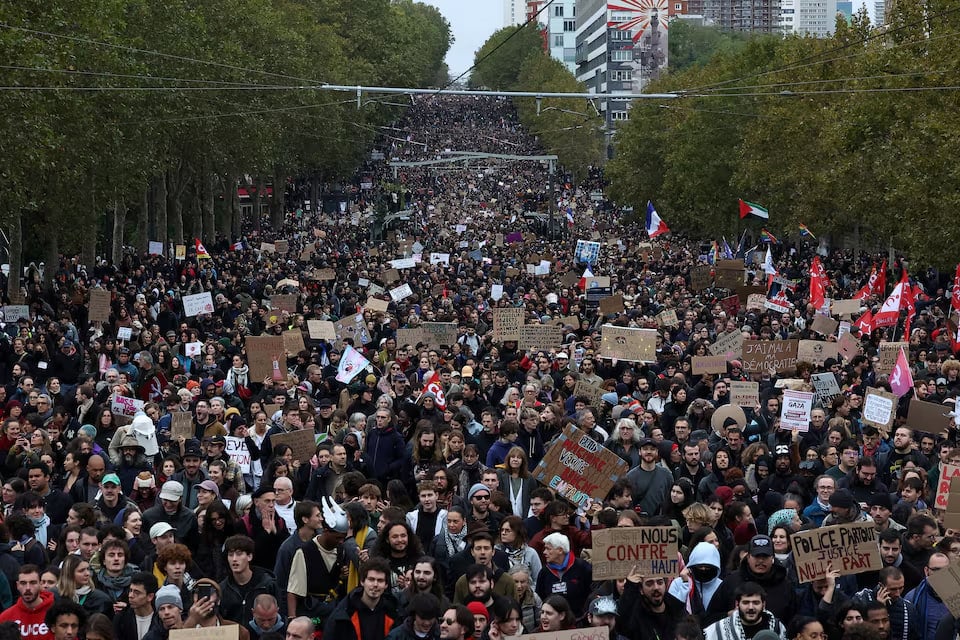
Fresh protests erupted across France on Saturday, October 24, with at least 135 people arrested as authorities deployed 70,000 police officers to prevent a repeat of last weekend’s riots and looting.
Demonstrators returned to the streets of Paris, Lyon and other cities over rising living costs, school funding and deteriorating public services, despite restrictions introduced by President Emmanuel Macron‘s government.
Police used tear gas against protesters in Lyon, while the main demonstration in Paris began peacefully under heavy security, according to Reuters.
JUST IN: 🇫🇷 Huge protest breaks out in Paris. https://t.co/SbM4ewy8sW
— BRICS News (@BRICSinfo) October 24, 2026
Interior Minister Laurent Nuñez said the 135 arrests had been made by early afternoon, with some suspects detained after police discovered fireworks, metal projectiles and other objects that could be used as weapons.
The government deployed 10,000 more officers than on October 17, supported by armoured vehicles, water cannon and specialist police units.
The unrest also forced major attractions to close, disrupted public transport and prompted businesses in central Paris to board up their windows.
Police fire tear gas as protesters clash with officers in Toulouse, France, sending clouds of gas across the streets as demonstrators scatter amid chaotic scenes. #Toulouse #France #Protests #BreakingNews #Paris #ParisRiots https://t.co/C4HafKvxbZ
— Sajjad Tarakzai (@SajjadTarakzai) October 24, 2026
Why are French people protesting again?
The latest demonstrations are part of a movement that began in September, when high school students protested overcrowded classrooms, staff shortages and poor learning conditions.
The movement subsequently expanded as trade unions, university students and Yellow Vest activists joined calls for higher wages, better public services and relief from rising prices.
According to the Associated Press, French consumer inflation reached 3.1%, while energy prices rose 21.3% year on year.
Protesters are demanding additional teachers, increased student grants, more university places and restrictions on rent increases in public student housing.
Macron tried to crackdown on the protests, but it backfired! Hundreds of thousands of people have turned out across France today to send a clear message that the people won’t be silenced by Macron’s regime. Neoliberalism is a failed ideology that has accomplished nothing except making the rich richer and tearing our world apart with imperialist wars all while emboldening neofascism. https://t.co/gpVHJ9pXYm
— Power to the People ☭🕊 (@ProudSocialist) October 24, 2026
On October 17, approximately 550,000 people demonstrated nationwide, according to the Interior Ministry, while organisers estimated attendance at around 800,000.
Although many marches were peaceful, serious violence erupted in several cities, with shops looted, vehicles set on fire and public buildings attacked.
More than 2,000 people were taken into police custody following the unrest. By October 23, Justice Minister Gérald Darmanin said 232 people had been imprisoned and 1,144 had been referred to prosecutors.
The government has since faced criticism both for failing to prevent the violence and for introducing restrictions that opponents say threaten the right to peaceful protest.
🇫🇷#France has implemented heavy security measures ahead of new protests Saturday, with police, helicopters and armoured vehicles as well as bans on certain #protests and local curfews seeking to prevent a repeat of the violence and looting which erupted during nationwide demonstrations last weekend. The restrictions, including outright bans on protests in some cities, have drawn criticism. To learn more, watch here ⤵️
— FRANCE 24 English (@France24_en) October 24, 2026
What has Macron done since last week’s riots?
Following the October 17 violence, Macron announced tighter controls on demonstrations and ordered security forces to prevent further attacks on businesses and public buildings.
At an October 22 security council meeting, the president acknowledged failures in anticipating the previous weekend’s unrest and called for tougher action against those responsible.
He accused radical far-left groups of attempting to destabilise the country and said authorities should respond firmly to criminal activity.
Macron also recommended avoiding demonstrations in the coming days, saying the government wanted a return to calm.
Ceux qui ont cherché à faire tomber la République auront à en répondre. https://t.co/qtqKUIXPpu
— Emmanuel Macron (@EmmanuelMacron) October 18, 2026
He announced that protests organised by established trade unions could be authorised, subject to security assessments, while other gatherings would face restrictions.
Local authorities subsequently banned or limited demonstrations in several cities, including Lyon, Marseille and Montpellier.
On October 23, the Interior Ministry issued instructions allowing prefects to impose alternative protest routes, strengthen checks at railway stations and major roads and deploy specialist units.
Jamais nous ne devons confondre nos compatriotes qui ont manifesté avec la volonté de porter des revendications légitimes, avec ceux qui ont détruit, pillé, cassé. https://t.co/3mhsCzCNOb
— Emmanuel Macron (@EmmanuelMacron) October 18, 2026
However, opposition parties and trade unions criticised the measures, arguing that the government was prioritising policing over addressing the grievances behind the protests.
Amnesty International France also warned that the restrictions could undermine the right to demonstrate peacefully.
Macron met student representatives on Friday, while Prime Minister Sébastien Lecornu is expected to hold further talks with students, teachers, trade unions, employers and local authorities on October 26.
Museums close and police use tear gas as protests continue
Saturday’s security operation brought significant disruption to central Paris.
More than 20 metro stations were closed, while the Louvre, Musée d’Orsay and Paris Opera suspended operations as a precaution.
Other institutions, including the Picasso Museum, Grand Palais and Musée de l’Orangerie, also closed. Art Basel Paris cancelled its weekend programme.
Shopkeepers across the capital installed protective boards over windows following widespread damage during the previous protests.
Authorities also introduced overnight curfews in selected areas, including restrictions affecting unaccompanied minors in parts of Paris.
The capital’s main authorised march was moved away from its original central route to the southeastern outskirts after police raised concerns about renewed looting.
Opposition politicians accused authorities of making participation more difficult, while officials argued that the changes were necessary to protect businesses.
In Lyon, police used tear gas to disperse demonstrators. Similar measures were reported in Clermont-Ferrand, where officers confronted protesters attempting to reach the city centre.
Meanwhile, a separate demonstration took place in Orléans against Marine Le Pen‘s far-right National Rally, which was holding its national party congress.
The march proceeded peacefully, according to Reuters.
As of Saturday afternoon, authorities had not released a final nationwide attendance figure or arrest total for the latest demonstrations.
