Nearly 1,000 arrested as fresh protests sweep across France

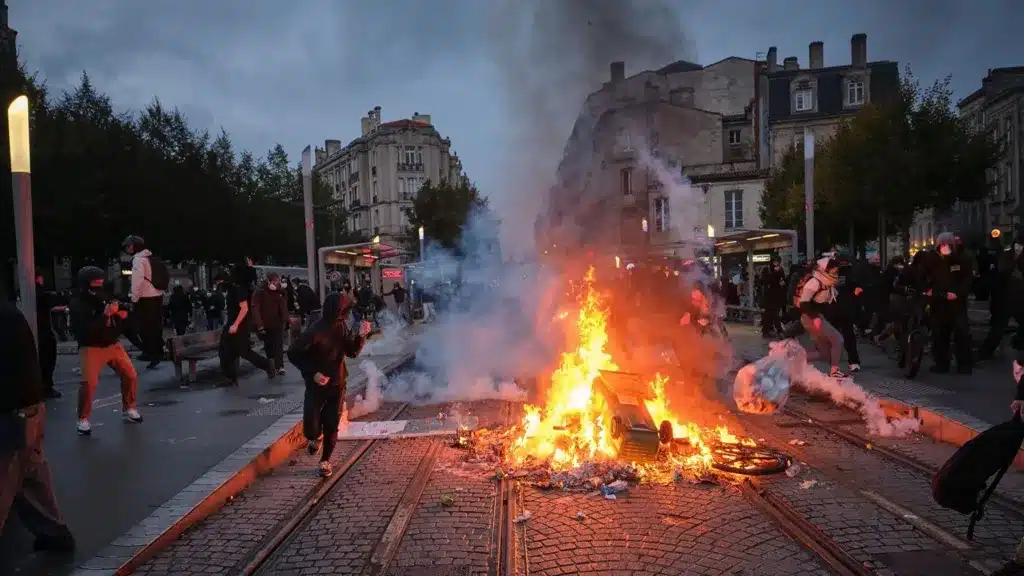
Nearly 1,000 people were arrested across France on Saturday, 24 October, as hundreds of thousands of demonstrators returned to the streets to protest against rising living costs, education funding and government policies.
The French Interior Ministry estimated that 410,000 people participated in demonstrations nationwide, including 110,000 in Paris. The CGT trade union put the national turnout at nearly 800,000.
#WATCH | France | Protests Turn Violent as Demonstrators Clash with Riot Police in Paris; large numbers of people are protesting across France against the rising cost of living. (Source: Reuters) https://t.co/Mtj9w1EL1l
— ANI (@ANI) October 25, 2026
Interior Minister Laurent Nuñez said the number of arrests was expected to rise as police consolidated reports from across the country. Authorities deployed approximately 70,000 officers in an effort to prevent a repeat of the violence that followed demonstrations on 17 October.
Although most marches began peacefully, clashes broke out in Paris when masked protesters threw fireworks and other objects at police near the end of the demonstration. Officers responded with tear gas, sound grenades and water cannons.
Clashes have erupted across France as hundreds of thousands of people protest against rising living costs, with police firing tear gas and nearly 1,000 arrests made nationwide. 🔗: https://t.co/t6wMRw7Nwl https://t.co/Q7eF39dzv6
— Al Jazeera English (@AJEnglish) October 25, 2026
Violence was also reported in Marseille, Lyon, Strasbourg and several other cities. In Marseille, protesters set rubbish bins alight and threw rocks and bottles at security forces. Police used tear gas to disperse crowds in several locations.
At least two people were seriously injured during the unrest, according to French authorities.
Why protests have continued despite government restrictions
The demonstrations began in September when secondary school students protested against teacher shortages, deteriorating school buildings and inadequate education funding.
BREAKING: Mass protests sweep Europe. · France: 410k march, 70k police, nearly 1,000 arrested. · Italy: 500 soldiers deploy in Milan, luxury boutiques boarded up. · Spain: 25k demand pensions in Madrid. · Albania: Agriculture Ministry entrance set on fire. https://t.co/YozeWNoiSu
— HINT News (@9415st) October 25, 2026
The movement subsequently expanded to include university students, teachers, trade unions and workers demanding higher wages, improved public services and measures to address rising living costs.
Following violent demonstrations on 17 October, the government introduced tighter security measures, including restrictions on protest routes, bans on gatherings in certain areas and the deployment of additional security personnel.
In Paris, authorities restricted Saturday’s main march to the southeastern edge of the capital, keeping demonstrators away from the city centre. Several major museums closed as businesses prepared for possible violence.
The government also imposed targeted curfews in areas affected by the previous week’s unrest, including restrictions affecting minors in some locations.
BREAKING: Police charge protesters with baton blows in Paris, France, the protest is turning violent. https://t.co/U4T8KOwWrz
— World Source News (@Worldsource24) October 24, 2026
Prime Minister Sébastien Lecornu acknowledged shortcomings in the police response to the earlier violence, citing intelligence failures and inadequate deployment strategies. The government subsequently announced plans to reinforce police with military personnel.
Meanwhile, 200 investigators were assigned to identify suspects involved in the earlier rioting, while parliament began establishing an inquiry into the unrest.
Macron faces mounting pressure as protesters plan further action
President Emmanuel Macron met representatives of secondary school students on Friday, 23 October, as the government sought to address the movement’s original demands.
Student representatives said Macron had promised changes to university admissions but insisted demonstrations would continue until concrete measures were announced.
WATCH: Large crowds marched through Paris today in a second national day of protests against the rising cost of living, as authorities deployed heavy security following last weekend’s riots. The police prefecture put turnout in Paris at about 110,000, while the CGT union claimed around 250,000. Nationwide, the Interior Ministry counted roughly 410,000 protesters, compared with up to 800,000 claimed by the CGT. https://t.co/zaogkGKwyY
— Clash Report (@clashreport) October 24, 2026
Interior Minister Nuñez defended Saturday’s security operation, saying police had prevented further attacks on public buildings and extensive looting. However, some demonstrators accused officers of excessive force and criticised restrictions on peaceful marches.
The unrest has increased political pressure on Macron ahead of France’s presidential election in May 2027.
Left-wing politician Jean-Luc Mélenchon has backed the demonstrations, while far-right leader Marine Le Pen has criticised the government’s handling of the crisis.
Footage of Saturday’s protests by French citizens in the streets of Paris, the capital of France. https://t.co/YL0KHDLNlQ
— Sprinter Press (@Sprinter_Press) October 25, 2026
Further protests are already planned. Groups associated with the Yellow Vest movement have called for nationwide demonstrations on 31 October, including gatherings outside parliament and town halls.
The movement’s organisers are demanding greater protection for civil liberties and an end to restrictions on demonstrations, raising the prospect of another weekend of nationwide mobilisation.
