Ukraine and Russia resume peace talks in Abu Dhabi as Trump says both are ‘tired of fighting’

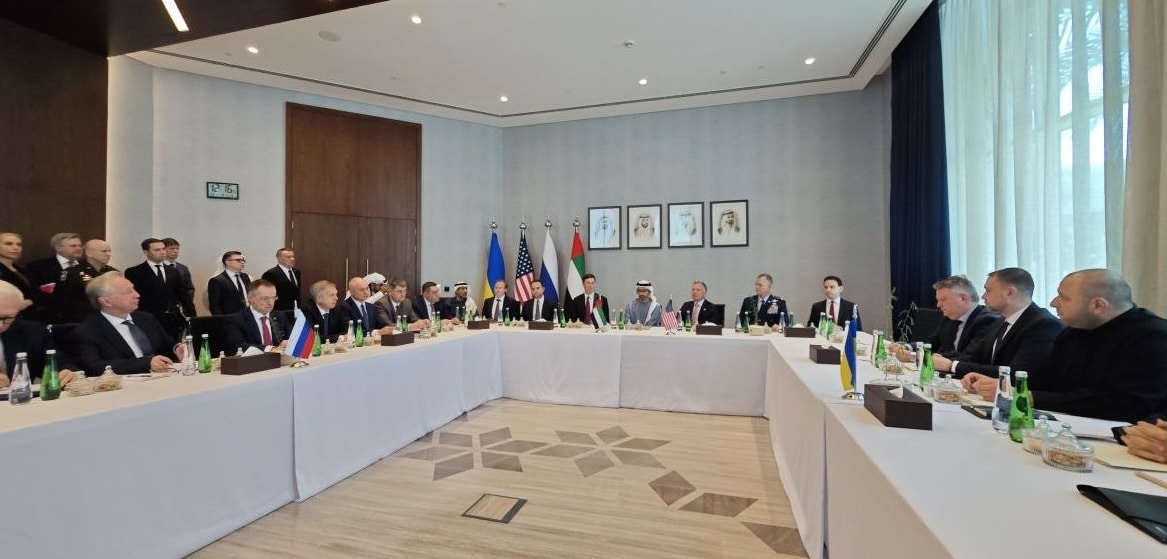
Ukraine, Russia and the United States are holding two days of peace talks in Abu Dhabi on 10–11 November, their first trilateral negotiations since February, Associated Press reports. The meetings will be held in private.
US President Donald Trump has appointed Steve Witkoff and Jared Kushner as his representatives for Washington. Russia has sent a delegation led by presidential aide Vladimir Medinsky, while Ukraine’s team is headed by foreign intelligence chief Rustem Umerov.
We have begun our work in the United Arab Emirates. The first meeting will be held with representatives of the United Kingdom, France, Germany, Italy, NATO and the European Commission, joined by US Special Envoys Steve Witkoff and Jared Kushner. We will align our positions and coordinate our steps ahead of the next stage of negotiations. This will be followed by a trilateral meeting involving Ukraine, the United States and Russia. The Ukrainian delegation, alongside me, includes Kyrylo Budanov, Davyd Arakhamia, Serhii Kyslytsia and Vadym Skibitskyi. Our key priorities are to end hostilities, secure reliable post-war security guarantees, ensure Ukraine’s economic recovery and development, and advance humanitarian efforts. We are working to make as much progress as possible on these issues and bring peace closer.
— Rustem Umerov (@rustem_umerov) November 10, 2026
Witkoff said the negotiations would cover post-war security arrangements, de-escalation, humanitarian issues and further steps towards a peace agreement.
Kushner also confirmed that the US delegation would consult Ukrainian and European officials before meeting Russian representatives. The discussions will address Ukraine’s future security and economic recovery.
What Ukraine expects from the negotiations
Ukrainian President Volodymyr Zelenskyy has called for reliable security guarantees, an end to attacks on energy infrastructure, safe navigation in the Black Sea and further prisoner exchanges.
President Trump is determined to bring an end to this horrible war, which has caused enormous loss of life, destruction, and suffering. We are working hard to find a negotiated solution that can deliver lasting peace and create the conditions for a sovereign, secure, and prosperous Ukraine within a more stable European security environment. Before beginning the two days of trilateral talks with Ukraine and Russia in Abu Dhabi, @SEPeaceMissions and I will meet with our partners from Ukraine, the EU, NATO, Germany, France, the United Kingdom and Italy to continue the close consultation and coordination we have undertaken on European security and Ukraine’s postwar future over the past several weeks. These will be the first trilateral talks since February. Building on our separate consultations with both sides, our objective is to bring Ukraine and Russia together to discuss directly their postwar security concerns, proposals, and potential solutions. We hope these discussions will identify areas of common ground, advance practical solutions, and build momentum toward the next phase of negotiations. Ultimately, achieving a comprehensive and lasting settlement will also require direct engagement between Russia and our European partners on the broader security arrangements that affect them. We hope the discussions in Abu Dhabi will create the conditions for that engagement to begin in the near future, as part of a broader multilateral process. Our work has focused on four interconnected priorities: ending the fighting, developing credible postwar security guarantees and arrangements that reduce the risk of renewed conflict, preparing a comprehensive economic and prosperity plan for Ukraine, and advancing humanitarian measures to alleviate suffering and address the human consequences of this war. Together with Ukraine, the EU, and other European partners, we are working to address Ukraine’s substantial postwar fiscal and reconstruction needs, support critical infrastructure, attract private investment, and create the conditions for long-term economic growth and self-sufficiency. We are also working with the parties on important humanitarian issues, including the return of prisoners and civilians, and practical measures to alleviate suffering and reduce the human cost of this conflict. An important part of this process is encouraging all parties to begin thinking seriously about what comes after the war. By discussing postwar security, economic recovery, and the mechanisms needed to prevent future conflict, we hope to shift the focus from managing the war toward building the foundations for a durable peace. The existing European security agreements and institutions provide an important foundation for this work. We want to build upon what has worked, identify where existing mechanisms have fallen short, and what practical improvements are needed to make them more effective in the future. Our discussions will focus on stronger consultation, reliable crisis communications, greater military transparency, and reciprocal measures to reduce escalation risks, while fully respecting the sovereignty and independent decision-making of every nation. This is an extraordinarily difficult and complicated conflict. We recognize the difficult decisions ahead and are approaching these discussions with determination and realism. Our hope is to make meaningful progress, establish a practical pathway forward, and help create the conditions for a lasting peace.
— Jared Kushner (@jaredkushner) November 9, 2026
During a November 4 call with Witkoff and Kushner, Zelenskyy said Kyiv had already submitted its proposals to Washington.
«Ukraine is ready to take the necessary steps. Our proposals are clear, and we have given them to the American side,» Zelenskyy said.
Ukrainian delegation member Davyd Arakhamia told Deutsche Welle that he did not expect an immediate breakthrough, although he described the resumption of direct negotiations as progress.
Diplomats from Britain, France, Germany, Italy, NATO and the European Union are also expected in Abu Dhabi for separate consultations with Ukrainian and American officials.
Russia’s stock market opened lower on November 10 as investors awaited news from Abu Dhabi. The MOEX Russia Index fell 0.83% to 2,449.68 points by late morning. Analysts cited by Interfax attributed the decline mainly to falling oil prices, with Brent crude trading near $91.50 a barrel.
The central disagreement remains territorial concessions. Russia continues to demand Ukrainian withdrawal from areas of Donbas it does not control, while Kyiv rejects surrendering territory as a condition for peace.
