From the Dollar to Bonds: How 2025 Changed the Investment Habits of Uzbekistanis


In 2025, the volume of bond transactions on the listing platform of the Republican Stock Exchange «Toshkent» increased 4.5 times and reached 1.7 trillion soums. The number of transactions almost quadrupled to 11,000. All of this indicates increased activity among issuers and investors in the debt market. At the same time, alternative ways of growing savings were also actively developing in Uzbekistan.
Kursiv Research, together with a Freedom Broker expert, examined where the country’s citizens invested their money and why bonds became the safe haven of 2025.
The Dollar Came in for a Landing
Over the year, Uzbekistan’s national currency strengthened by approximately 7%, which came as a complete surprise. Previous years had seen depreciation: 4.7% in 2024, nearly 10% in 2023, and 3.6% in 2022.
Those who purchased U.S. dollars at the beginning of 2025 were effectively unable to protect their savings from depreciation, and even dollar-denominated deposits did not help, as their yields ranged between 5% and 7%.
What Factors Influenced the Exchange Rate
Freedom Broker Chief Investment Analyst Muhammadkamron Murodov comments on the dollar situation as follows: exchange rates were shaped by opposing trends in the global economy, slower growth in a number of developed countries, instability in commodity markets, and the strengthening of U.S. protectionist policies.
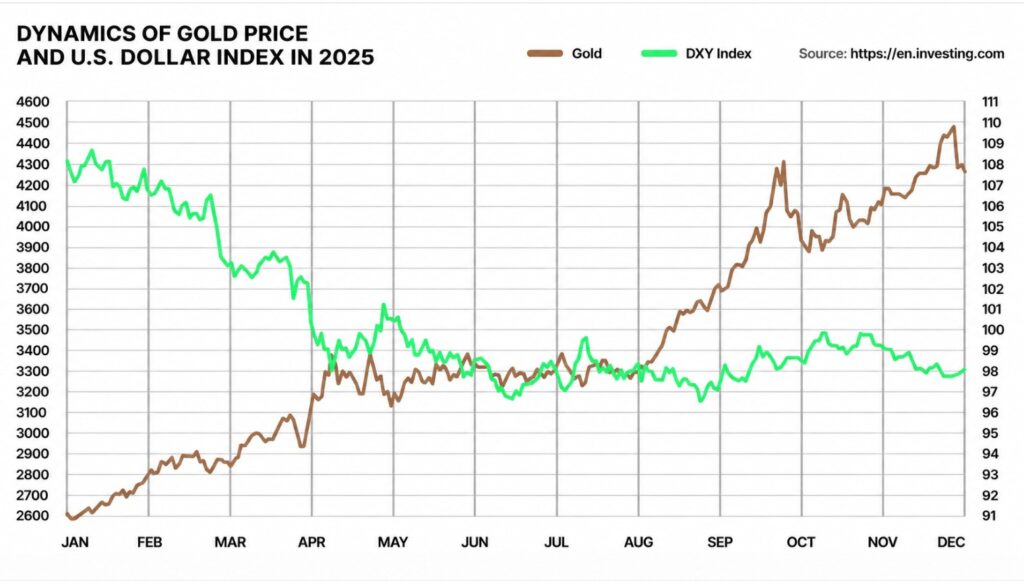
The introduction of large-scale tariff duties created additional risks for global trade and increased imbalances in world markets. Against this backdrop, the U.S. dollar index declined by more than 9% since the beginning of the year. Such weakening directly affected the performance of other currencies.
The strengthening of the soum is explained not only by the weakening of the dollar but also by domestic factors. According to preliminary data, Uzbekistan’s economy grew by more than 7% in 2025, supported by the expansion of foreign trade turnover and investment inflows.
Savings in Banks: Figures and Trends
The situation with soum deposits looked better than with dollar deposits, but yields were also declining despite the increase in the policy rate in March 2025. Muhammadkamron Murodov notes that an increase in the key rate would traditionally be expected to stimulate higher deposit rates. However, the market reacted in the opposite way, and rates moved downward.As of November 2025, the weighted average deposit rate for individuals stood at 21%, compared to 22.1% in January. It is important to take into account that inflation in Uzbekistan is also slowing down (7.3% in 2025 versus 9.8% in 2024).
Along with it, inflation expectations are decreasing, meaning that real interest rates (adjusted for inflation) are increasing. The deposit portfolio of Uzbekistan’s financial institutions demonstrated strong growth: as of December 1, 2025, it had increased by 31% year-on-year. The share of foreign-currency deposits decreased from 26% to 21%, indicating a redistribution of liquidity in favor of the national currency.
Gold Exceeded Expectations
The Freedom Broker analyst believes that 2025 can confidently be described as both unpredictable and successful for the gold market. Investments in the precious metal delivered high returns: the price surpassed the psychologically important level of $4,000 per troy ounce, significantly exceeding market expectations and the forecasts of most analysts.
«The growth resulted from geopolitical tensions, inflation risks, expectations of monetary policy easing by the U.S. Federal Reserve, and general uncertainty regarding the economic and political outlook of the United States,» the Freedom Broker analyst believes. «Additional support for prices came from the weakening of the U.S. dollar, since the precious metal is denominated in U.S. currency.»
According to the expert’s calculations, the price of gold increased by approximately 64.5% over the year, reaching $4,300 per ounce, while the all-time high stood at $4,532.63. Over two years, the price effectively more than doubled.
How to Invest in Gold
In Uzbekistan, it is possible to invest in gold by purchasing gold bars from the country’s banks. In just the first eight months of 2025, more than 17,400 bars with a total weight of around 380 kilograms were sold.
For comparison, sales totalled 236 kilograms and 14,400 bars throughout 2024, and 109 kilograms and 5,700 bars in 2023. How much could investors have earned from investing in gold?
Example. On January 17, 2025, 100-gram pure gold bars became available for sale in Uzbekistan. At that time, their price was 116.6 mln soums. As of January 12, 2026, such a bar was already worth 180.2 mln soums. However, when buying back the bar, the bank offers a price lower than the selling price: 173.2 million soums for a bar with intact packaging and 171.4 mln soums if the packaging has been damaged. Thus, by selling a bar with preserved packaging, the investor’s profit amounted to 56.6 mln soums, or about 48.5% in less than a year. In the case of damaged packaging, profit declined to 54.8 million soums, corresponding to approximately 47% annually.
Cryptocurrencies: Volatility as the Norm
In 2025, cryptocurrencies once again found themselves at the center of attention in global financial markets. The most popular asset remained Bitcoin. Growing interest from institutional investors and discussions about the role of digital assets in the reserves of certain countries supported demand, although any negative news quickly led to corrections.
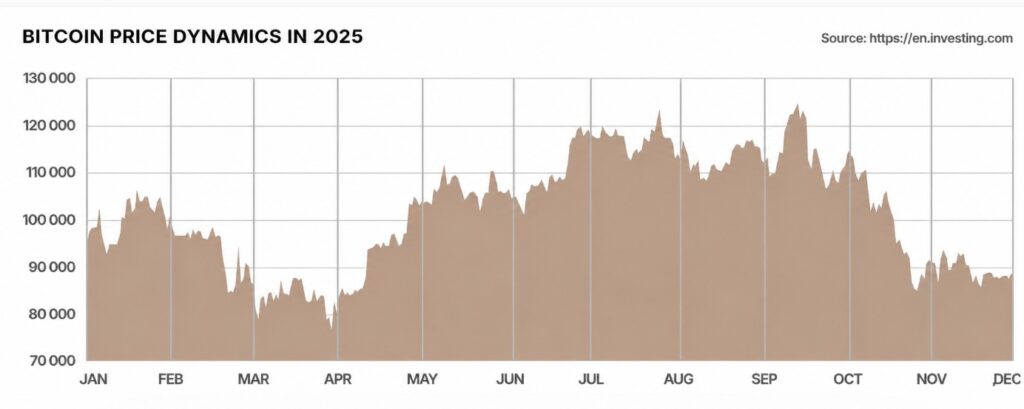
Freedom Broker analyst Muhammadkamron Murodov emphasizes that Bitcoin’s returns during the year largely depended on the investment horizon. From January to early April, the asset’s price fell to its yearly low of around $76,300. During this period, an investor could have recorded a loss of 18.43%, which would have had a noticeable impact on portfolio structure.
However, holding the position until early October, when Bitcoin reached a new all-time high of $124,700, would have generated a return of 63.44% from the April low and approximately 33.31% from the beginning of the year. By the end of the year, the asset once again turned downward, losing 6.35% from the beginning of the year, which once again highlighted the market’s dependence on news flow and market noise.
«Against this backdrop, it is still premature to speak of cryptocurrency as a reliable investment instrument,» the specialist emphasises.
Stocks: When the Market Was Looking for Ideas
Despite expectations of IPOs and SPOs from major state-owned companies, 2025 did not bring new public issuers to the market. Delays in privatization and companies’ lack of readiness for listings limited supply, but this did not become a restraining factor for investors.
On the contrary, attention shifted toward already traded securities, which throughout the year demonstrated both price growth and substantial returns. Muhammadkamron Murodov highlights the strongest investor interest in the shares of Hamkorbank (ticker: HMKB), the Uzbek Republican Commodity Exchange (URTS), as well as Uzbektelecom (UZTL) and the Chilonzor Buyum Savdo Kompleksi trading complex (CBSK).
These companies attracted investor attention for various reasons — from fundamental improvements in financial performance to market demand and investor expectations.
Uzbektelecom shares rose by 43.85% in 2025. The expert attributes this primarily to the recovery of the company’s financial results: by the end of the third quarter, net profit had reached 321.1 billion soums, significantly exceeding the figures of previous years.
At the same time, as Murodov emphasizes, the share-price performance can only partially be explained by fundamental factors, since the growth occurred in the absence of major corporate events. Another notable asset was CBSK shares, which more than doubled in value since the beginning of the year, becoming one of the few instruments to demonstrate a prolonged upward trend.
Which Stocks Rose in 2025
The Freedom Broker expert notes that HMKB shares gained 76.3% in 2025, reaching 43 soums per share, while trading volume increased 23-fold and exceeded 46 billion soums.
Since capitalisation in February 2024, cumulative growth has amounted to approximately 33.4%. The shares were supported by the bank’s strong financial performance, its leading position in net profit and loan portfolio size, consideration of a possible international listing, and the first-ever decision to pay dividends on ordinary shares — a practice the market expects to continue.
URTS shares are among the most sought-after instruments and are frequently regarded by investors as a priority investment. Their attractiveness stems from the company’s stable financial results, growing exchange trading volumes, developed infrastructure, and consistent dividend policy, which includes annual payments of at least 50–70% of net profit.
In 2025, the stock reached a peak of 7,100 soums per share (nearly doubling), ending the year at 6,249.99 soums (+71.2% versus 2024). Additional support came from developments in 2025, including cooperation between the exchange and Nasdaq and plans for the IPO of Uzbekistan’s National Investment Fund (UzNIF) in 2026, which includes URTS within its structure.
Bonds: When Predictability Matters
If stocks in 2025 allowed investors to profit from price appreciation, bonds provided what many investors sought during uncertainty — predictable income. The volume of corporate bond issuance increased significantly during the year.
According to Freedom Broker, 13 bond issues from seven issuers were placed through public subscription for a total of 1.33 trillion soums. Yields ranged from 17.5% to 29% per annum.
According to Muhammadkamron Murodov, demand was particularly strong for securities issued by Agat Credit and Biznes Finans.
«Investors were attracted not only by high yields but also by active trading in the secondary market, which increased the liquidity of the securities,» the analyst explains.
An additional factor was the shift in investor preferences against the backdrop of declining deposit rates and limitations on state deposit guarantees (up to 200 mln soums). Other bond issues also played an important role in creating market liquidity, each targeting a specific investor audience. Professional market participants showed interest in bonds issued by companies within the Uzum ecosystem, offering annual yields of 24–25%, while assessing the company’s business prospects and plans for an international IPO.
At the same time, demand was also observed for bonds issued by the Uzbekistan Mortgage Refinancing Company and MK Leasing, a subsidiary of the international Mikro Kapital group. These instruments became an important factor supporting and strengthening the market. Ultimately, 2025 clearly demonstrated the differences between investment instruments.
Stocks, cryptocurrencies and gold remained sources of potentially high returns but required investors to be prepared for volatility and market fluctuations. Bonds, by contrast, became an instrument of «income on schedule», with predictable payments and yields that, in some cases, significantly exceeded rates offered by bank deposits.