Yale economist tells which jobs will AI take first — and which may survive

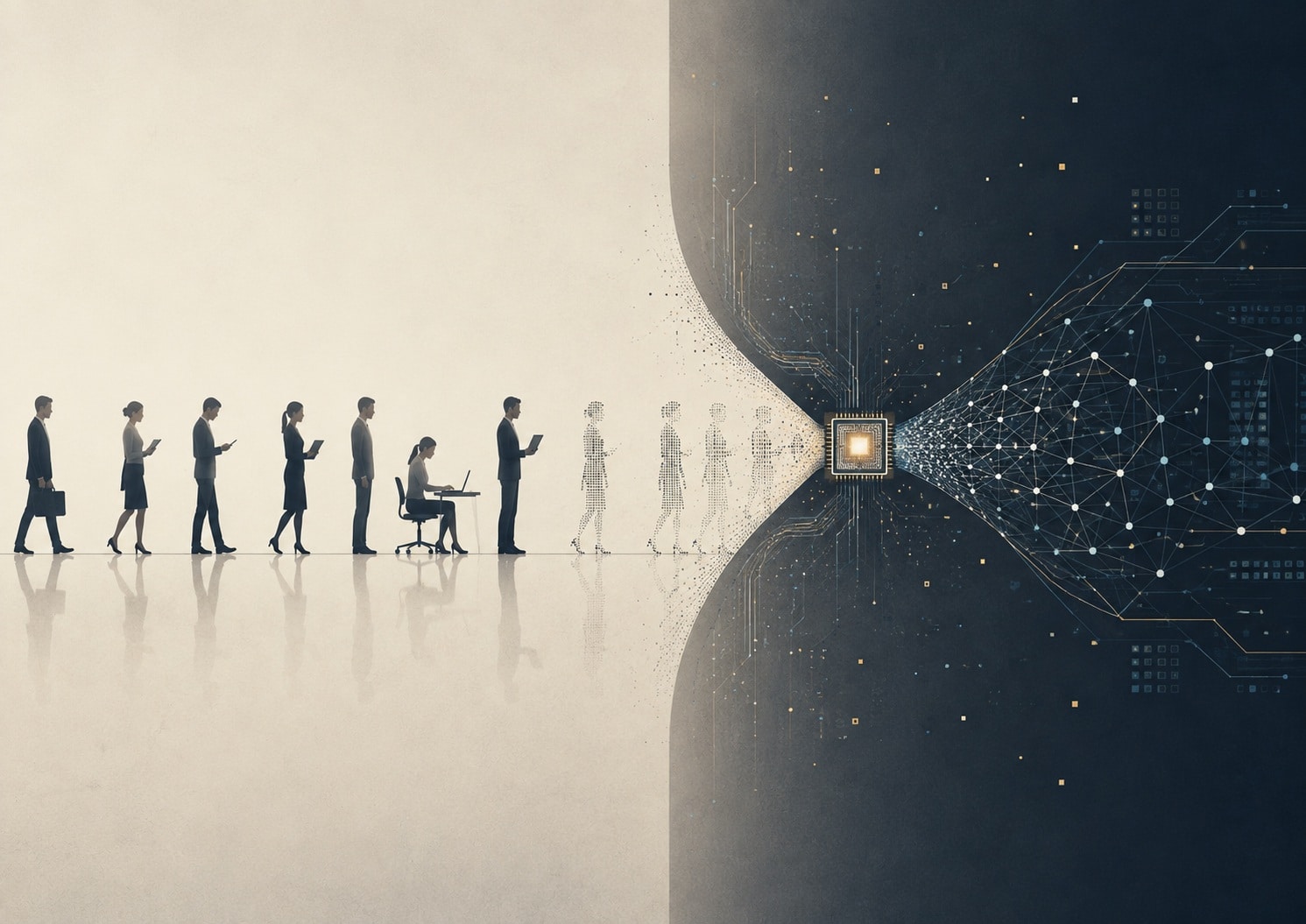
Pascual Restrepo, a Yale economist, believes that artificial intelligence is unlikely to sweep through the labour market and eliminate millions of jobs overnight. The strangest possibility is that machines can replace people before computing power is justified.
Restrepo has spent years researching automation and is a member of Anthropic‘s Economic Advisory Council. Anthropic appointed him to the council to advise on AI’s impact on employment, growth, and inequality.
In a recent interview with Russian economic outlet The Bell, Restrepo pushed back against both the notion that today’s AI will immediately demolish the labour market and the comforting assumption that work will simply continue as usual. His picture is more gradual at first, but it could become much more radical later on.
AI picks off tasks rather than entire professions
Restrepo sees a minor obstacle to mass unemployment: AI is good at some things but unreliable at others.
He anticipates localised shocks rather than widespread job losses in the short term. Jobs with automatable core functions may disappear. Occasionally AI can automate tedious peripheral tasks, increasing the productivity of the remaining employees.
«AI can provoke local shocks in the labour market,» Restrepo told The Bell. But for many occupations, he argued, it will initially take over routine tasks rather than the job itself.
Anthropic’s research this year found little evidence of increased unemployment in US occupations most exposed to AI, but younger workers entering some highly exposed professions saw slightly lower hiring.
Restrepo’s adoption description resembles Ernest Hemingway‘s bankruptcy formula: gradually, then suddenly. Individual companies will initially use AI selectively. While some industries will change significantly, others may barely notice. He thinks capable AI will spread throughout the economy.
Read more: Anthropic embeds invisible watermarks in Claude AI text output
AI could replace you — but decide you are not worth the chips
Restrepo contends that AI capabilities and practical economic utility are currently advancing faster than the supply of computing infrastructure required to support them. The result could be an economy in which intelligence is plentiful in theory but prohibitively expensive to deploy on a large scale.
Suppose, he says, that the same limited computing resources could be used by an AI system looking for a cancer cure or attempting to crack nuclear fusion. These applications could have far greater economic value than automating a single university professor.
In that world, it may still be cheaper to continue paying the professor.
Given limited computing capacity, he contends that society would hardly prioritise using it to replace an economist when a perfectly competent human economist is already available. Human workers may thus survive in many other jobs, not because machines cannot replace them, but because doing so would waste scarce computing resources.
Read more: Central Asia risks becoming a consumer, not creator, of AI – World Bank
Some jobs may survive
There is another reason why human work may refuse to go away: people can be sentimental. «Economic research,» joked Restrepo, when asked about professions likely to endure.
He said AI could become fully capable of writing novels, making films or producing other forms of art. But capability does not mean audiences will stop caring who made them.
People might still want to pay human actors to dance ballet, read books by living authors and watch films directed by humans. These jobs might continue to exist, not because AI creates less work, but because human authorship has cultural value.
«We will remain hopeless romantics,» is how Restrepo puts it.
The same reasoning applies to jobs that do not just produce an output but also interpret the world. As AI becomes more powerful, Restrepo expects a growing demand for people who can make sense of what it is up to, understand the social transformation around it and explain that change to everyone else.
Journalists, too, may discover themselves unusually useful; so may philosophers and economists. Professions where the core task is to «look at the world, understand it and point it out to others» may continue to be in strong demand, as people will still want explanations from other people.
It may be one of the sunniest career predictions a journalist will hear from an economist this decade.
The new capital may be compute
If computing power is the main bottleneck in an AI economy, Restrepo expects more wealth to flow to its suppliers or owners. Advanced AI would require more chips, data centres, electricity, and infrastructure to drive economic growth. Labour would lose relative importance.
Restrepo’s theory suggests that as computing resources drive growth, labour’s share of economic output could vanish. This is one of his counterintuitive points. People could earn more in absolute terms while receiving a smaller share of a much larger economy.
According to Restrepo, focusing solely on a worker’s nominal salary can be misleading. Extremely capable AI could make many goods and services much cheaper, allowing a lower wage to buy more. The uncomfortable question is less whether humans will still make money and more who captures AI’s extraordinary new wealth.
Read more: Oracle cuts 21,000 jobs as company accelerates AI expansion
What happens when jobs stop distributing the money?
Eventually, that becomes a political problem. In industrial societies, employment has served two purposes simultaneously. Work produces goods and services, but it also distributes income: most households receive their claim on the economy through wages.
Restrepo thinks very advanced AI could break that connection.
«It will probably be a world in which traditional work is no longer the main mechanism for distributing income,» he told The Bell.
Yet Restrepo is not particularly dystopian about the destination. If the transition goes well, he argues, future generations could access opportunities and material abundance far beyond what is available today. The difficult part is the transition between those two worlds.