
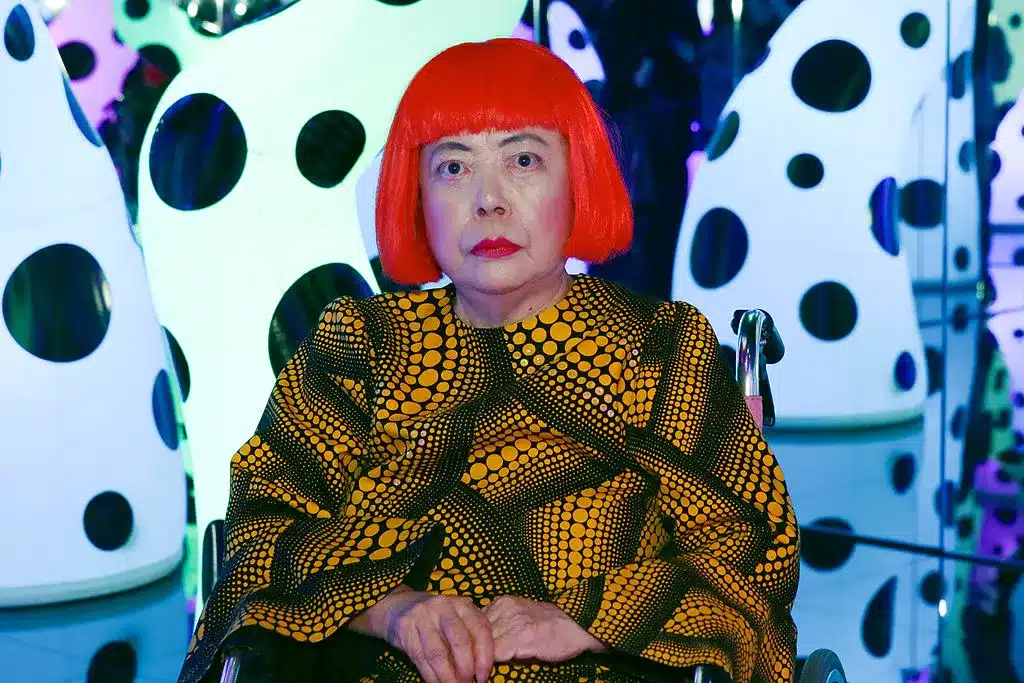
Japanese avant-garde artist Yayoi Kusama, whose polka dots, pumpkins and mirrored installations turned her into one of the world’s most recognisable contemporary artists, has died aged 97.
Kusama died at a hospital in Tokyo on 14 August, her company said in a statement released this Thursday. She continued creating art into her final years, maintaining a practice that spanned painting, sculpture, installation, performance, literature and design.
«Throughout an extraordinary lifetime devoted entirely to artistic creation,» Kusama pursued an internationally acclaimed career as a pioneering avant-garde artist, her company said.
Born in 1929 in Matsumoto, Nagano Prefecture, Kusama began experiencing vivid visual and auditory hallucinations as a child. She turned those experiences into recurring patterns of dots and nets that would eventually become the foundation of her artistic language.
From Japan to the New York avant-garde
Kusama moved to the United States in 1957, arriving in New York with hundreds of works and ambitions that clashed with the conventions of Japan’s art world.
She quickly established herself within New York’s experimental scene, producing large-scale monochromatic paintings, sculptures and installations. Her early Infinity Net paintings consisted of densely repeated marks that appeared to continue across the canvas without an obvious beginning or end.
Kusama had moved on from painting by the 1960s and was now working in sculpture, happenings, performance, and film. She covered furniture and other objects with repeated forms, and her public events challenged social conventions and addressed subjects such as sexuality, celebrity, and the Vietnam War. Museums later recognised her as a pioneering figure who crossed the boundaries between Pop Art, Minimalism and other avant-garde movements.
Her work also intersected with that of artists who would become major names in the American art scene. Kusama’s distinctive use of repetition and accumulation predated or paralleled developments associated with Minimalism and Pop Art, while her aggressive self-promotion helped her remain visible in a competitive New York scene.
The mirrored rooms that made Kusama a global phenomenon
Kusama’s most famous works emerged from her experiments with mirrors, light and repetition.
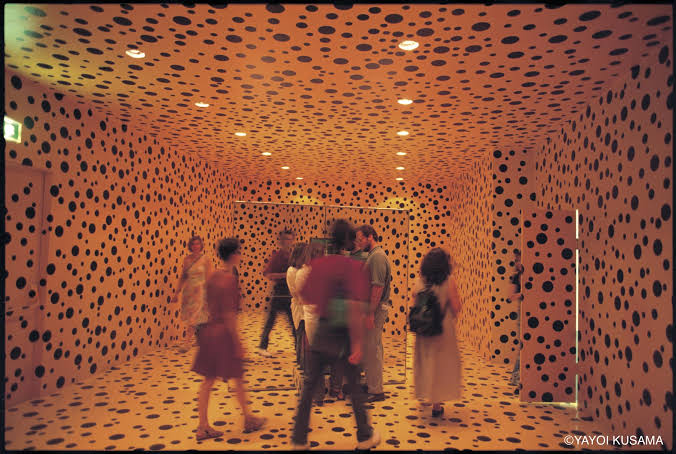
Her first Infinity Mirror Room, Phalli’s Field, was created in 1965. The installation used mirrors to multiply hundreds of soft sculptures covered in polka dots, creating an illusion of seemingly limitless space.
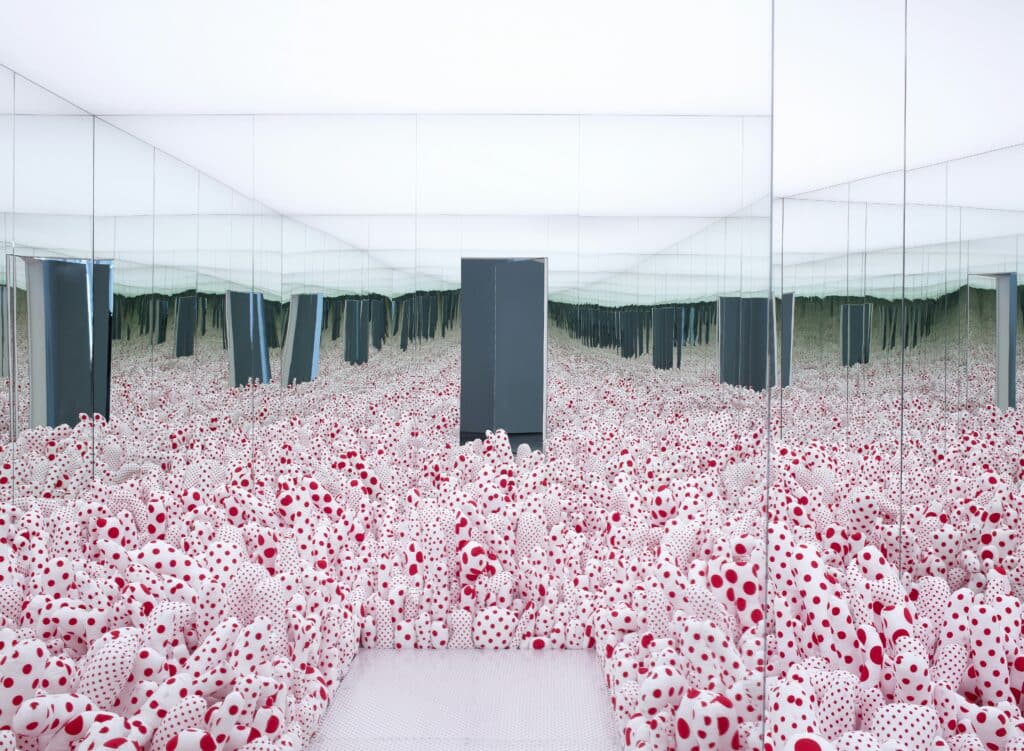
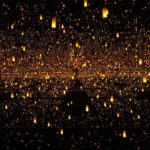
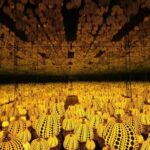
She returned to the concept repeatedly over subsequent decades, developing immersive environments in which visitors became part of the artwork. More than 20 Infinity Mirror Room installations have since been created, with the works becoming some of the most popular contemporary art experiences in major museums around the world.
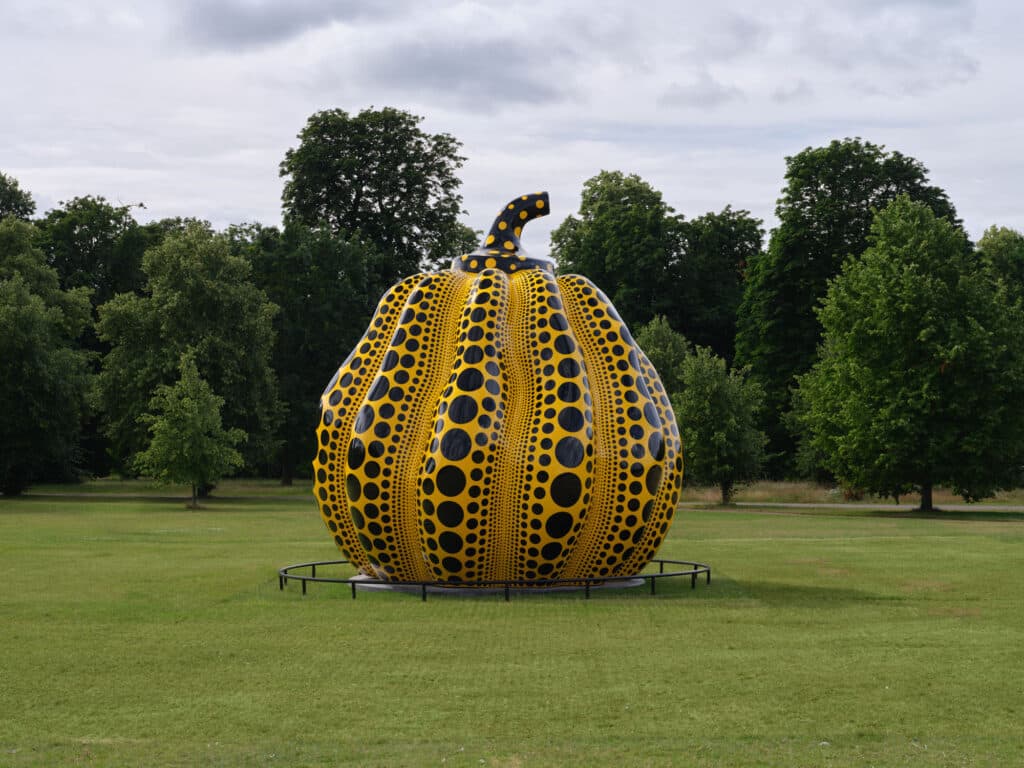
Her pumpkin sculptures became another defining motif. Brightly coloured pumpkins covered in contrasting dots combined the playful appearance that became synonymous with Kusama with her broader interest in repetition, infinity and the relationship between the individual and the surrounding world.
Her career eventually expanded into fashion and commercial collaborations, including a high-profile partnership with Louis Vuitton, bringing her visual language to audiences far beyond traditional galleries and museums.
A late-life rise to international fame
Kusama’s worldwide popularity grew dramatically later in her life. She had returned to Japan in 1973 and entered a psychiatric hospital in Tokyo several years later, where she continued to live while working from a nearby studio.
Her mental health was closely connected to her artistic practice. Kusama openly described using art as a way of confronting the hallucinations and obsessive thoughts she had experienced since childhood, transforming them into repeated dots, nets, lights and mirrored spaces.
The international art world began reassessing her work in the late 1980s and 1990s. In 1993, she represented Japan at the Venice Biennale, which marked a significant moment in her international recognition. Her exhibitions subsequently travelled to leading museums across Europe, North America, Asia and Australia.
Her output remained prolific well into old age. The My Eternal Soul series alone produced about 900 works between 2009 and 2021, while she began another painting series, EVERY DAY I PRAY FOR LOVE, in 2021.
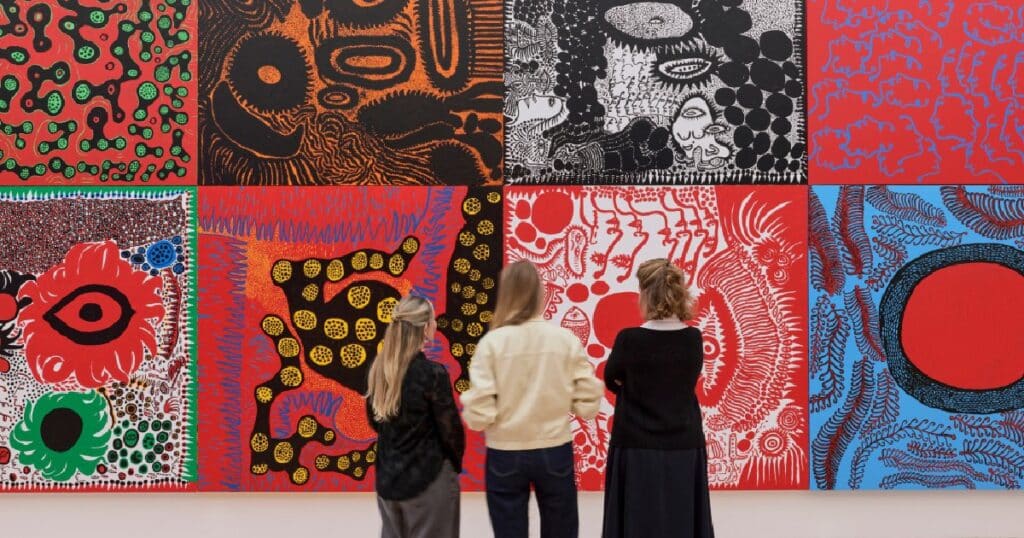
Kusama received Japan’s Order of Culture in 2016, one of the country’s highest honours for her contributions to culture. A museum dedicated to her work opened in Tokyo in 2017, further cementing her status in Japan’s cultural history.
Her work was held and exhibited by institutions including the Museum of Modern Art and the Whitney Museum of American Art in New York, Tate Modern in London and the Centre Pompidou in Paris.
Known publicly for her bright red wig and boldly patterned clothing, Kusama eventually became as recognisable as the visual language she had spent decades developing.
Her career transformed motifs born from private hallucinations and psychological distress into some of the most widely recognised images in contemporary art. She leaves behind a body of work that spans paintings, sculptures, mirrored environments, performances, films, novels and poetry and a visual style that has influenced generations of artists while reaching millions of people outside the traditional art world.