
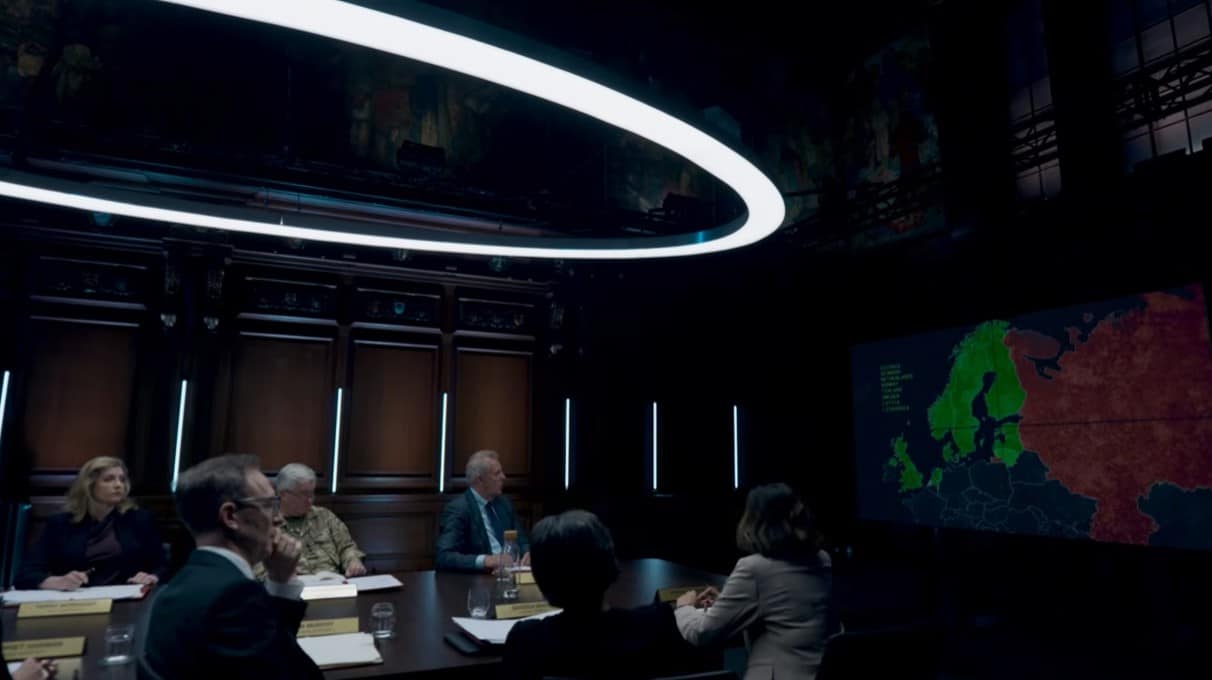
Sky News premiered The Wargame, a four-part experiment that imagines how Britain would respond to a major military conflict in Europe, on the International Day of Peace. It is the third recent production, following Finland’s Konflikti and France’s Jupiter, to investigate what happens when NATO deterrence and political (mis)judgement are put to an ultimate test.
None of the three is a prediction, but together they reflect a real shift in European public debate: governments are talking more openly about defence readiness, hybrid threats, the reliability of alliances and what greater European responsibility for security might actually mean.
The Wargame: Britain in crisis room
Sky’s The Wargame imagines a crisis six months from now in which Britain faces a rapidly escalating security emergency linked to Russia. A fictional government gathers in a COBR-style room and has to respond to intelligence updates, cyber disruption, military developments and uncertainty over how far events will go.
The cast serves as the biggest hook, with Michael Gove as the British prime minister, Nicola Sturgeon as his deputy and Penny Mordaunt as defence secretary, alongside former officials and top army brass.
The cast gives the show the feel of a live policy exercise rather than a conventional thriller.
The similarity to present-day events is less about any one plot point than the atmosphere: questions around cyberattacks, sabotage, drones and whether European states could react quickly enough in a crisis are already part of mainstream security debate. The programme takes those concerns to a deliberately worst case scenario.
Read also: Trump offers Ukraine licence to produce Patriot missiles
Jupiter: France reaches nuclear threshold
Alexandre Smia’s French thriller Jupiter sees a newly elected president rushed to an underground command bunker after blame for an assassination attempt on the Russian president is pinned on Ukraine. The situation quickly escalates to the brink of a nuclear conflict.
Political responsibility, not nuclear weapons, is its focus. The film asks what happens if Europe has to pay more for defence as US involvement decreases. In Jupiter, France and Britain matter as Europe’s nuclear powers, not junior NATO partners.
Europe’s leaders are already debating strategic autonomy, defence spending, and how much of their security architecture can depend on Washington, making this theme unusually relevant. Jupiter illustrates this point most clearly.
In case you missed it: ‘Minotaur’: Creepy call-up bureaucracy behind France’s Oscar pitch
Konflikti: war without starting gun
Finland’s Konflikti (Conflicts) begin more quietly. Unidentified forces seize a small coastal town during Midsummer, trapping thousands of civilians and leaving the country’s political leadership off-guard.
The series then expands with cyber operations, disinformation, political pressure, and military action. Its most effective idea is that a modern conflict may begin ambiguously enough for governments to debate what is going on before deciding how to respond.
That is also why Konflikti resonates with current European security concerns. Officials are increasingly discussing hybrid threats and grey-zone tactics because they can blur the distinction between peace, coercion, and open conflict.
The big picture: French, German and UK envoys meet Russian officials amid ceasefire push
On the International Day of Peace, celebrated on 21 September, the three films make for unusually sombre viewing — but they also provide a revealing snapshot of what Europe is currently worrying about.