Rain threatens Sepang F1 weekend as tyre degradation adds uncertainty

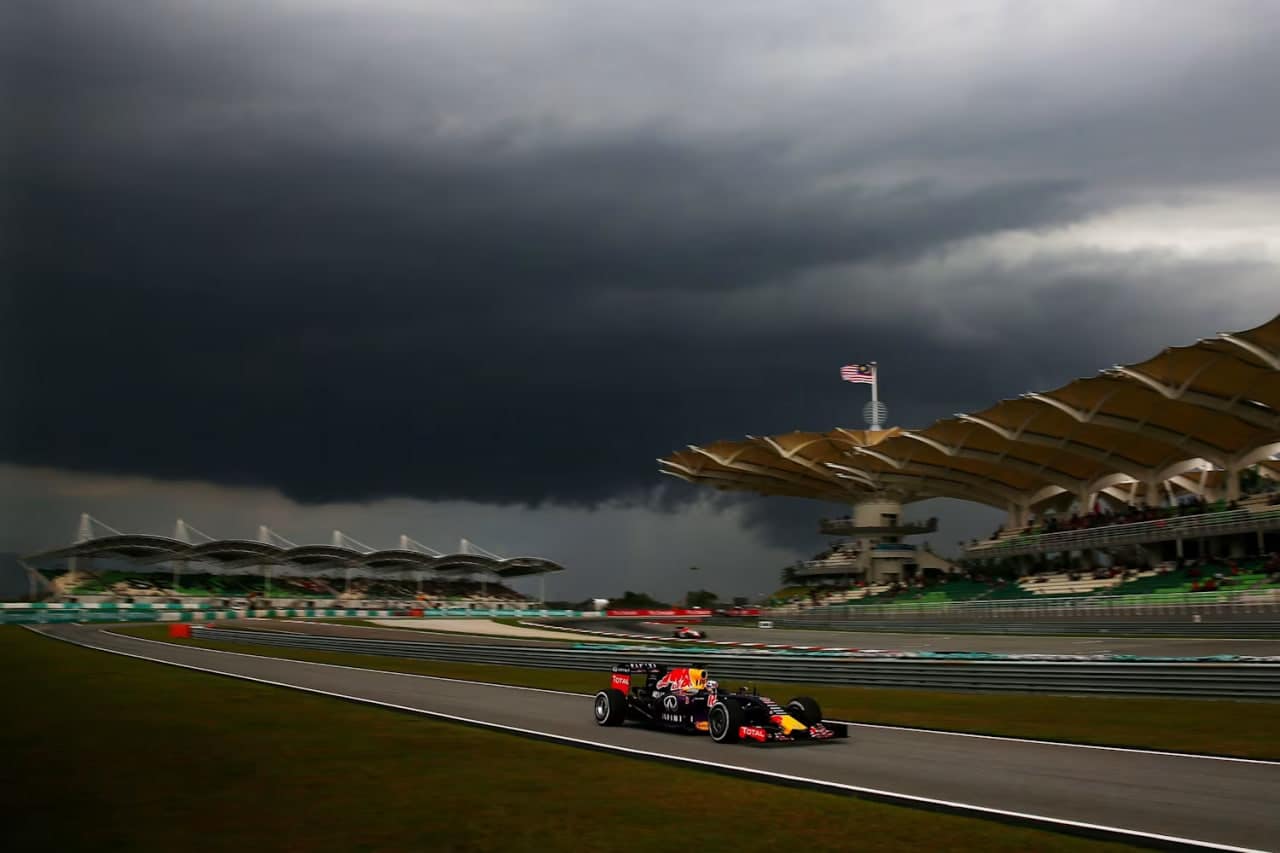
Formula 1’s return to Sepang could turn into a wet-weather test, with rain threatening the second practice session on Friday and remaining a possibility throughout the Bahrain Grand Prix weekend in Malaysia.
FP1 was completed on a dry but dusty circuit, with Max Verstappen setting the pace in a 1:37.520, 0.383 seconds ahead of Mercedes driver George Russell. Isack Hadjar was third for Red Bull, followed by Ferrari’s Charles Leclerc.
Conditions could change quickly before FP2, which starts at 4pm local time.
The AccuWeather forecast shows a 70% probability of rain around 4pm on Friday, exactly when FP2 begins. The wider Friday forecast puts the probability of precipitation at 90%, with around 3.1mm of rain possible during the day. Sepang Formula 1’s own pre-weekend forecast was somewhat less pessimistic, putting Friday’s overall chance of rain at 50%.
The uncertainty does not disappear after Friday. The forecast shows a risk of thunderstorms on Saturday afternoon, while showers and thunderstorms are also possible around the time of Sunday’s 3pm race. Sepang F1’s forecast currently gives Saturday a 40% rain chance and Sunday 30%.
Sepang’s abrasive asphalt
Even without rain, tyres have emerged as one of the weekend’s biggest variables.
Sepang’s asphalt is particularly abrasive and has not been resurfaced since Formula 1 last raced at the circuit in 2017. Pirelli has brought the C2, C3 and C4 compounds as the hard, medium and soft, respectively. The supplier deliberately avoided the hardest possible selection in an attempt to keep both one-stop and two-stop strategies viable.
All the necessary information you need to know about the SEPANG CIRCUIT. pic.twitter.com/nvwqNMaW4J
— Formula One (@F1Cox256) October 2, 2026
Drivers were already experiencing significant degradation in FP1. Mercedes struggled with tyre wear, particularly around Turn 4, while Ferrari encountered similar problems.
The problem was anticipated before cars even went onto the track. Oscar Piastri described the surface as being similar to «sandpaper», while F1 reported that two or even three stops could become realistic if degradation remains high.
Heat adds another factor. Track temperatures could approach 54C on Friday and Saturday if conditions remain dry, potentially increasing thermal degradation. A shower, however, could dramatically reduce temperatures and erase accumulated rubber from the racing line, resetting grip levels between sessions.
Drivers interested in seeing rain
For the current generation of F1 cars, a wet Sepang would also provide something teams have had little opportunity to study this season.
Championship leader Kimi Antonelli said on Thursday that he would welcome some wet running because drivers have accumulated relatively little experience with the 2026 cars and wet-weather tyres.
🌧️ SEPANG IS ALREADY GETTING WET 🇲🇾
— F1Knight (@F1KNIGHT_) October 1, 2026
Heavy rain and thunderstorms are hitting the area one day before FP1.
And F1 has almost no current-gen data here.
FP1 currently has a 56% rain chance.
Could the first test of these cars at Sepang come in the wet? #F1 #Sepang #MalaysianGP pic.twitter.com/lEArWfTaz6
Antonelli believes Sepang could be particularly suitable. Its unusually open and rough asphalt allows water to drain into the surface rather than remaining entirely on top, potentially reducing standing water and the risk of aquaplaning unless the rainfall becomes exceptionally heavy.
George Russell has also played down the additional complication presented by Malaysia’s current haze, noting that every driver faces the same conditions.
The combination nevertheless creates an unusual environmental backdrop. Malaysia has been affected by transboundary haze linked to fires in Sumatra and Kalimantan. Malaysia’s Department of Environment said more than 500 hotspots had been detected across the two Indonesian regions, with smoke reaching parts of Peninsular Malaysia.
Air quality had improved by Thursday, but several areas in and around the Klang Valley were still recording unhealthy Air Pollutant Index readings.
Sepang’s last wet race
The last Malaysian Grand Prix at Sepang, significantly affected by rain, was in 2012, rather than the circuit’s final F1 race in 2017. Heavy rain intensified shortly after the start, prompting drivers to switch to full wet tyres before the Safety Car was deployed. The race was then red-flagged after nine laps and stopped for roughly 50 minutes before restarting.
Fernando Alonso eventually won for Ferrari after a tense battle with Sauber’s Sergio Perez, who finished second. The 2017 Malaysian Grand Prix, by contrast, was raced in dry conditions and was won by Verstappen, although rain had affected practice earlier in that weekend.