Bypassing Russia: Rhenus plans 14 cargo terminals to link Central Asia with Europe

Rhenus, a German logistics company, plans to build a network of 14 goods terminals that will connect Uzbekistan and its neighbours to Europe via a route that avoids Russia. The investment aims to make the Middle Corridor a more reliable option for businesses transporting goods across Eurasia.
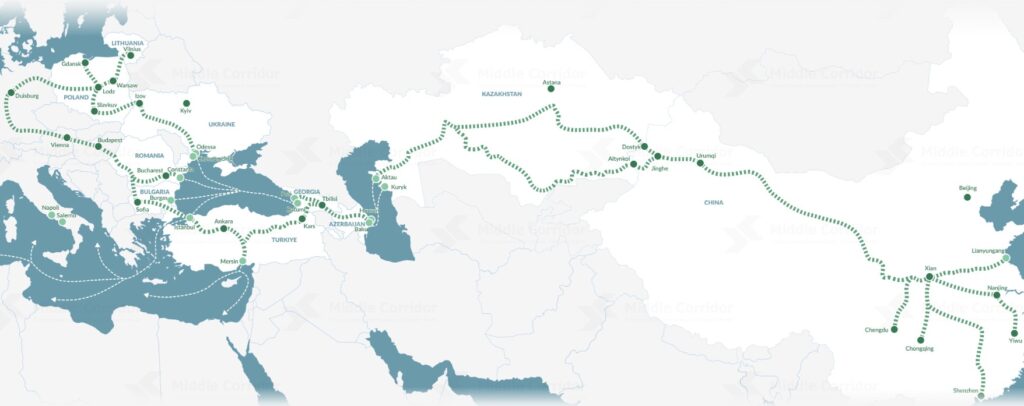
Chief executive Tobias Bartz told Euronews that the terminals in question would extend from Uzbekistan through Kazakhstan and Azerbaijan to Türkiye before connecting with the company’s European network.
Rhenus already has 23 container terminals and around 70 port facilities across Europe. The company has separately committed €11 million to upgrade its Andijan terminal, in partnership with Uzbekistan’s state railway network.
The three-stage overhaul aims to expand road-to-rail freight handling and introduce additional warehousing services. After the first stage, annual handling capacity is expected to reach about 200,000 TEU.
Read more: Uzbekistan’s logistics ambitions: Integrating into trans-Eurasian corridors
Bringing Middle Corridor together
The Middle Corridor combines rail, road and sea transport through Central Asia, across the Caspian and through the South Caucasus to Europe. For Uzbekistan, it offers another way to reach overseas customers without relying on northern routes through Russia.
A central project is a new container terminal at Kazakhstan’s Caspian port of Aktau, which is being developed with the port and national railway company Kazakhstan Temir Zholy.
Read more: Uzbekistan and Georgia aim for $1bn trade target with new economic roadmap
According to Rhenus’s announcement from 30 September the planned facility would connect ships, trains and trucks on a site covering at least 30 hectares. It is designed to add an annual handling capacity of at least 150,000 TEU — a standard measure equivalent to 150,000 twenty-foot containers.
Read more: UAE joins Uzbekistan’s railway push for access to Pakistani ports
The project remains in preparation, and its next steps include assessing cargo flows and technical and economic feasibility. Bartz said the challenge was to bring individual infrastructure projects together into an efficient network.