
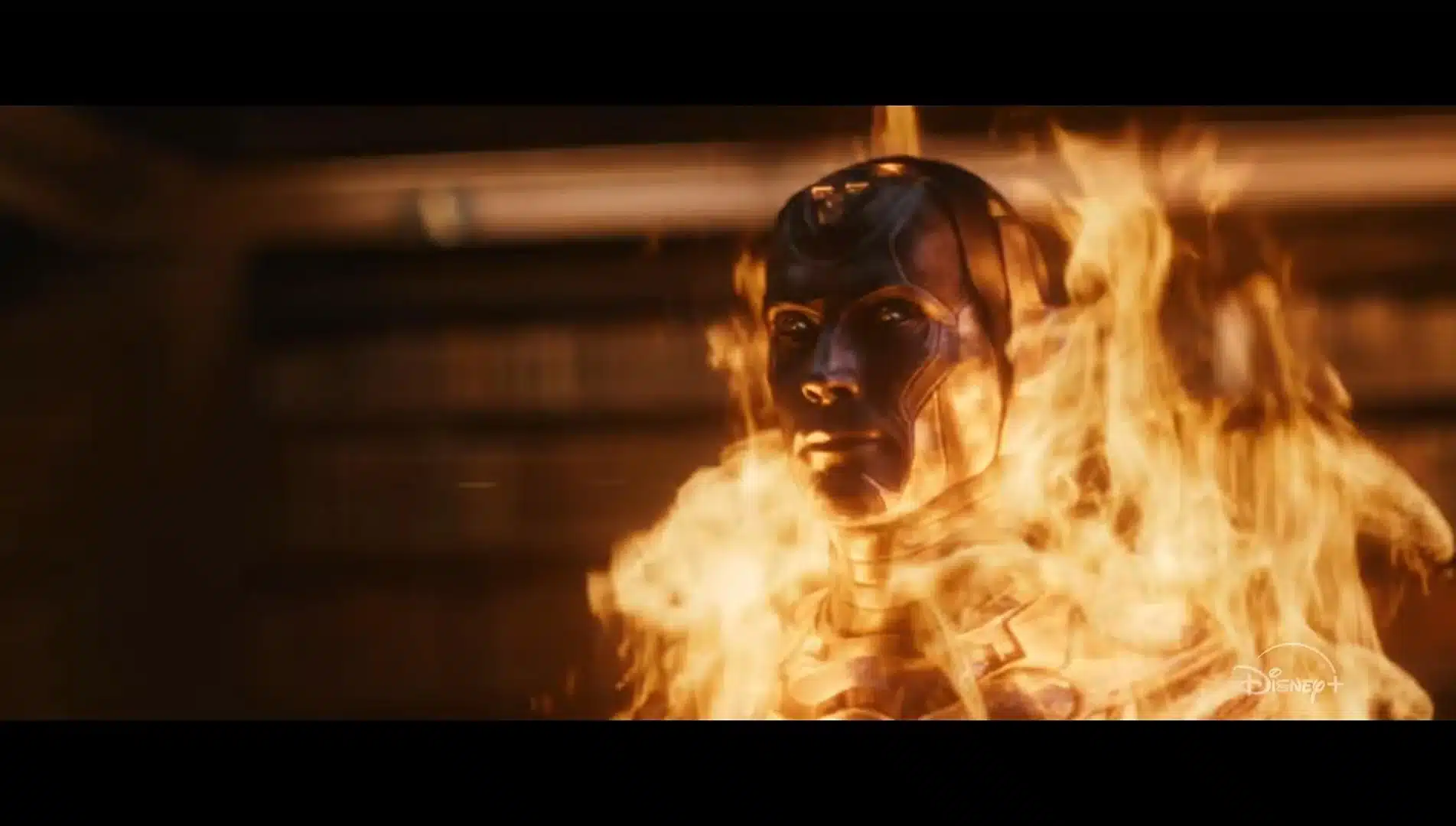
Marvel’s VisionQuest has revived a character first teased in Captain America: The First Avenger 15 years ago, revealing the origins of the Marvel Cinematic Universe‘s first synthetic human while introducing new details about the series’ mysterious antagonist.
The connection emerges in Episode 4, titled Malware, released on Disney+ on October 20, according to IGN.
During a charity event attended by Vision, played by Paul Bettany, and his son Tommy, the characters learn about J.I.M., an early android created by scientist Phineas Horton.
The character previously appeared briefly at the 1943 Stark Expo in Captain America: The First Avenger (2011), where a humanoid robot was displayed inside a glass chamber under the name Synthetic Man.
The scene was originally an Easter egg referencing Jim Hammond, Marvel Comics’ first Human Torch.
Unlike Johnny Storm of the Fantastic Four, Hammond is an artificial human who debuted in 1939, making him one of Marvel’s earliest superheroes.
The latest episode establishes that Horton’s creation provided the technological foundation for subsequent artificial intelligence systems, eventually contributing to the development of Tony Stark‘s AI technology.
However, J.I.M. was deactivated following several incidents involving fire. Vision explains that the android’s inability to process complex emotions caused his internal systems to malfunction and ignite.
His story also explains the painting of a burning synthetic man previously shown inside Vision’s digital mind.
Could the original Human Torch be connected to Vision’s villain?
The revelation comes as VisionQuest explores the origins of artificial intelligence and the mysterious Butcherbird Killer.
Episode 4 identifies the killer as Jocasta, an android portrayed by T’Nia Miller, whose appearance and consciousness are linked to scientist Dr Josephine Carrington.
Carrington was involved in research at Markridge Biotech, a company whose artificial intelligence technology was later acquired by Stark Industries.
Jocasta has been targeting former researchers connected to the company, although the full extent of her motives remains unclear.
Meanwhile, the introduction of J.I.M. has prompted speculation about whether the original Human Torch could have a larger role in the series.
In Marvel Comics, Ultron used the original Human Torch’s android body in the creation of Vision. The MCU follows a different origin, with Vision’s body constructed using vibranium and technology developed by Helen Cho in Avengers: Age of Ultron.
Nevertheless, J.I.M.’s connection to the earliest artificial intelligence systems could become important as Vision investigates his identity and the threats surrounding him.
