Uzbekistan cuts poverty, but 85% of new jobs are informal

Around one in five people in Uzbekistan remains vulnerable to poverty, despite a sharp fall in the national rate, the World Bank warned in a recent report. Access to better work could determine how long that progress lasts, it noted.
The World Bank’s brief, as of October 2026, has put the national poverty level at 5.8% in 2025, down from 8.9% a year earlier. Higher wages and employment were among the drivers behind the decline.
Elsewhere across Central Asia, poverty stood at 4.9% in Kazakhstan, 24% in Kyrgyzstan in 2025, and 19.8% in Tajikistan in 2024.
Back in Uzbekistan, about 2.1 million people found themselves below the country’s national poverty line last year. At the World Bank’s higher $8.30 daily benchmark, the count was 4.6 million, or 12.4%.
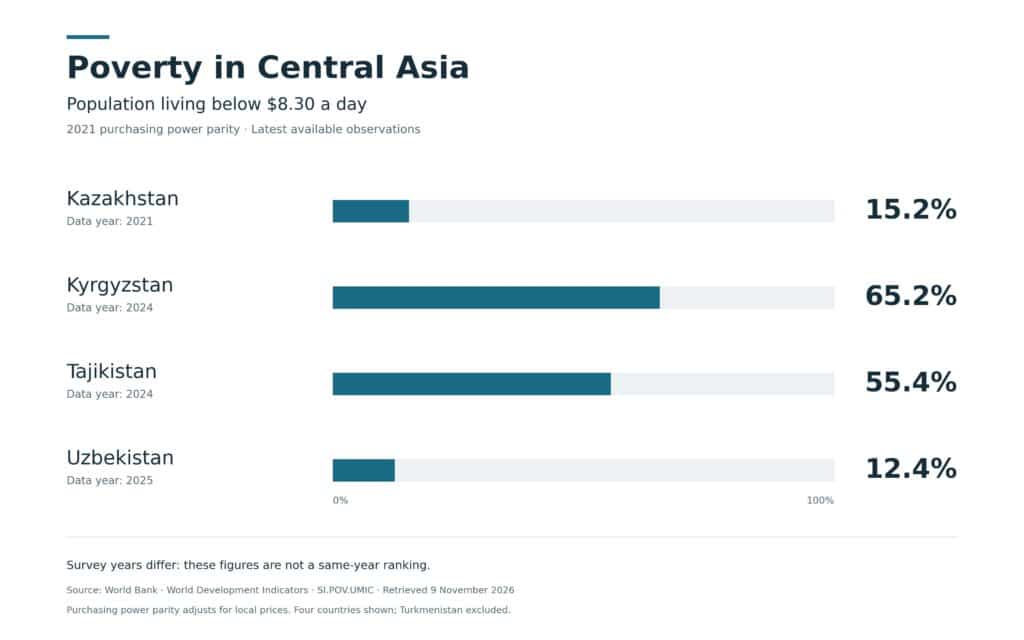
The benchmark reflects poverty standards typical of upper-middle-income economies, adjusts for differences in purchasing power, and is not simply $8.30 converted into soums at the current exchange rate.
The side story: New data highlights NEET crisis among Uzbekistan youth population
Informal employment
According to the World Bank’s wider Poverty and Equity Assessment, about 85% of new jobs created in Uzbekistan were informal, with two-thirds in construction and trade.
Net employment increased by roughly 670,000 people in 2025. Yet many new roles involved low-productivity activities, while better opportunities clustered around Tashkent.
Tashkent and its surrounding region accounted for half of all high-skilled jobs. According to the findings, location plays a significant role in obtaining better employment opportunities.
Women and families struggle harder
Women face additional hurdles when trying to enter the country’s tight labour market. Only 39% of Uzbek females aged 15 to 64 were employed in 2025, compared to 78% of men. The Bank advocated for affordable childcare and training that leads to higher-paying jobs.
The gains have nevertheless reached the bottom of the income distribution. Real household income grew by 26% among the poorest fifth during 2024–25, against 13% among the richest fifth.
Read more: Money transfers to Uzbekistan rise as inflows pass $15bn
Meanwhile, coverage of the Low Income Family Allowance fell from 26% of households in 2022 to 8% in 2025, and the World Bank warned that many vulnerable families lack a safety net.
