Uzbekistan’s external debt hits $88bn. Why do official totals differ?

Uzbekistan’s foreign debt increased by almost a quarter in 2025, with private borrowers accounting for nearly half of the increase. Their liabilities increased faster than public and state-backed debt, according to updated World Bank data.
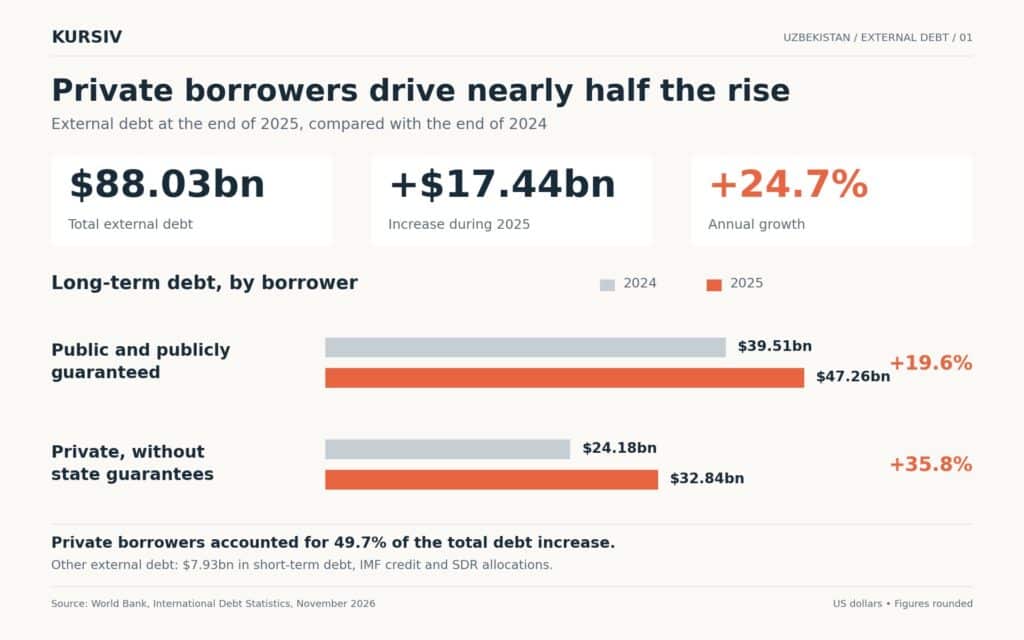
The bank’s International Debt Statistics, actualised in November, put total external debt at $88.03bn at the end of 2025, up from $70.59bn a year earlier — an increase of $17.44bn, or 24.7%.
Long-term private debt without government guarantees climbed by 35.8% to $32.84bn. That $8.66bn increase accounted for just under half the overall rise, calculations from the World Bank’s borrower breakdown show.
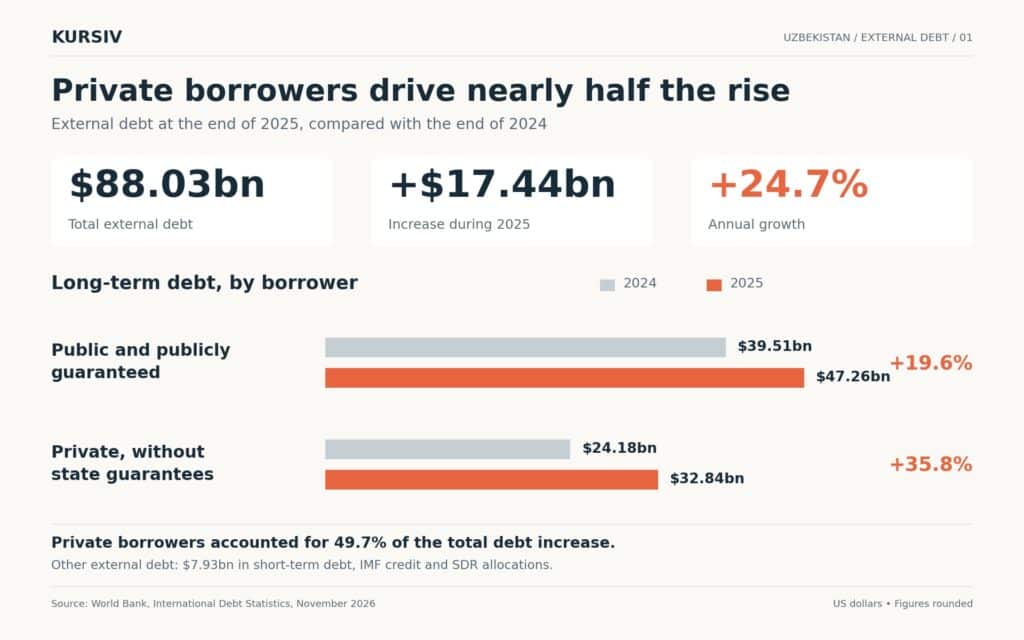
External debt covers money owed to overseas lenders across the economy, including government, banks and businesses. Within the World Bank total, public and publicly guaranteed long-term debt reached $47.26bn, up 19.6%. Private borrowing without guarantees leaves repayment with the borrowers.
Up close: Uzbekistan’s public debt rises to 27% of projected GDP
Interest costs rise
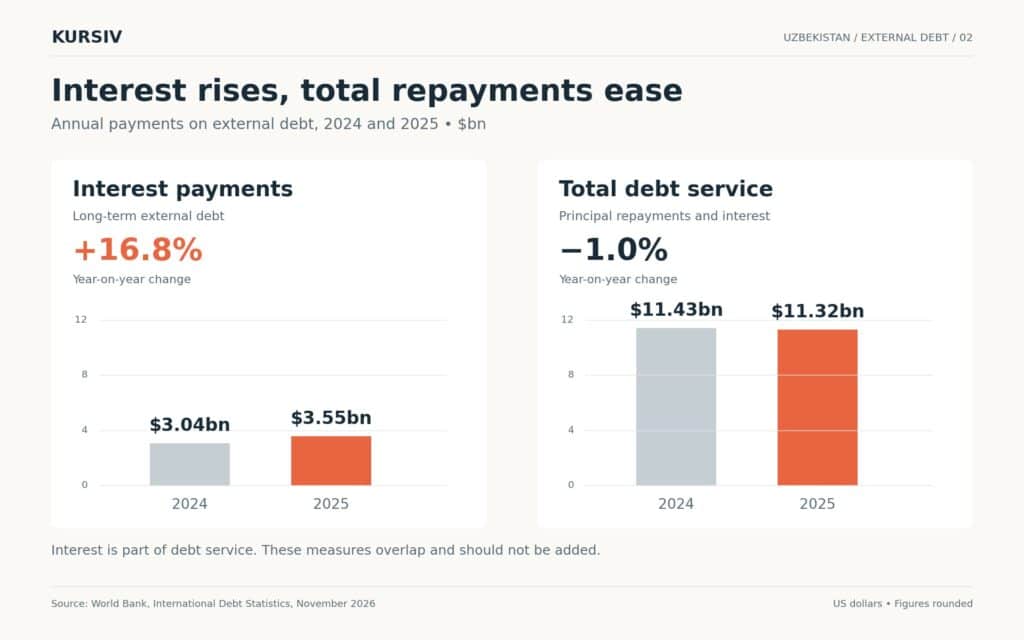
Interest payments on long-term external debt increased to $3.55bn in 2025, from $3.04bn in 2024. Total debt-service payments, which also include principal repayments, nevertheless edged down to $11.32bn from $11.43bn. The larger outstanding debt therefore came with a higher interest bill, although less money was paid out overall during the year.
Foreign borrowing also exposes businesses to exchange-rate risk, especially when their revenues are primarily in soums.
In an earlier interview with Kursiv Uzbekistan, Fitch analyst Pavel Kaptel highlighted foreign-currency lending to companies with limited export earnings and their limited access to protection against currency movements as vulnerabilities if the soum weakens.
Read more: Uzbek banks face profit squeeze as credit risks surface
Official totals differ
There is a substantial gap between the World Bank’s total and Uzbekistan’s domestic statistics. Previously, the Central Bank put external debt at $82.2bn for the same end-2025 date — about $5.8bn below the World Bank readings. The difference remains unexplained in the publications.
According to the Central Bank’s own estimates, external debt subsequently reached $84.1bn on 1 July 2026, comprising $41.7bn in state debt and $42.4bn in corporate debt. The bank says companies and banks are responsible for servicing corporate borrowing without government guarantees from their own resources.
In 2026, the International Monetary Fund (IMF) continued to classify Uzbekistan as being at low risk of debt distress. It nevertheless called for stronger oversight of risks arising from state-owned enterprises and public-private partnerships.
