
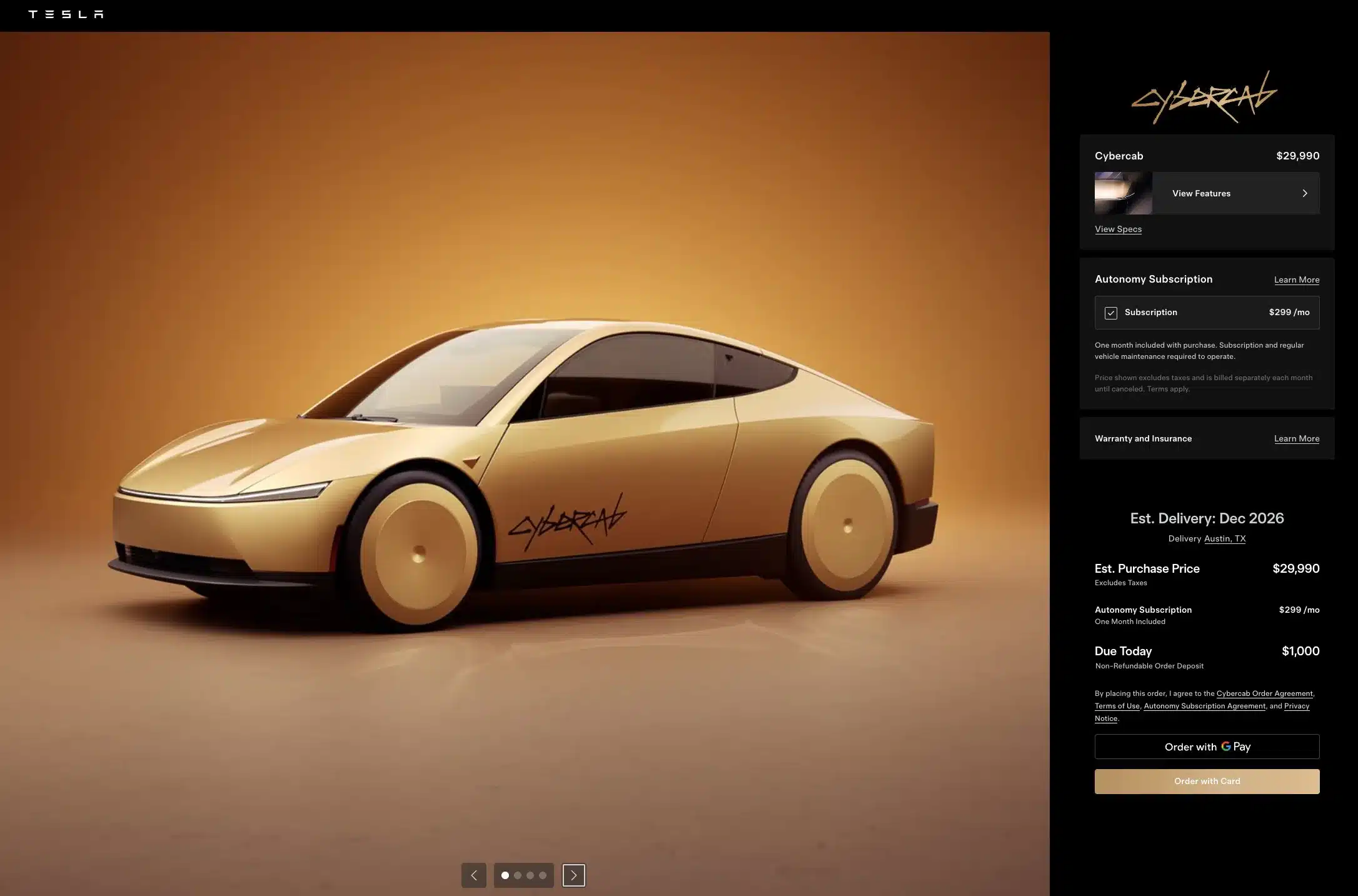
Tesla has started accepting orders for its Cybercab, offering selected US customers the chance to own its fully autonomous electric vehicle for $29,990. However, buyers must also pay $299 every month to use it, Digital Trends reports.
The company announced the invitation-only sales programme on November 13. Customers must pay a non-refundable $1,000 deposit, with the first deliveries expected in December 2026.
Unlike ordinary Teslas, the Cybercab has no steering wheel or pedals. Its two-seat cabin is designed entirely around self-driving technology, meaning owners cannot take manual control if the software becomes unavailable.
How much does owning a Tesla Cybercab really cost?
The advertised $29,990 price covers the vehicle itself, but operating it requires Tesla’s Autonomy Subscription.
At $299 per month, the service costs $3,588 annually. With the first month included, buyers would spend approximately $33,279 during their first year, excluding taxes, insurance and other expenses.
Cancelling the subscription would leave the Cybercab unable to operate on public roads.
Even Tesla CEO Elon Musk believes the monthly charge is excessive.
«But the monthly fee is too high. Should match the cost of Tesla FSD and connectivity for other models, which is more like ~$115/month,» Musk wrote on X.
@MKBHD It will be available nationwide, as we receive regulatory approval. But the monthly fee is too high. Should match the cost of Tesla FSD and connectivity for other models, which is more like ~$115/month.
— Elon Musk (@elonmusk) November 14, 2026
Where can Cybercab owners actually travel?
For now, customers can only arrange deliveries in five Texas cities: Austin, Dallas, Houston, San Antonio and Fort Worth. Purchases are limited to one vehicle per person.
The biggest restriction concerns where the car can operate.
Cybercab owners will be confined to areas approved for Tesla’s Robotaxi service. These geographical boundaries, known as geofences, mean buyers cannot simply programme a destination anywhere in the country and expect the vehicle to take them there.
There is another limitation: owners cannot use their Cybercabs to earn money through ride-hailing, rentals or delivery services without Tesla’s permission.
That rules out joining Tesla’s Robotaxi network for now, even though the vehicle was originally developed for autonomous passenger transport.
Musk said the Cybercab would eventually become available throughout the United States once regulatory approvals are secured. He did not provide a timeline.
The company also faces questions about whether the vehicle complies with federal safety standards, particularly because it lacks conventional driving controls.
The limited launch comes after Tesla began Cybercab production earlier this year. Musk has previously indicated that most vehicles would remain under Tesla’s ownership for its commercial Robotaxi operations.
