
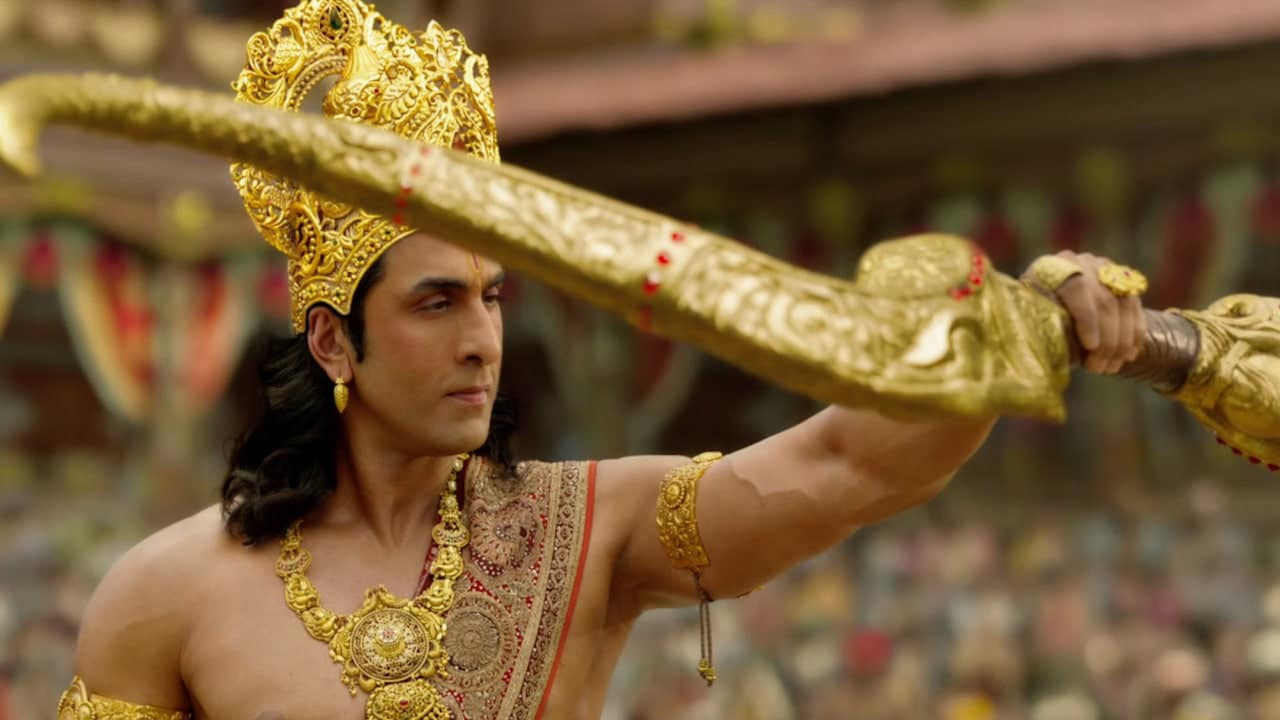
Ranbir Kapoor’s «Ramayana: Rise of a Legend» overtook the lifetime worldwide earnings of RRR after just 11 days in cinemas, collecting 1,384.5 crore rupees ($147.1 mn), according to Sacnilk.
The film, directed by Nitesh Tiwari, earned 75 crore rupees ($8 mn) in India on Sunday, November 15, bringing its domestic net collection to 760.6 crore rupees ($80.8 mn). The weekend total reached 196 crore rupees ($20.8 mn).
Its latest worldwide figure puts it ahead of RRR, the 2022 blockbuster directed by S. S. Rajamouli, which earned approximately 1,230 crore rupees ($130.7 mn) globally.
The film is now just 15.5 crore rupees ($1.6 million) away from reaching the 1,400-crore milestone.
How much has Ramayana earned in India and overseas?
India remains the film’s biggest market, accounting for 909 crore rupees ($96.6 mn) in gross ticket sales. International audiences have contributed another 475.5 crore rupees ($50.5 mn), or roughly 34% of the worldwide total.
The Hindi-language version has been particularly successful, earning 582.25 crore rupees ($61.9 million) net in India.
However, the film has also attracted audiences in other languages. The Kannada version has collected 63.1 crore rupees ($6.7 mn), followed by Telugu at 49.4 crore rupees ($5.2 mn), Tamil at 34.4 crore rupees ($3.7 mn) and Malayalam at 31.45 crore rupees ($3.3 mn).
Sunday’s domestic earnings rose slightly from Saturday’s 72.9 crore rupees ($7.7mn).
When will Part 2 be released?
Released on November 5, «Ramayana: Rise of a Legend» is the first instalment of a planned adaptation of the ancient Indian epic attributed to Valmiki.
The film stars Ranbir Kapoor as Rama, Sai Pallavi as Sita and Yash as Ravana, with Sunny Deol portraying Hanuman.
Its story follows Rama, a prince of Ayodhya, whose life changes after his exile and the abduction of his wife by Ravana.
The film was produced by Namit Malhotra‘s Prime Focus Studios in collaboration with DNEG and Yash’s Monster Mind Creations. Producer Namit Malhotra has confirmed that Ramayana Part 2 is scheduled for Diwali 2028, a year later than initially planned.
