Uzbekistan’s GDP turns out to be bigger than thought, and here is why


Uzbekistan has added $22bn to its estimate of what the economy produced in 2025. The growth rate moved by just a tenth of a percentage point.
The National Statistics Committee estimated GDP for 2025 at $169bn compared with $147bn in figures presented on November 13. At current prices, the estimate increased by 277.1 trillion soums or 15% to 2,126.8 trillion soums. The revision for real growth, which excludes price changes, was to 7.8% from 7.7%.
More than half the increase was due to updated business reports. The rest was drawn from the population and agricultural censuses, which gave officials a better count of the nation’s homes and farmland.
The committee ran the annual and quarterly numbers back to 2017. The revisions raised the measured size of the economy over those years, so they altered the pace of growth much less. For example, nominal GDP was revised up 14.3% in 2024, but real growth was 6.7%.
Read more: 2026 Census results: Uzbekistan’s population reaches 39 million
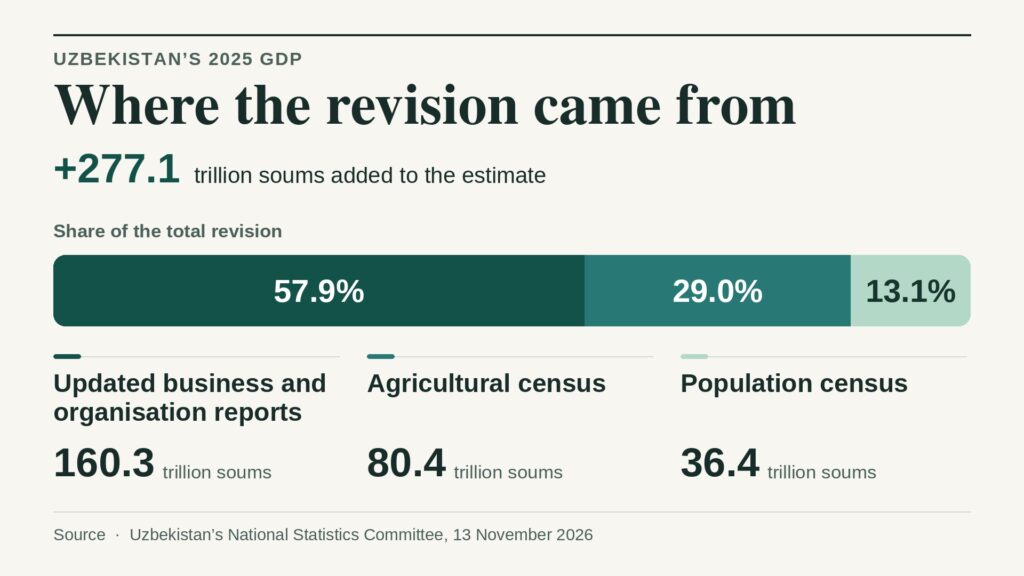
Where the extra GDP came from
Trade was one of the most significant changes. New reporting forms let statisticians calculate retailers’ and wholesalers’ margins from sales, the cost of goods and changes in stock. The estimated value of trade services rose by 56.8% to 260.1 trillion soums.
Farming also looked different after the census. It identified about 985,000 hectares missing from earlier records, including cropland, orchards and vineyards. The revised figures put grain output 8.6% higher and the number of cattle almost 2.3 million lower.
Read more: Uzbekistan’s GDP Grows 7.6% in First Nine Months of 2025
Housing helps explain how a census can change GDP. The count put Uzbekistan’s residential floor space at just over 1bn square metres, which is 41% above the previous estimate. GDP includes an estimated rental value for homes people own and live in. With a larger housing stock, that figure rose from 83.9 trillion to 112.5 trillion soums.
What changed on paper
GDP per person for 2025 was revised from about $3,881 to $4,373, even after officials raised the year’s average population estimate from 37.9m to 38.7m.
A bigger GDP also changes how large the same debt looks. The finance ministry’s 2025 table puts year-end public debt of $46.85bn at 31.9% of GDP. Dividing that same debt total by the revised $169bn estimate gives about 27.7%.
