
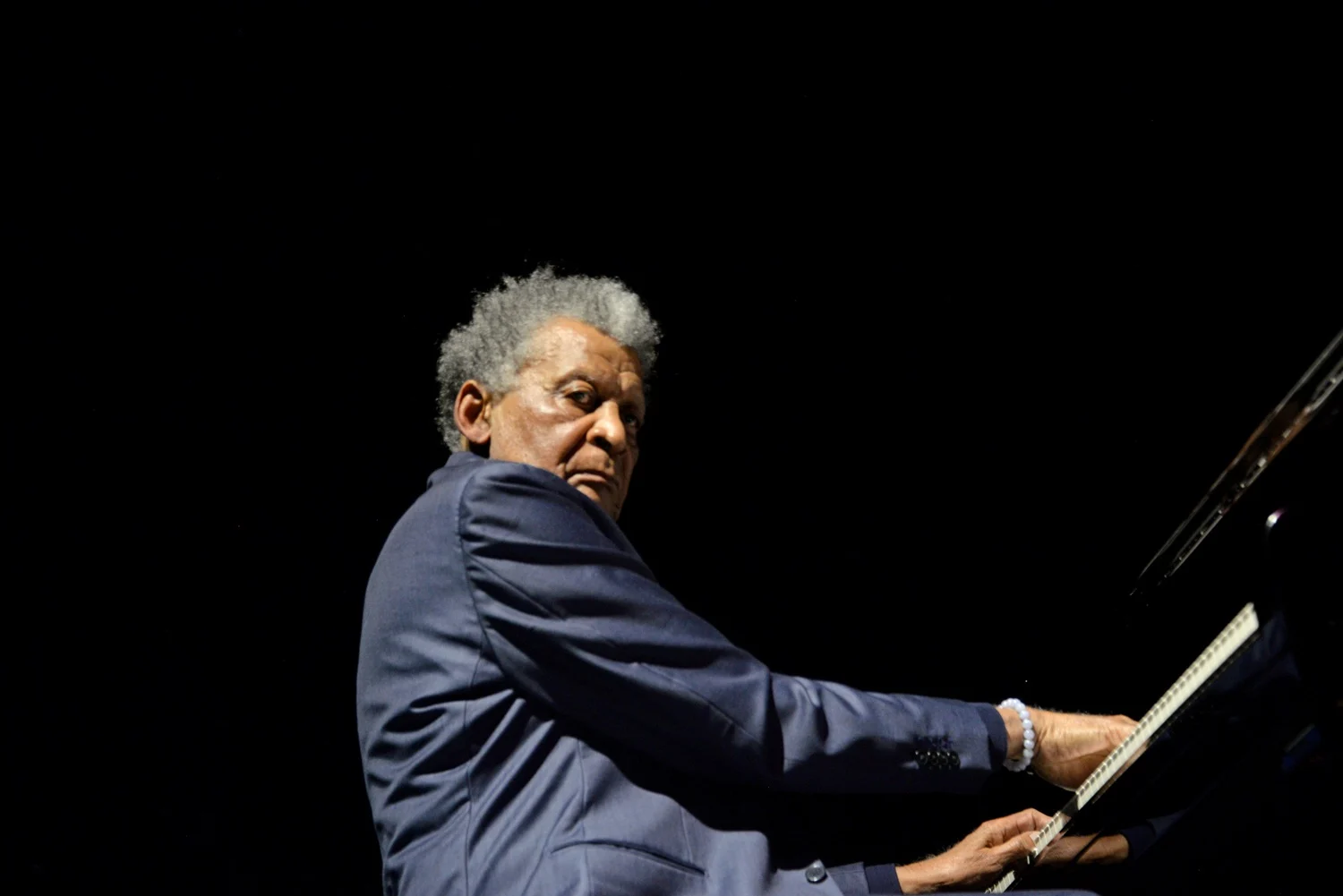
South African jazz pianist Abdullah Ibrahim, whose evocative music captured the spirit of the nation’s townships and became an anthem for the anti-apartheid movement, has died at the age of 91. The office of President Cyril Ramaphosa announced his passing on Monday without detailing a specific cause of death.
Ibrahim forged a unique musical identity by fusing American jazz and spirituals with the distinct rhythms of southern Africa. This innovative sound ultimately served as a potent cultural challenge to the brutal white supremacist government of his homeland.
Early life and jazz epistles
Born Adolph Johannes Brand in 1934, he was raised in the tough Cape Town suburb of Kensington. His childhood was marked by tragedy after his father was murdered in a bar fight when Brand was just four years old. He grew up believing his mother was his sister and it was his grandmother who first noticed his affinity for her old upright piano.
He soon attended a school where he began composing music heavily influenced by the diverse African, European, Arab and Asian communities of Cape Town’s port. His fascination with imported American records earned him the nickname «Dollar», leading him to adopt the stage name Dollar Brand as a teenager.
Despite the severe restrictions placed on Black musicians under the newly enforced apartheid system, he formed the Dollar Brand Trio in 1958. A year later the group evolved into the Jazz Epistles, featuring the legendary trumpeter Hugh Masekela. Their 1960 release is widely celebrated as the first jazz album recorded by a Black South African band.
Exile and international recognition
As authorities increasingly harassed musicians and closed down jazz venues, the political climate became unbearable following the 1960 Sharpeville massacre. After a final confrontation with the police over a traffic incident, Brand fled to Zurich alongside vocalist Sathima Bea Benjamin.
His international breakthrough occurred in Switzerland when Benjamin convinced jazz legend Duke Ellington to attend a performance by the reformed Dollar Brand Trio. Ellington was so captivated that he arranged a recording session, resulting in the 1964 release Duke Ellington Presents the Dollar Brand Trio.
Brand and Benjamin married the following year and relocated to New York. There he collaborated with the Duke Ellington Orchestra and played alongside 1960s jazz giants including Ornette Coleman, John Coltrane, Archie Shepp and Elvin Jones.
Spiritual awakening and «Mannenberg“
Returning to Cape Town in 1968, the musician underwent a profound personal transformation. He gave up smoking and alcohol and converted to Islam. He subsequently changed his name to Abdullah Ibrahim.
“The most beautiful, potent aspect of Islam is the unity of things. This realisation has been a driving force for me.» — Abdullah Ibrahim speaking to the Guardian in 2001.
A prolific period of recording followed, highlighted by the 1974 release Mannenberg — «Is Where It’s Happening“. Named after a township created by forced removals, the defiant track evolved into a timeless anti-apartheid anthem. Following the 1976 Soweto uprising, Ibrahim organised an illegal benefit concert for Nelson Mandela‘s banned African National Congress (ANC).
Return to a free South Africa
When the apartheid system began to collapse in 1990, a newly freed Nelson Mandela invited Ibrahim back to South Africa. The pianist proudly performed at Mandela’s presidential inauguration in 1994. Recalling a backstage encounter, Ibrahim later noted Mandela’s deep appreciation for his art:
“He came backstage and said, ‘Bach and Beethoven, we’ve got better.'»
Ibrahim spent his later years residing in a village near Munich while continuing to tour across Europe and the United States. He released his final album, 3, in 2024 just before turning 90. Even while living abroad, the rural expanses of his native land continued to inspire his compositions.
He is survived by his son Tsakwe and his daughter Tsidi, a prominent New York-based rapper known as Jean Grae. His wife passed away in 2013.
British jazz pianist Pete Letanka, who previously worked with Abdullah Ibrahim, praised his enduring relevance and profound emotional depth. Letanka noted that despite facing the obscenities of the apartheid regime, Ibrahim retained the ability to write deeply moving music.
«He never needed to dazzle us with incredible technique. There was something so spiritual, so awakened within him.»
