U.S. Senators Ease Tariffs on Russian Energy Buyers in New Sanctions Bill

U.S. senators introduced a revised Russia sanctions bill on July 14 that softens proposed trade restrictions for nations purchasing Russian oil and natural gas.
The legislation, initially championed by the late Senator Lindsey Graham more than a year ago, now features 26 co-sponsors. Graham previously visited Uzbekistan in 2005 and 2011. Congressional aides expressed confidence that the updated document will pass the Senate.
Tariff reductions and regional exemptions
According to Reuters, the revised draft significantly lowers the maximum tariffs for third-party countries buying Russian energy. While the original framework demanded a 500% penalty, lawmakers reduced the maximum rate to 100%. Furthermore, these punitive duties will only apply to the five largest international buyers of Russian energy resources.
The updated legislation includes an exemption for countries that import less than 15% of their natural gas from Russia, provided they are taking substantial steps to eliminate those purchases. Japan, France, Hungary and Belgium are expected to qualify for this waiver.
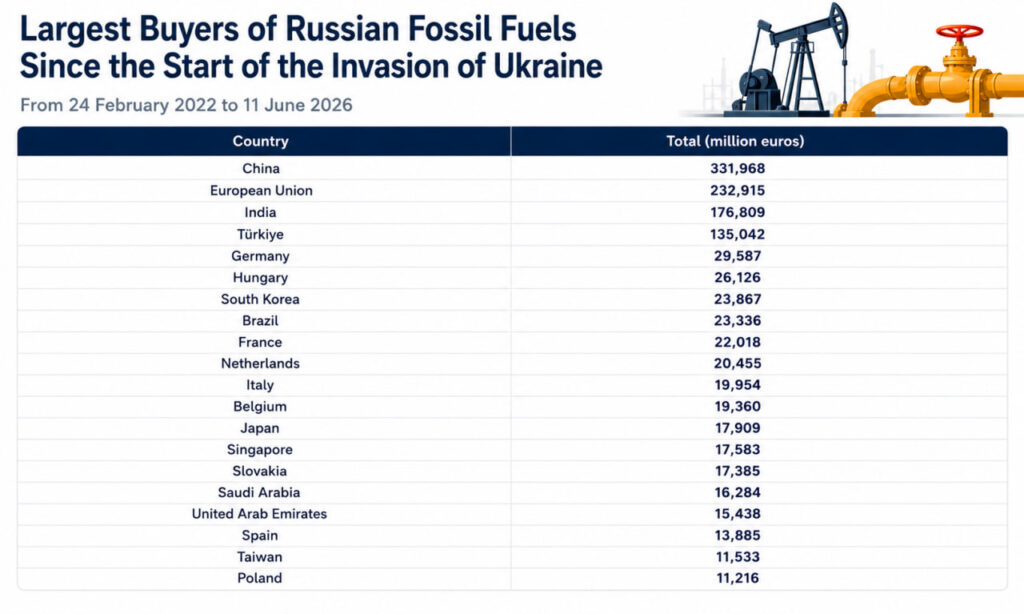
Recent data from the Centre for Research on Energy and Clean Air highlights the primary export markets for Russian fossil fuels since the invasion of Ukraine began. As of July 11, the top destinations included China with 331.9 mln euros, the European Union at 232.9 mln euros, India at 176.8 mln euros, Turkey at 135 mln euros and Germany at 29.5 mln euros.
During July 2026, the primary recipients of Russian pipeline gas were the European Union, China, Turkey, Serbia and Moldova. Uzbekistan does not rank among the top 10 global purchasers of Russian fossil fuels and remains insulated from these targeted tariffs.
Expanding targets to banks and shipping
Beyond energy tariffs, the bipartisan bill proposes new penalties targeting Russia’s covert maritime operations and financial sector. The legislation outlines sanctions against the so-called shadow fleet used to transport crude oil. It also targets major Russian financial institutions, including the central bank.
The restrictions will strike at Russia’s state-backed energy expansion by hitting liquefied natural gas initiatives such as Yamal LNG alongside the Arctic LNG 1, Arctic LNG 2 and Arctic LNG 3 projects.
Crucially, the revised text grants U.S. President Donald Trump the executive authority to temporarily waive these sanctions if he determines doing so aligns with American national interests.
Addressing the decision to dilute the original tariff threats, a senatorial aide revealed that securing Trump’s endorsement required months of delicate negotiations.
«This is the only option that is currently supported by all parties and probably the only document that can pass and put the pressure on Russia that we all want to achieve,» the anonymous aide told Reuters, citing the confidential nature of the legislative discussions.