Where Uzbeks get their news, and which media they trust most?


Telegram leads television as a news source in Uzbekistan, but a fresh media consumption survey shows that TV still commands far more trust. Audiences want more reporting on prices, jobs and everyday problems — and less repetitive programming.
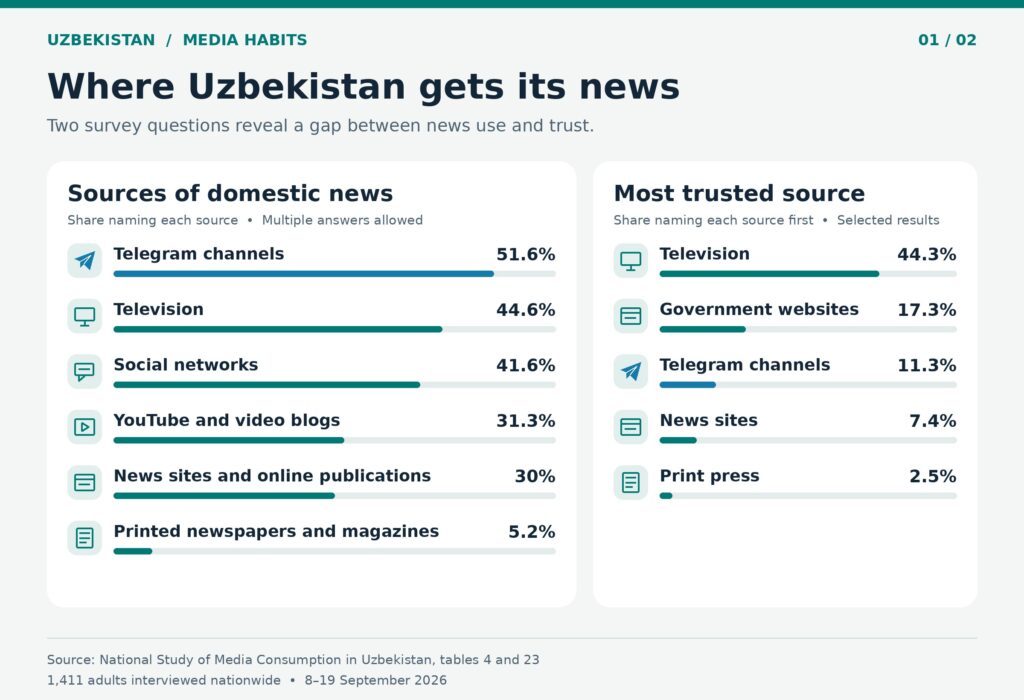
Telegram channels supply news to 51.6% of respondents, ahead of television’s 44.6% and other social networks’ 41.6%.
News websites are now up to 30% with printed newspapers and magazines trailing at 5.2%. Respondents could select up to three sources so these audiences are overlapping. The figures measure how people get news, not which publishers make it.
But reach doesn’t necessarily translate into confidence. 44.3% of the respondents trust television, compared to 11.3% who trust Telegram channels and 7.4% who trust news websites. Those numbers don’t mean that everyone else distrusts them.

The nationwide survey, released on 2 November, was funded by the EU Delegation to Uzbekistan and conducted by Uzbekistan’s media foundation, the presidential office’s media centre and state pollster Ijtimoiy Fikr.
The sidestory: Uzbek YouTubers may soon monetise content as talks with Google move on
Different generations, different screens
Among 18–24-year-olds, 66.2% get news through Telegram and 54.4% through other social networks. Among respondents aged 55 and above, television reaches 77.4%, while Telegram falls to 28.3%.
TV nevertheless retains a broad audience: 67.5% of all respondents watch television content. The study also identifies print as a continuing source for older readers.
Digital platforms compete on convenience, with respondents citing speed of delivery at 48.6% and access whenever they want at 31% as reasons for using them.
Read more: Telegram adds AI summaries for lengthy posts and articles
More useful news, fewer repeats
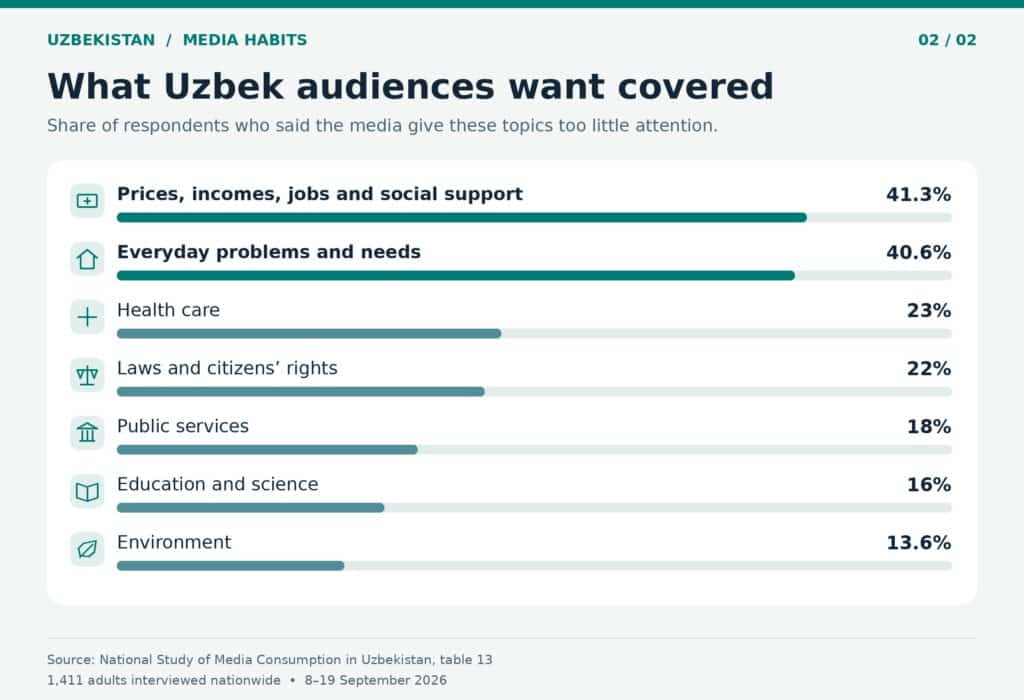
When asked what was missing in coverage, household concerns topped audiences’ lists. Some 41.3% wanted additional information on prices, incomes, employment and social support, while 40.6% said there were gaps in the reporting of everyday problems.
Health followed at 23%, laws and citizens’ rights at 22%, government services at 18% and education and science at 16%.
65.3% of urban viewers and 75.4% of rural viewers found news programming attractive. They also showed interest in health, family life and parenting, documentaries, and journalistic investigations.
The demand extends beyond subject matter: 27.6% want deeper analysis and 22.5% want different viewpoints presented objectively. Respondents complained about repetitive television programmes and similar storylines.
Read more: Meta discusses advertising fraud and support for Uzbek content creators
The study surveyed 1,411 adults through face-to-face interviews across Uzbekistan’s 14 regions on 8–19 September.
