How Foreign Investors Council is transforming Uzbekistan’s business climate
The Foreign Investors Council (FIC) under the President of the Republic of Uzbekistan has undergone a massive institutional transformation. The platform, initially created as a forum for open dialogue, has evolved into an independent association that directly participates in modernising legislation. Tashkent’s initiatives are now being scaled to neighbouring countries. Aziz Gafurov, Head of the FIC Secretariat, writes in his column for Kursiv Uzbekistan about the changing profile of foreign business, the Council’s new status and the creation of the Regional Alliance.
New status and financial independence
The FIC model initiated by the EBRD was deployed in 13 countries worldwide and Uzbekistan, becoming the thirteenth member of this pool, created a unique instrument for direct state dialogue with foreign investors on its basis. In our case, this dialogue is elevated to the highest level: the Head of State personally chairs the Council, while the EBRD President serves as co-chair.
At the end of last year, a significant event occurred. Following the Plenary Session of the Foreign Investors Council, the President supported the participants’ proposal to transform the Council into a non-governmental, non-profit organisation (NGO) with legal entity status. In November 2025, the Secretariat of the Foreign Investors Council officially received NGO status as an association of legal entities known as the “Foreign Investors Council” (Association). Thus, the Council acquired its own institutional foundation for further development.
We have introduced a system of official membership and membership dues. While events and working groups were previously financed primarily with EBRD support, since late 2025 the Council has transitioned to a self-financing model using funds from its members. This allows for deeper and more systematic work and the implementation of investor initiatives.
At the same time, the scale of the community itself has grown significantly. Over the past year, the number of Council members increased from 54 to 85 companies, while business involvement in its activities grew fivefold. Today, Council members represent 19 countries and 23 economic sectors ranging from energy and industry to financial services, technology and the digital economy. It is especially important that investors within the Council operate in all regions of Uzbekistan. For us, this is not just an increase in the number of participants. It is an indicator that businesses view the Council as a practical mechanism for engaging with the state and a real opportunity to help shape the country’s investment environment.
Transition to multilateral dialogue and new selection criteria
In 2025, the President supported another crucial initiative. At the proposal of Council members and the institutions themselves, the Executive Committee was expanded. Now, alongside the EBRD, the Asian Development Bank and the International Finance Corporation participate in its work.
This fundamentally changes the quality of dialogue. We are combining the experience of global business, international financial institutions, and the state around a single objective: creating long-term, predictable conditions for investment.
Meanwhile, interest in participating in the Council continues to grow. We are seeing a large number of applications from international companies and development institutions. And we are taking a more systematic approach to the process of reviewing and admitting them to the Council: what matters to us is not only the volume of investments but also their real contribution to the economy. This includes job creation, technology transfer, human capital development, localisation and a long-term presence in the country, contribution to the work of the Council and readiness to take responsibility for bringing initiatives to implementation.
A new working group model: from dialogue to joint implementation of reforms
Until 2025, the Council’s working groups consisted predominantly of investors. They discussed problems, formulated proposals and submitted them to government departments.
Last year, investors proposed a new format: interdepartmental working groups, where a relevant government department head leads the group and a foreign investor who is a Council member serves as co-head.
Over the last plenary year, the number of working groups grew from 5 to 16. Their agenda has also become much broader: alongside traditional investment climate issues, new areas have emerged such as artificial intelligence, the circular economy, the development of alternative investments, managerial competencies and other topics that will determine the country’s future competitiveness.
Why is this necessary? Transnational companies and IFIs have extensive experience operating in dozens of countries worldwide. They know the consequences of certain regulatory steps, both positive and negative. When a government department considers a new regulatory model, Council participants can provide international experience, data and practical expertise.
At the same time, a strict balance is maintained within the Council. If a particular proposal reflects only the commercial interest of a single company, colleagues immediately steer the discussion back to the systemic impact. Our goal is to ensure that legislation is transparent, instructions are clear, and the rules of the game are designed for the long term.
Investor initiatives: from discussions to roadmaps
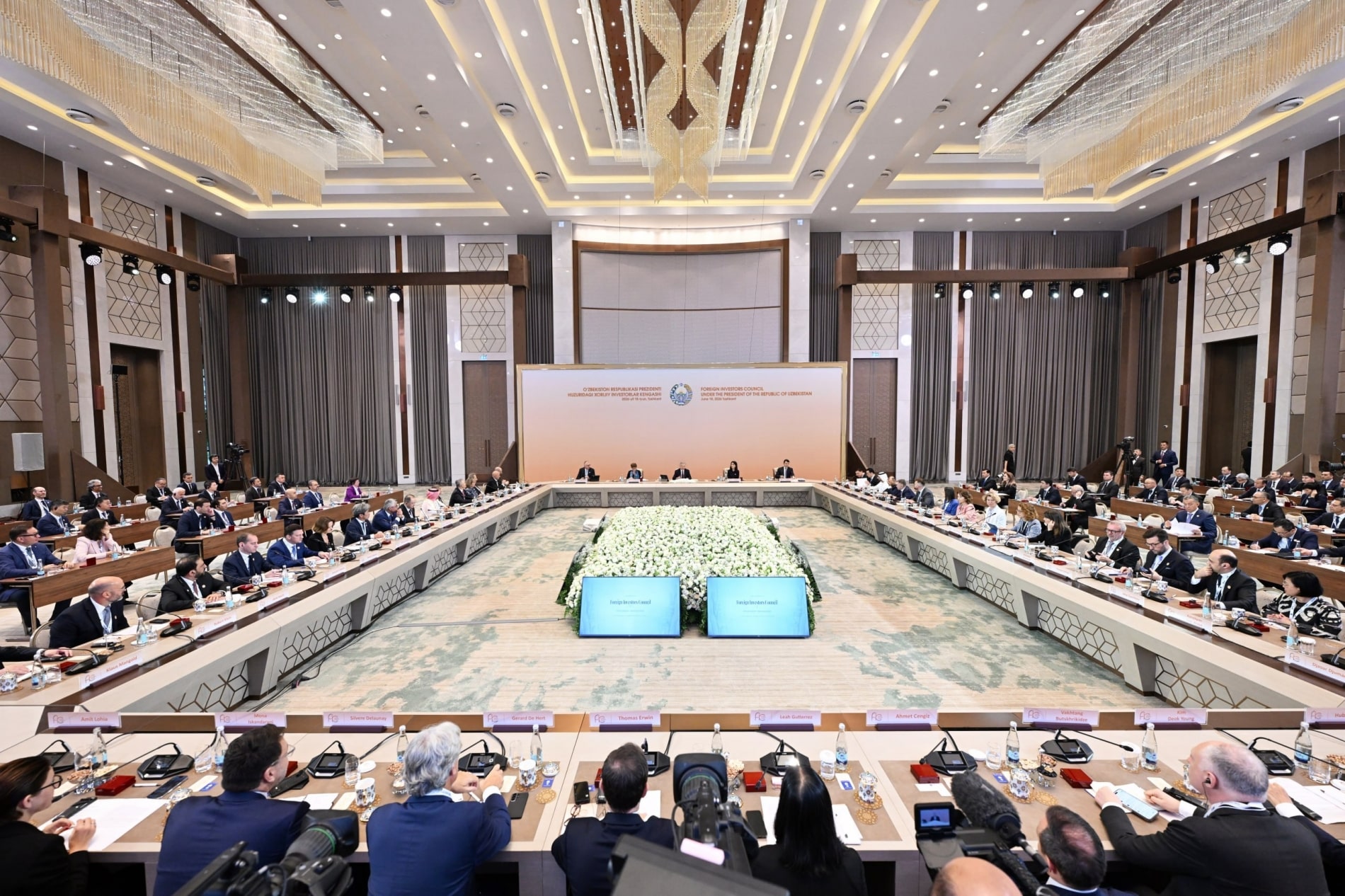
At the last meeting in June 2026, Shavkat Mirziyoyev emphasised that the Council has transformed from a simple discussion platform into an institutional organisation. The main marker of this is the volume of work completed. For the 2026 plenary session, we prepared a record 120 initiatives.
Company activity has grown exponentially over the last year. Between last year’s plenary session and the current one, we held 55 working group meetings. On 18 May, we held an interim session where we discussed each of the initiatives presented.
The proposals were presented to the President. At the plenary session, the Head of State instructed the government to take strict control of the implementation of these initiatives to ensure their high-quality adoption. We are now awaiting the release of the corresponding presidential decree and roadmap.
To understand the dynamics: 14 initiatives were implemented in 2024, and last year, 22 out of 45 proposed initiatives were included in Decree No. 226. This year, we presented 120. Even if half of them make it into the roadmap, it will be a colossal step forward.
From investor initiatives to new legislation
All these figures do not simply remain statistics.
During the plenary year, work on eight draft regulatory legal acts was conducted with the Council’s direct participation. They cover alternative investment funds, responsible business conduct, tax regulation, the electric power industry, public-private partnerships, land issues and the improvement of the financial accounting system in accordance with international requirements and standards.
One illustrative example is the draft Law on Alternative Investment Funds. It was prepared within the relevant working group led by the Ministry of Investment, Industry and Trade with support from Vision Invest, the IFC, market participants and international experts.
This is not just a new law. It is about creating a legal framework for the development of private equity, venture capital, infrastructure funds and other forms of long-term institutional capital. For Uzbekistan, this is an opportunity to form a more diversified investment ecosystem and create new financing mechanisms for the private sector.
Not just regulation: new approaches to investment policy
Another important change is that the Council is gradually moving beyond solely addressing regulatory barriers.
Modern investment policy requires the ability to foresee new trends. Therefore, with the active participation of international investors and partners, five analytical reports were prepared over the year on topics that will determine Uzbekistan’s future competitiveness.
These include a comprehensive assessment of the effects of investment activity, creative investments, the development of managerial competencies, the investment environment in Central Asia and the Caucasus and the circular economy.
Our objective is to use the Council not only to solve today’s business problems but also as a platform for developing and testing new approaches to investment policy. International companies possess a vast array of practical knowledge, and it is important to leverage this expertise to identify new avenues of economic growth.
Expanding geographical boundaries: creation of a Regional Alliance
One of the Council’s most ambitious proposals in 2026 went beyond Uzbekistan’s borders. The creation of the Regional Alliance is perhaps the most interesting and strategic project of the year. Previously, the Council served only as a bridge within Uzbekistan. But the modern major investor, diversifying portfolios in search of a safe haven, looks not at a single country but at the region as a whole.
Since 2017, Uzbekistan has shown the best results in the region in terms of GDP growth, reforms and rating improvements. However, one country’s economy cannot develop in isolation from its neighbours. If ideal conditions are created here for an investor, replication, meaning the expansion of these standards to neighbouring markets, becomes their priority.
Throughout the year, we conducted complex negotiations and held the inaugural meeting during the Tashkent International Investment Forum, where we officially signed a memorandum establishing the Regional Alliance of Investment Councils. Currently, 7 countries have already joined it: the Central Asian states plus the Caucasus – Armenia and Georgia. This initiative was actively supported by IFIs, including the EBRD and ADB, and the President specifically emphasised its importance at the plenary session. By the end of the year, we plan to conclude discussions with Azerbaijan and Mongolia.
The practical purpose of the alliance is to unify standards and exchange best practices in reforms. Imagine if we could standardise legislative acts, for example, on public-private partnerships (PPPs) across seven countries. This would open up a colossal single market for major capital. Competition for investments between countries will remain, but it will be a healthy competition that pushes the region towards evolutionary progress. By the way, the creation of the International Financial Centre in Tashkent is also a natural continuation of this chain of reforms initiated within the Council.
Evolution of the capital market and the Corporate Governance Code
The processes of privatisation and IPOs of large state-owned companies are currently actively unfolding in Uzbekistan. UzNIF recently went public, and Uzbekistan Airways is on the way. The interdepartmental working group on improving corporate governance on behalf of the Council is co-headed by Marius Dan, CEO of Templeton Global Investments for Central Asia.
Corporate governance is the foundation of the capital market, protecting the rights of minority investors (whether they are large funds or citizens who have invested 10 million soums). Without it, giant structures might simply fail to notice the capital of smallholders.
At the 2026 plenary session, the President supported one of the most important initiatives: the development and creation of a unified Corporate Governance Code. Of the 13 initiatives in our capital market block, this one will serve as the anchor. The securities market has long been a weak link, but the time has now come for it to accelerate naturally. The entry of players like Franklin Templeton and BlackRock is the best proof of this. They are already here and investing money.
A new investor profile: focus on long-term and human capital
If we evaluate the reforms in retrospect, the difference between the past and the present is colossal. When the market first opened, with liberalisation and the introduction of free currency conversion, consultants were the first to enter. They were looking for quick and easy money. There were almost no long-term strategies.
Today, the investor profile is completely different. Large strategic players are coming here who see a long-term development trajectory for the country until 2030 and beyond. Uzbekistan is already working on its strategic vision for 2040 and 2050. Investors are interested in these programmes. But the main marker of a long-term investor is their readiness to invest in human capital.
Today, more than a dozen of the largest foreign investors are pouring millions of dollars into educational projects in Uzbekistan, building schools and opening training centres. Businesses that seek quick profits will never invest in education.
Capital is coming to Uzbekistan to build and capitalise on its wealth as a stable haven, leveraging a strong demographic factor. The republic’s annual population growth is about one million, and these individuals have a high capacity for learning and a strong desire to work.
Council’s internal work and main request from business
Usually, only official releases make it to the press. But if you look behind the scenes and remove any subjectivity, every investor notes the most important thing: the state is listening and ready to pursue reforms.
Investors share their experiences of participating in similar councils in other countries, including neighbouring ones, and say openly:
“There is no level of interaction like the one in Uzbekistan anywhere else.”
When the President goes off-script during a plenary session, announces an open microphone, gives companies without prior approval the floor to ask questions, then brings up relevant ministers and demands immediate decisions on «red flags», it makes a strong impression on international business. This is not just protocol-driven lobbying; it is immediate action.
Meanwhile, officials in ministries have also changed their approach. They say:
“We don’t need abstract criticism and pie-in-the-sky ideas. It is important for us to be given a specific action plan, so prove based on international experience that this will work and won’t cripple other sectors, and we will take up this flag and move forward.”
It is precisely this applied expertise of the Council that we are proud of. Every initiative is fundamentally well thought out. By the way, to show how large investments change lives not just on paper but at the level of ordinary citizens, we are launching a major media project: a documentary film called «The Voice of Investment», featuring ordinary representatives of foreign business discussing their activities.
If we try to summarise and name the main principle that the government of Uzbekistan must continue to adhere to in order to fully meet the expectations of large capital, it is remarkably simple: be consistent.