China–Kyrgyzstan–Uzbekistan railway: How this new route will transform Central Asia’s economy


What if a new railway between China and Central Asia changed where goods travel and shifted the balance of economic opportunities across the region? Independent expert Markus Friedrich Schneider examines who stands to gain from the China–Kyrgyzstan–Uzbekistan (CKU) railway, why Kazakhstan could face new competition and what the route could mean for the other Central Asian countries.
A new geography of economic relations
Central Asia’s role in international trade is gradually changing. For decades, the region’s economic development has been shaped largely by geography, limited access to seaports and reliance on transport routes inherited from the Soviet era. But expanding trade with China, the growth of Trans-Caspian transport and rising interest in alternative overland corridors are creating scope to rethink the region’s transport network.
One of the most significant projects in this shift is the China–Kyrgyzstan–Uzbekistan (CKU) railway, designed to provide an additional rail link between western China and the central part of the region. Many existing routes run through Kazakhstan. The new line will allow Chinese freight to enter Kyrgyzstan and Uzbekistan directly and continue towards Turkmenistan, Iran, Türkiye and other markets.
The project’s economic significance extends well beyond the three participating countries. An additional transport corridor could change the distribution of transit traffic, the attractiveness of particular areas to investors, and the competition among national logistics networks.
For Kyrgyzstan, the railway is an opportunity to overcome longstanding infrastructure constraints. Uzbekistan could strengthen its position as a regional trade hub, while Kazakhstan will have to adapt to a new route linking China with Central Asian markets. Tajikistan and Turkmenistan, although they are outside the construction project, could also gain from better transport links across the region.
Read more: $4.7bn China-Kyrgyzstan-Uzbekistan railway gets security boost
The project is particularly relevant ahead of the Bishkek Investment Forum, scheduled for 25 November 2026. Discussions about Central Asia’s prospects through 2030 offer an opportunity to envision the CKU not only as an infrastructure initiative but also as a driver of the region’s long-term economic transformation.
The central question, however, is whether the railway will expand regional trade and industrial cooperation or primarily redistribute existing transit flows among Central Asian states.
From years of negotiations to construction
A railway linking China and Uzbekistan through Kyrgyzstan had been under discussion for more than two decades. Difficult mountain terrain, high construction costs, disagreements over the route and the search for an acceptable financing model remained the main obstacles. The breakthrough came with the signing of an intergovernmental agreement on 6 June 2024, followed by an official groundbreaking ceremony on 27 December that year.
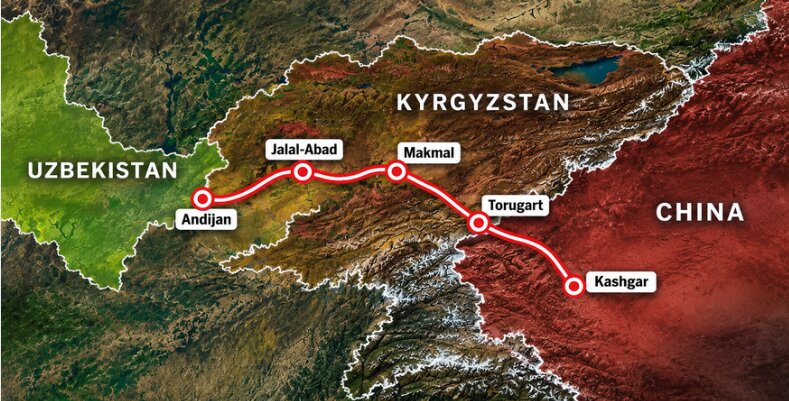
The project envisages a connection from Kashgar in China, through Torugart, Makmal and Jalal-Abad in Kyrgyzstan, to Andijan in Uzbekistan. The overall route is estimated at roughly 530 kilometres, including about 305 kilometres in Kyrgyzstan. The Kyrgyz section is the most demanding from an engineering perspective because numerous tunnels, bridges and other structures must be built in mountainous terrain.
The International Monetary Fund puts the cost of the project at about $4.7 billion. A joint project company is planned, with China holding 51%, Kyrgyzstan 24.5% and Uzbekistan 24.5%. The financing model calls for equity to cover half the cost and loans from Chinese financial institutions to cover the remainder. This structure shares the financing among the participating countries and creates long-term obligations whose economic justification will depend on how much traffic the line actually carries.
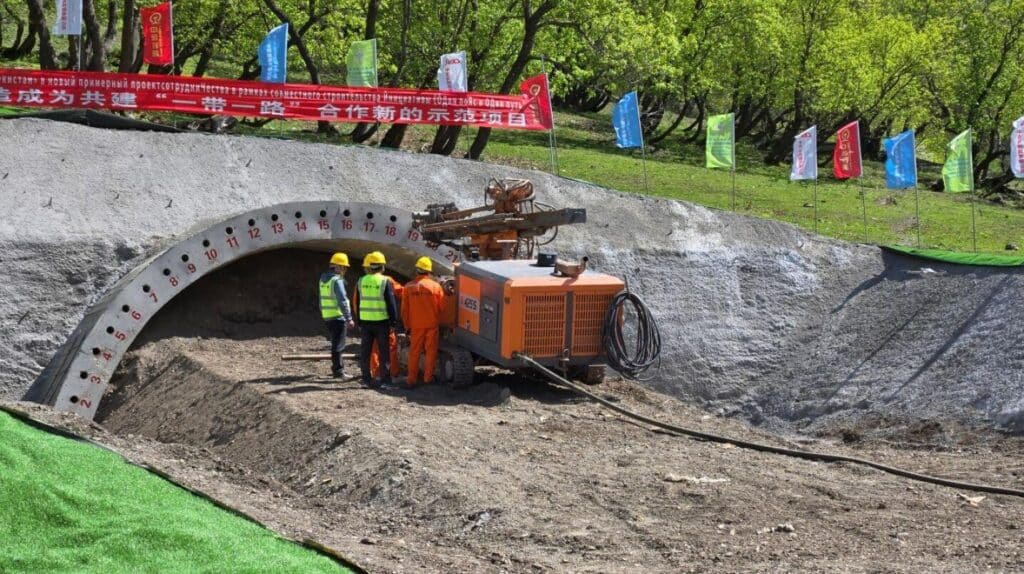
By autumn 2026, construction was well under way. According to a 3 November report by Eurasianet, citing Kyrgyz Railways, work was in progress on 28 of the 29 planned tunnels and 47 of the 50 bridges. By the end of 2026, contractors expect to complete about 22% of the total construction work. The official target for opening is 2031, although contractors are aiming to finish sooner. It would therefore be premature to treat 2030 as a guaranteed opening date.
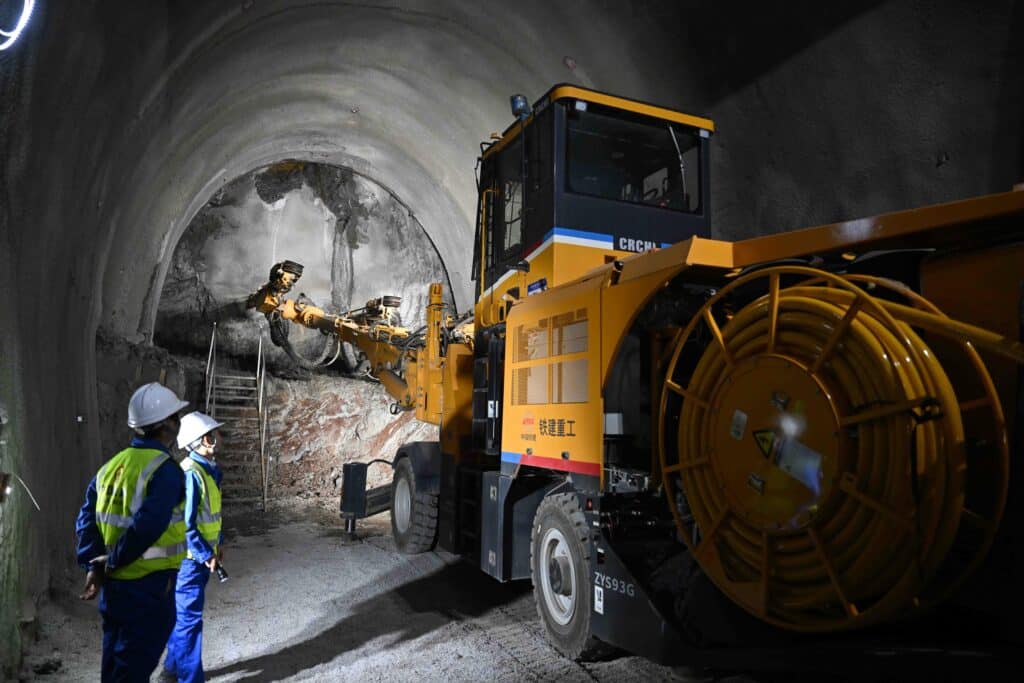
The railway is already influencing investment during construction. It is generating additional demand in Kyrgyzstan for building materials, transport services, engineering specialists and energy infrastructure. Much bigger changes will follow once the line opens and freight operators can choose between established routes and the new one.
The economics of the new route
The chief advantage of the CKU railway is that it will provide an additional rail link from China to Central Asia. A substantial share of rail freight between China and western markets currently passes through Kazakhstan, including via the Dostyk–Alashankou and Altynkol–Khorgos border crossings. These routes have well-developed infrastructure and established international freight services, although some shipments could take a shorter route.
The new railway could make the most significant difference to shipments from western China to Uzbekistan, Turkmenistan and Iran. Going through Kyrgyzstan would shorten the journey on some trade routes, although the actual savings in time and money will depend on freight rates, how quickly cargo is handled and how efficiently border procedures work.
It is crucial to keep in mind that a shorter route can still be expensive to use. The mountainous Kyrgyz section will be relatively costly to build and maintain. The switch from China’s 1,435 mm track gauge to the 1,520 mm gauge common in Central Asia also requires additional technical work. The route’s competitiveness will therefore depend on the total cost of shipping, with distance only one factor.
Read also: Bypassing Russia: Rhenus plans 14 cargo terminals to link Central Asia with Europe
Economically, the railway can perform two related functions. The first is to redistribute existing freight flows between corridors. The second is to generate additional transport demand by reducing logistical barriers and expanding trade opportunities.
The second function is especially important for Central Asia’s long-term development. If the railway merely diverts some Chinese exports from routes through Kazakhstan to the route through Kyrgyzstan and Uzbekistan, its overall economic impact on the region may be limited. If the new infrastructure helps manufacturers and export industries expand and cross-border trade grow, its significance will extend well beyond transit.
The railway is also taking shape as China’s economic presence in Central Asia grows. The Times of Central Asia reported on 3 November 2026 that China’s trade and investment ties with Uzbekistan span industry, energy and infrastructure, while the United States is also seeking greater involvement in technology and raw materials projects. Railway infrastructure is thus becoming a factor in competition for investment as well as a means of moving goods.
Kyrgyzstan and Uzbekistan stand to gain the most
The railway is likely to bring the most visible structural changes to the economies of Kyrgyzstan and Uzbekistan. The two countries are partners in the project, but their interests differ.
For Kyrgyzstan, the railway offers a chance to address two closely related gaps in its infrastructure. The north and south lack a proper rail link, and the country is poorly connected to international transport networks. A location that has long made foreign trade more expensive could now generate transit revenue.
The project’s financing model warrants particular attention. The $4.7 billion investment is equivalent to a substantial share of Kyrgyzstan’s annual economic output. The railway’s economic viability therefore is relevant for fiscal policy as well as for the transport sector. The IMF has already taken Kyrgyzstan’s participation in the project into account in assessing the country’s medium-term public financing needs.
Bishkek, therefore, needs to involve domestic firms as fully as possible in building and later operating the railway. Logistics terminals, warehouses, repair facilities and manufacturing sites along the route would increase the value generated within the country. Otherwise, Kyrgyzstan risks ending up with costly transit infrastructure that generates much of its economic benefit abroad.
Read more: From $5bn power plant to «railway of the century»: Key takeaways from Uzbek-Kyrgyz summit
Uzbekistan has a more developed industrial base and an existing railway network, giving it more ways to use the new line. A direct link to China through Kyrgyzstan could strengthen the Fergana Valley’s role as an industrial and logistics hub connecting eastern Central Asia with external markets.
The project is particularly important for Uzbekistan’s textile, chemical, food-processing and mechanical engineering industries. Under favourable conditions, lower transport costs could make Uzbek exports more competitive and make it easier to import equipment and components for manufacturing.
Better transport links could also boost imports from China, increasing competition for local producers. Tashkent therefore needs to use the railway to attract investment in processing industries and joint manufacturing ventures as well as to increase trade.
There are also opportunities to connect the CKU railway to southbound routes, including those through Turkmenistan and Iran and, in the longer term, proposed rail links through Afghanistan. These initiatives would need separate investment and international agreements, so their economic benefits remain prospective.
Kyrgyzstan and Uzbekistan could both benefit directly from the railway in different ways. Bishkek’s priority will be to earn revenue from its position as a transit country. Tashkent’s goal will be to integrate the new route into its existing industrial and foreign trade networks.
A shift in opportunities for Kazakhstan, Tajikistan and Turkmenistan
The effect on the other Central Asian countries will be mainly indirect but could still be significant.
Kazakhstan, which has the region’s most developed international railway infrastructure, may face stronger competition for cargo from China. This is particularly relevant to freight bound for Uzbekistan and farther south, where the new route may offer a geographically shorter alternative.
Kazakhstan’s competitive strengths extend beyond the length of its routes. Established rail crossings, major logistics hubs, and access to Russia’s transport network and Caspian ports allow it to serve international trade in several directions.
Moreover, development of the Trans-Caspian International Transport Route gives Kazakhstan access to the South Caucasus, Türkiye and European markets across the Caspian Sea. CKU and the Middle Corridor will therefore compete for only some potential freight flows while performing different transport functions.
Kazakh companies developing logistics projects in Uzbekistan illustrate the scope for cooperation. Eurasianet reported in early November 2026 that Kazakhstan’s PTC Holding had signed an agreement with China’s International Freight Trains to expand cross-border freight services. The Chinese company also expressed interest in the Silkway Central Asia logistics centre in Uzbekistan. Such projects show how companies from different countries can work together to serve new routes even as competition between corridors intensifies.
Kazakhstan’s best economic response to the emergence of alternative corridors is to make its own infrastructure more efficient and play a larger role in regional logistics networks.
Tajikistan could benefit as its neighbours become better connected. Its firms could use new logistics hubs in Kyrgyzstan and Uzbekistan to expand trade with China, even though Tajikistan is outside the project.
The size of that benefit will depend on the condition of roads, border infrastructure and transport links with the Fergana Valley. Without investment in those connections, Tajikistan risks remaining on the margins of the emerging transport network.
Growing regional trade is also creating opportunities for Tajikistan to export agricultural products, textiles and certain industrial raw materials. Dushanbe should give priority to improving access to existing transport corridors over building parallel railway infrastructure at any cost.
Turkmenistan is in a different position. Its railway links with Uzbekistan and Iran could make it a key link for onwards shipments from China to the Middle East.
If transit volumes rise, so could demand for rail services, logistics terminals and related infrastructure. The international seaport at Turkmenbashi also offers a way to connect the new overland route with Caspian shipping.
Realising these benefits, however, will depend on transparent tariffs, efficient border procedures and external economic restrictions affecting routes through Iran.
Kazakhstan, Tajikistan and Turkmenistan will therefore have to adapt in different ways. Kazakhstan will need to enhance the competitiveness of its existing routes, Tajikistan will need to improve access to regional transport hubs, and Turkmenistan will need to take advantage of opportunities to expand southbound transit.
Regional integration or competition between transport corridors?
CKU’s economic effect will depend to a considerable degree on whether Central Asian countries can coordinate the development of their national transport systems.
At first glance, an additional railway inevitably means more competition. Kazakhstan wants to retain freight traffic through its existing crossings with China, Kyrgyzstan expects new transit revenue, Uzbekistan wants to strengthen its position as a regional logistics hub, and Turkmenistan is interested in developing routes to the south.
Such competition can coexist with closer regional integration. Having several routes can make trade links more resilient and reduce exporters’ reliance on individual border crossings.
Laying track is only the first step towards efficient international rail services. Uncoordinated tariffs, lengthy customs procedures, capacity constraints and limited digitalisation can erode the advantages of even relatively short routes.
Closer economic integration in Central Asia therefore requires harmonised transport standards, more use of electronic documentation, more transparent tariffs and arrangements that allow transit freight to move smoothly across borders.
Joint industrial and logistics projects are also important. If new railways carry only Chinese goods westwards, the region’s economies will remain primarily transit economies. Developing processing plants and distribution centres, and working together in manufacturing, would allow the region to capture a larger share of the value added.
The five countries also have different economic models. Kazakhstan has substantial natural resources and well-developed transport infrastructure. Uzbekistan has a large domestic market and an industrial base, Kyrgyzstan is well placed to develop transit trade, and Tajikistan has scope to expand certain export industries. Turkmenistan has transport links to Iran and the Caspian.
By coordinating how they use these advantages, the countries could gain more economically than they would by competing for a limited pool of transit revenue.
Project constraints and prospects through 2030
Despite CKU’s strategic importance, its long-term economic outcomes remain uncertain.
The main risk is the combination of high construction costs and the need to attract enough freight once the line opens. Kyrgyzstan’s difficult mountain terrain means spending heavily on engineering works and on maintaining the railway afterwards.
How well the route can compete commercially will be just as important. International shippers will weigh freight rates, delivery times, infrastructure reliability, the availability of container services and conditions at border crossings, alongside distance.
The railway is also being built as international trade policy changes. Sanctions, instability on some transport routes and competition between major economic partners could affect the pattern of freight flows.
There are three possible scenarios for the project.
Under the baseline scenario, construction is completed on schedule and freight traffic grows gradually. CKU becomes an additional international trade route whose economic importance increases as terminals and supporting infrastructure develop.
In a more favourable scenario, new manufacturing and logistics clusters emerge along the railway. Expanding exports, developing joint ventures and coordinating regional transport policy could help the railway bring Central Asia’s economies closer together.
An adverse scenario could involve higher construction costs, a delayed opening or insufficient commercial freight traffic. The project could then generate lower economic returns than initially expected and impose a greater financial burden on the participants.
The year 2030 should therefore primarily serve as a point for assessing construction progress and the readiness of the transport infrastructure. Given the official target of a 2031 opening, reported in November 2026, the main effects of the railway’s operation are expected to occur after the end of the decade.
Conclusion
The China–Kyrgyzstan–Uzbekistan railway could become one of Central Asia’s most important infrastructure projects in decades. It could reshape the region’s transport geography, expand trade with China and open up additional routes for international freight.
The effects on the five Central Asian economies will vary. Kyrgyzstan and Uzbekistan will benefit directly from the new rail link. Kazakhstan will face more competition between transport corridors, while Tajikistan and Turkmenistan will have opportunities to benefit from expanding regional trade.
It would be economically shortsighted to judge the project solely by how it affects competition between national transit routes. Its greater potential lies in cooperation in manufacturing, attracting investment and building a connected transport network across Central Asia.
The main challenge for the region is to move away from an economic model centred on transit revenue towards one in which transport infrastructure underpins industrial development and the expansion of foreign trade.
Ultimately, the decisive measure of the China–Kyrgyzstan–Uzbekistan railway’s importance will be whether Central Asian countries can turn their geography into a lasting economic advantage. The length of the new track and even the volume of freight carried tell only part of the story.
If the countries of the region can coordinate transport policy and create conditions for joint manufacturing and logistics projects to develop, the railway will offer an alternative route between China and western markets while also helping to build a more integrated and competitive Central Asian economy.