
From green economy to ESG: Uzbekistan's new regulatory model

Viktor Kovalenko
EY Partner, Head of Sustainability and Climate Change Services for Central Asia, the Caucasus and Ukraine
Roman Dovolnov
Head of Sustainability and Climate Change Services in Uzbekistan, EY
Ruslan Sadgalin
Senior Manager, Sustainability and Climate Change Services, EY
Alisher Abdullaev
Assistant Manager, Sustainability and Climate Change Services, EYEY explains how Uzbekistan moved within a few years from environmental targets and energy efficiency to ESG reporting, IFRS Sustainability Disclosure Standards and a new disclosure model for government, business and investors.
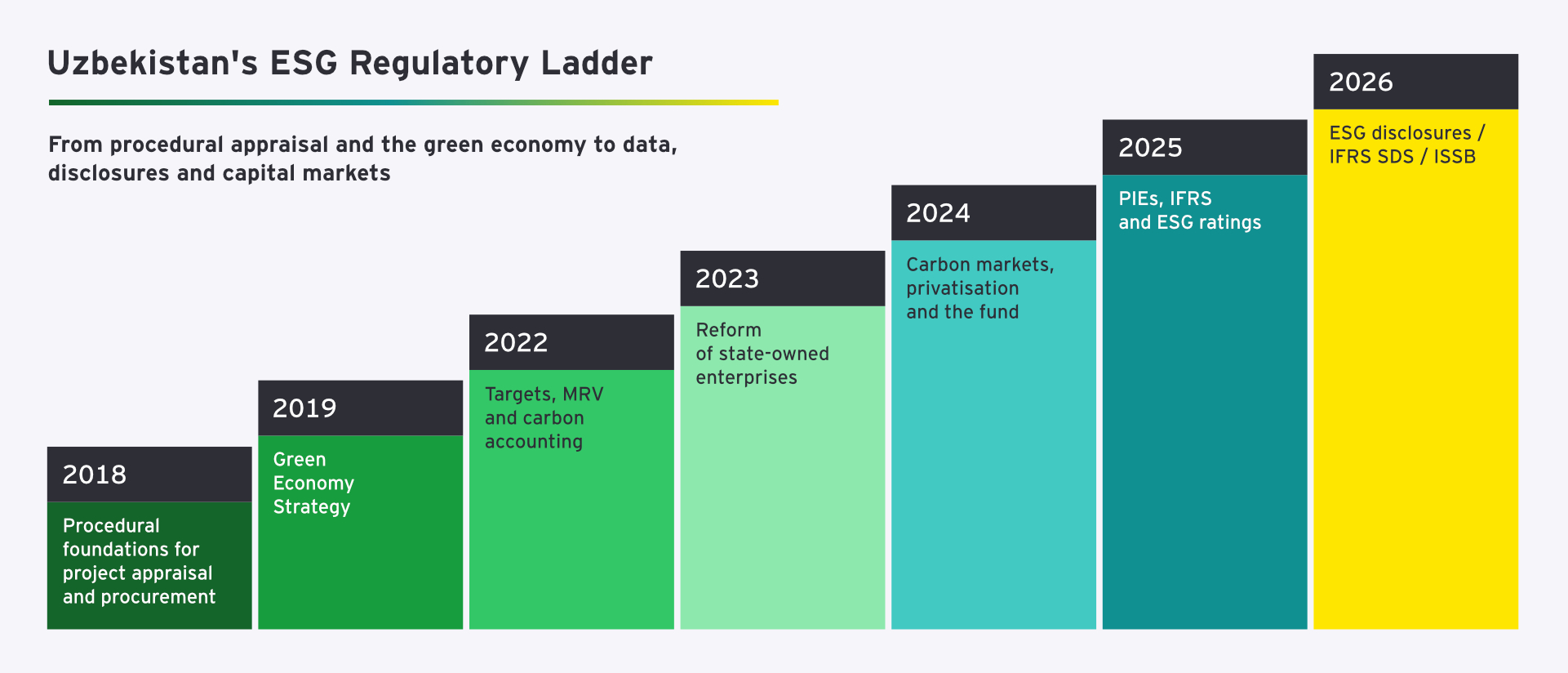
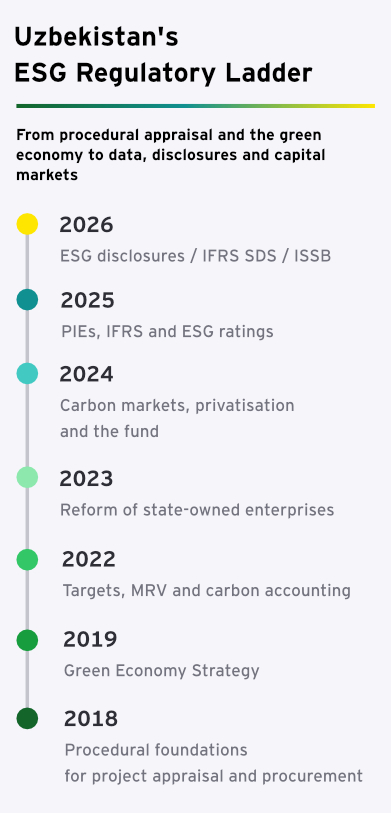
Recently, Uzbekistan has established a substantial regulatory framework in the region for the green economy, sustainable development and ESG. This framework did not emerge through the one-off introduction of ESG reporting. Instead, it developed through the gradual construction of a new economic regulatory infrastructure: from strategic green economy objectives to climate accounting, carbon credits, reform of state-owned enterprises, improvements in their investment attractiveness and disclosures based on international sustainability standards.
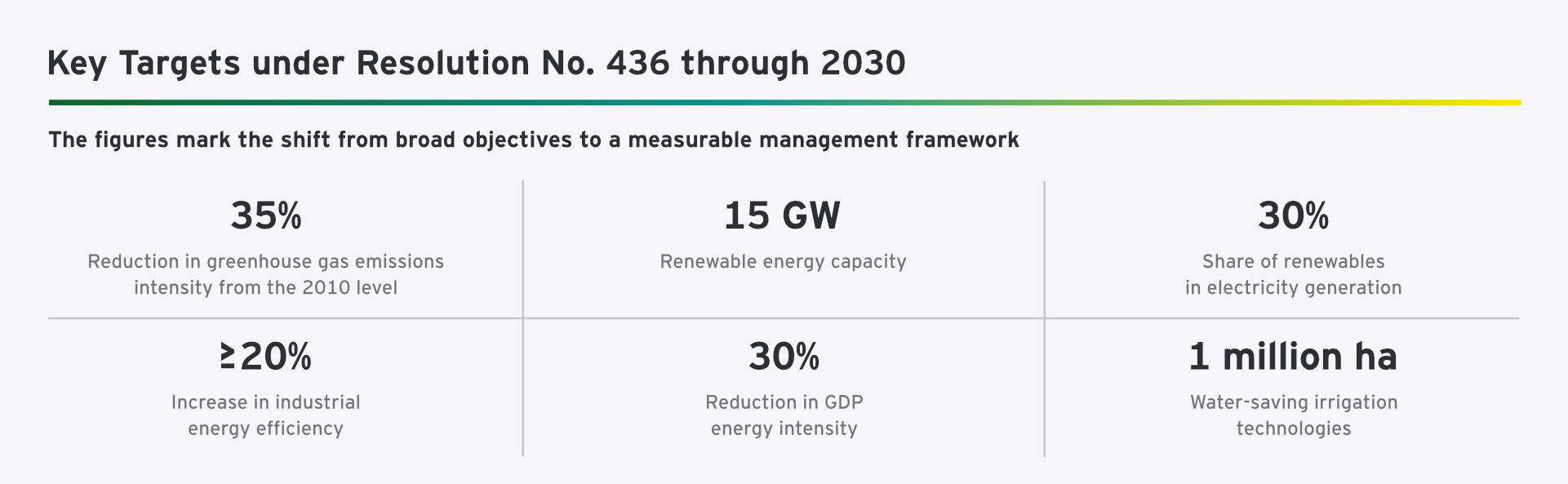
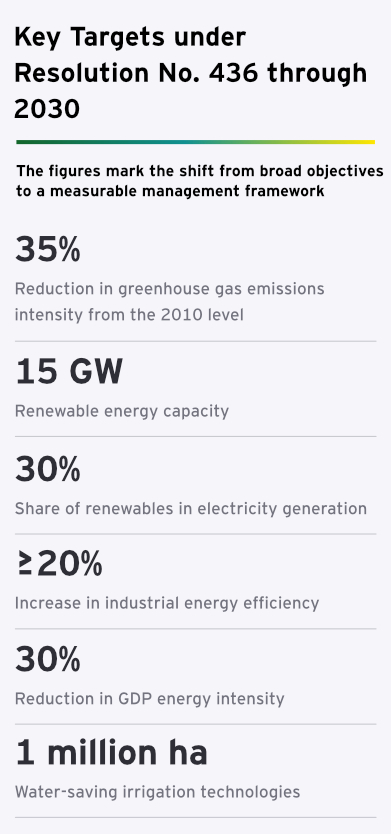
The first fundamental step was the Strategy for the Transition of the Republic of Uzbekistan to a Green Economy for 2019–2030. It established a long-term model of resource-efficient and environmentally orientated growth. Presidential Resolution No. 436 of 2 December 2022 then moved the green agenda into a more measurable and manageable domain by setting targets for reducing greenhouse gas emissions intensity, expanding renewable energy, improving energy efficiency, reducing the energy intensity of GDP and introducing water-saving technologies.
In 2023–2024, the regulatory focus shifted toward state-owned enterprises and capital markets. The reform of state-owned companies, the transfer of state shareholdings to UzAssets Investment Company JSC, the preparation of major enterprises for IPOs and SPOs, the establishment of the National Investment Fund and the development of international carbon credit trading linked ESG with corporate governance, privatisation, investment attractiveness and investor confidence.
In 2025–2026, the ESG agenda entered a phase of institutionalisation. Presidential Decree No. 16 strengthened the green transformation and public ESG practices of major enterprises; Presidential Resolution No. 282 introduced the legal status of public interest entities (PIEs); and Cabinet of Ministers Resolution No. 221 of 4 May 2026 provided for the further implementation of sustainable development and ESG principles, including sustainability disclosures based on international standards.
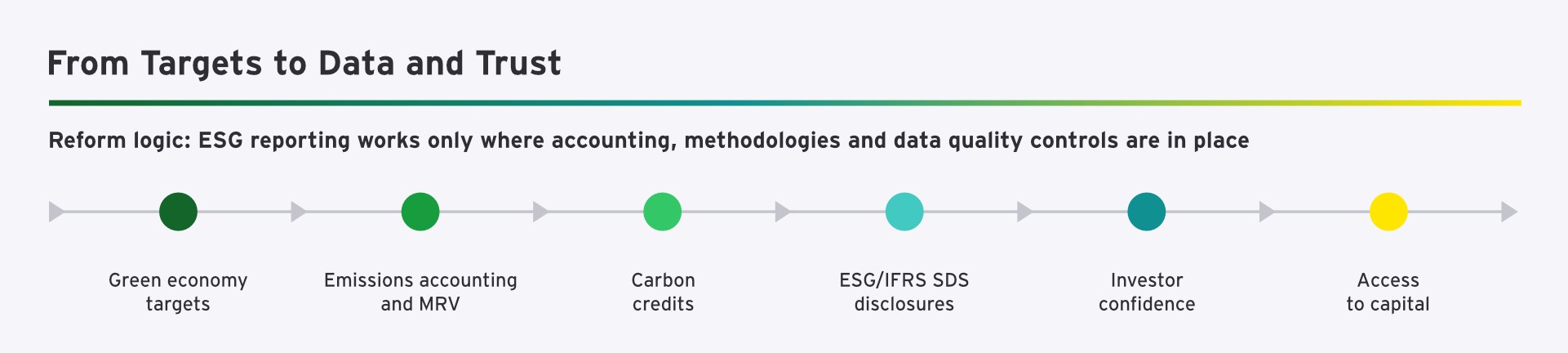
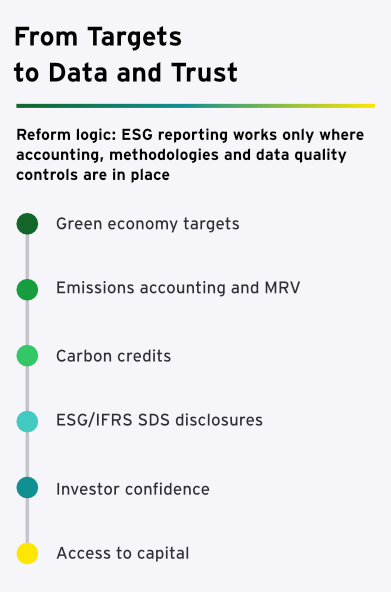
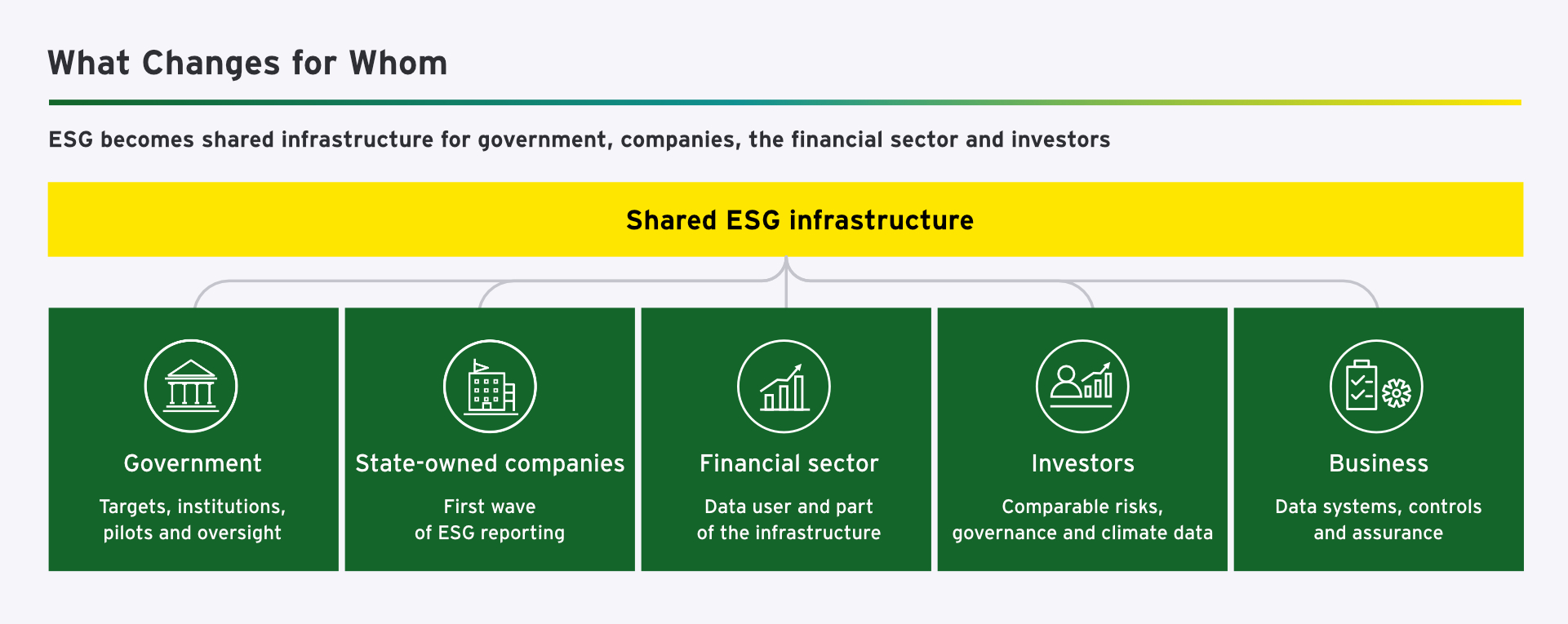
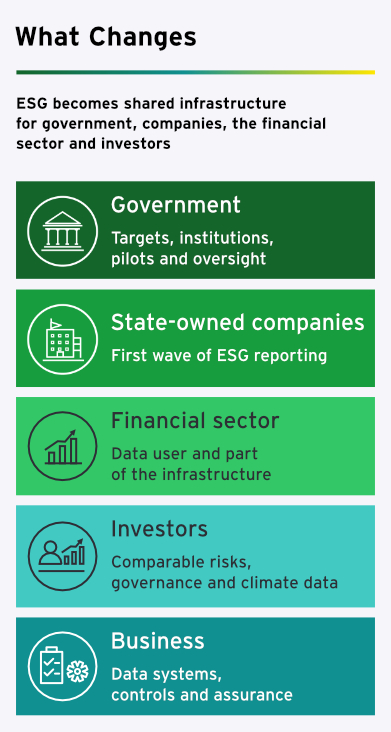
As a result, ESG in Uzbekistan is becoming not only a matter of corporate reporting, but also part of a broader infrastructure of trust among the government, companies, investors, the financial sector and international partners. For businesses, this means shifting from sharing ESG information on their own to having organised systems for data, internal controls, and risk disclosures, creating stronger connections between sustainability and financial reporting, and being prepared for independent checks.
From individual initiatives to a new regulatory model
At first glance, the development of the ESG agenda in Uzbekistan may appear to be a collection of separate initiatives: the green economy, renewable energy, energy efficiency, carbon credits, the transformation of state assets, corporate governance, ESG ratings, IFRS and sustainability reporting. A closer review of the legislation, however, shows that these are not isolated measures but stages in the gradual construction of a new regulatory system.
A defining feature of the country's approach is that ESG was not introduced all at once as a reporting requirement. The government first established a strategic framework for the green economy, followed by the infrastructure for climate accounting and carbon instruments. It then advanced the transformation of state-owned enterprises and efforts to improve their investment attractiveness before moving towards systematic disclosures based on international sustainability standards.
In other words, Uzbekistan did not arrive at ESG by following a trend in corporate reporting. It did so in response to a broader set of objectives: modernising the economy, reducing resource intensity, improving the quality of corporate governance, attracting capital and preparing major companies to compete in international markets.
Stage one: the green economy as a national strategy
The early regulatory approach focused primarily on improving the selection, appraisal and oversight of public projects and procurement. Presidential Resolution No. 3464 of 8 January 2018 did not yet introduce ESG or green criteria in their modern sense, but it laid an important foundation by establishing a comprehensive appraisal of design, pre-design, tender and other documentation under state development programmes and public procurement processes.
In this respect, Resolution No. 3464 should be viewed not as a 'green' instrument in itself but as part of the administrative infrastructure. Such procedures subsequently make it possible to embed environmental, climate and other ESG criteria into the appraisal of public projects, procurement and investment decisions.
The next fundamental step was the adoption of the Strategy for the Transition of the Republic of Uzbekistan to a Green Economy for 2019–2030. The strategy treated the green economy not as a standalone environmental programme but as part of the country's structural modernisation: improving energy efficiency, expanding renewable energy, using natural resources responsibly, adapting to climate change, and developing green finance and international cooperation.
From that point onwards, the green economy became a matter of planning, monitoring and inter-agency coordination. This marked an important shift from declarative environmental policy to a managed development model in which objectives are expected to be measurable, comparable and linked to economic decisions.
Stage two: from strategy to climate infrastructure
Presidential Resolution No. 436 of 2 December 2022 was a landmark document. Its significance lies not only in strengthening the green economy targets for 2030. More importantly, it moved the green agenda from the level of strategic intent to the level of regulatory infrastructure.
Resolution No. 436 established more ambitious targets for reducing greenhouse gas emissions intensity, expanding renewable energy, improving industrial energy efficiency, reducing the energy intensity of the economy, introducing water-saving technologies and expanding green areas. The document should therefore be viewed as a bridge between the green economy and future ESG reporting: companies need data to disclose ESG information; and comparable data requires methodologies, accounting, monitoring and accountability.
The institutional framework for climate regulation deserves particular attention: a system of green certificates, national greenhouse gas emissions accounting, a national cadastre, a carbon credit registry, sector-specific emissions reduction targets, and a modern monitoring, reporting, and verification system for climate change. Within this framework, ESG ceases to be merely a communications term and begins to rest on a data infrastructure.
Stage three: state-owned enterprises as the first platform for ESG transformation
The next important development was the transformation of state-owned enterprises. Presidential Resolution No. 83 of 1 March 2023 was intended to accelerate the reform of major enterprises with state participation, improve operational efficiency and transparency, and support the transition to market-based mechanisms.
By transferring state shareholdings in several major enterprises to UzAssets Investment Company JSC and reforming corporate governance, the government began to use state-owned companies as a platform for managerial transformation. In this model, ESG is not a separate environmental agenda but part of a broader effort to improve the transparency, efficiency and investment attractiveness of major assets.
This is a fundamental shift. ESG is no longer limited to environmental matters. It becomes part of corporate reform: transparency, accountability, governance quality, investment attractiveness, operational efficiency and a company's ability to work with international investors.
Stage four: carbon credits and international markets
Cabinet of Ministers Resolution No. 117 of 7 March 2024 marked the first comprehensive step towards regulating international carbon credit trading. The document approved temporary regulations governing the implementation of projects under international carbon market mechanisms and established the role of the designated national authority under the mechanisms of the Paris Agreement.
The significance of this instrument extends beyond climate policy. It turns emissions reductions into an economic asset: when emission reductions can be measured, verified, registered and traded, climate policy becomes part of the financial and investment system.
Equally important are the rules for preventing the double counting of carbon credits and the link between carbon markets, digitalisation and MRV. Without reliable accounting and verification, carbon credits cannot be regarded as a credible instrument in international markets.
Stage five: privatisation, IPOs and ESG as a common language with investors
In 2024, ESG became increasingly linked to investment and capital markets. Presidential Resolution No. 163 of 19 April 2024 on the transformation and acceleration of the privatisation of major state-owned enterprises strengthened the connection between corporate reform, international standards and capital markets.
The document addresses pre-privatisation preparation, IPOs and SPOs, international capital markets, the engagement of professional advisers, the preparation of financial statements under international standards and the achievement of stable performance against international rating criteria. Notably, the preamble states that 26 assets with a total value of USD 1.3 billion had been sold to foreign investors over the preceding three years.
This is where it becomes clear that ESG in Uzbekistan is not solely an environmental agenda. It is an instrument for preparing companies to access capital markets. International investors assess not only profits and assets but also governance quality, climate and environmental risks, social-related risks and impacts, compliance, data reliability and the comparability of reporting.
Presidential Resolution No. 303 of 27 August 2024, establishing the National Investment Fund, reinforces the same approach. The fund is meant to make investments more appealing, attract international investors, adopt OECD corporate governance standards, switch to international financial reporting standards, and help apply ESG practices to investment assets.
Stage six: 2025 as the year of ESG institutionalisation
Presidential Decree No. 16 of 30 January 2025, related to the implementation of the Uzbekistan 2030 Strategy during the Year of Environmental Protection and the Green Economy, became an "accelerator" of the ESG agenda.
The decree broadened the agenda across several areas: sustainable finance, decarbonisation and climate change adaptation, a long-term carbon neutrality strategy, the expansion of renewable energy, reduction of the economy's carbon footprint and the green transformation of industries.
For the ESG agenda, the shift from principles to public practice is especially important: corporate programmes, national ESG reports, ESG ratings and sustainability indicators are beginning to be treated as tools for managing major enterprises and strengthening the confidence of government, investors and society in them.
Stage seven: from ESG reports to IFRS Sustainability Disclosure Standards
The next stage concerns the financial architecture. Presidential Resolution No. 282, issued on 15 September 2025, aims to enhance the financial accounting system to meet international requirements and standards. Formally, the document concerns financial reporting, IFRS and public interest entities, but it has systemic significance in the context of ESG.
Resolution No. 282 introduces the legal status of public interest entities (PIEs). These are entities whose activities, size, impact and range of stakeholders warrant more stringent requirements for financial reporting, audit and governance.
This logic is important: sustainable development and ESG disclosures cannot become equally mandatory for every company at the same time. Requirements should first apply to organisations whose activities are material to society, the economy, the financial system and investors.
Together with subsequent regulation, this framework forms the basis for PIEs to transition to sustainability disclosures under IFRS S1 and IFRS S2. Internationally, these standards do not operate separately from financial reporting: their purpose is to provide users of general-purpose financial reports with information about sustainability-related risks and opportunities that could affect cash flows, the cost of capital and enterprise value.
Stage eight: Cabinet Resolution No. 221 and the new ESG reporting model
Cabinet of Ministers Resolution No. 221 of 4 May 2026 represents the culmination of the preceding regulatory logic. It establishes measures for implementing sustainable development and environmental, social and governance principles, moving ESG from a set of principles and pilot initiatives into a formalised disclosure system.
A new phase begins on 1 July 2026: enterprises will need to adapt their internal control systems, information collection processes, IT systems, staff capabilities and resources for preparing sustainability-related information. This is a critical point. Reporting under international standards requires more than drafting a report; it requires effective systems for collecting and processing data, internal control procedures, links between ESG information and financial and operational reporting, the assessment of risks and opportunities, and the ability to explain how risks affect the company's business model and strategy.
Cabinet Resolution No. 221 can, therefore, be viewed not only as a reporting instrument but also as an instrument concerned with data quality. Sustainability disclosures must be accurate, objective, comparable, supported by documentation and suitable for independent assurance. This is particularly important in preventing greenwashing, where ESG claims are not supported by robust evidence and data.
Although the IFRS Sustainability Disclosure Standards issued by the ISSB provide the central framework, the practical relevance of disclosures will also be shaped by the broader international context: industry standards, investor requirements, European regulation of supply chains and sustainable finance, the national green taxonomy and the expectations of the financial sector.
Key instruments: from strategy to practical mechanisms
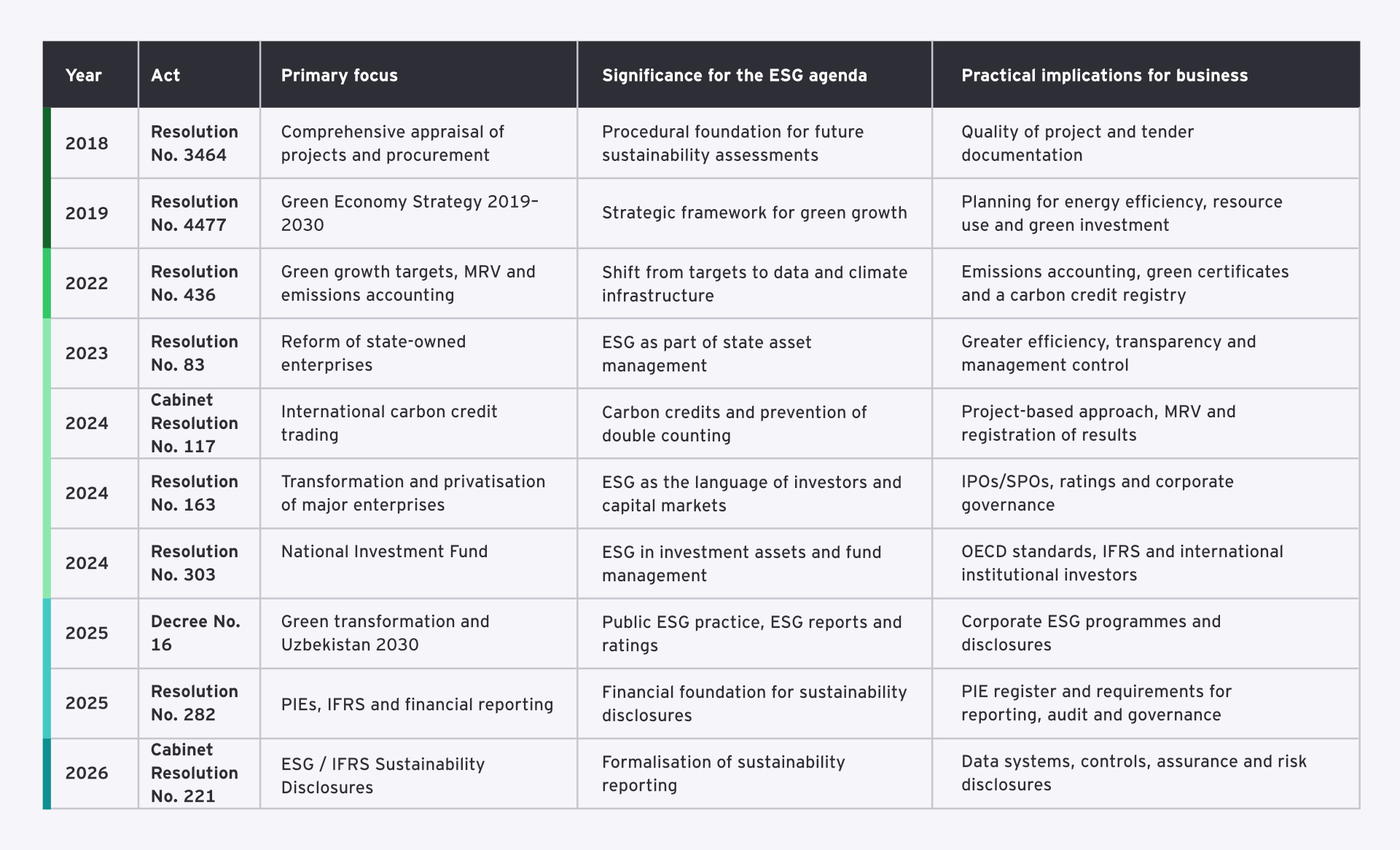
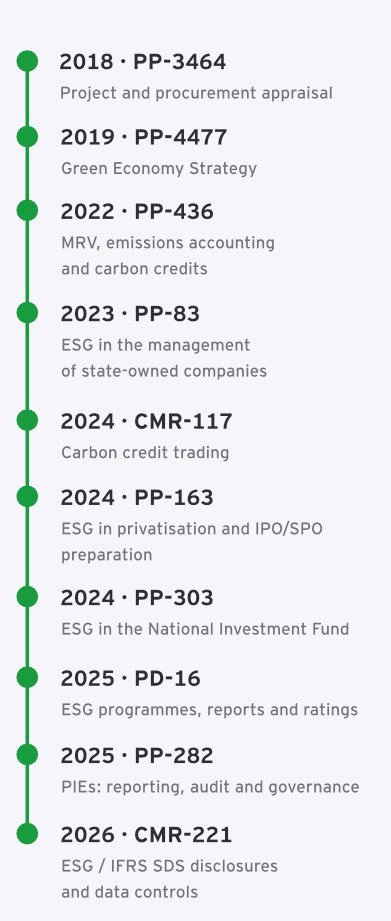
We believe it is important to distinguish between foundational instruments that set the direction of reform and implementation instruments that translate the reform into specific requirements, processes and tools.
What this means for business
For companies, the new regulatory model means that ESG is gradually ceasing to be a voluntary communications practice. ESG is becoming an integral part of governance, reporting, access to finance, and competitiveness.
Major enterprises will need to do more than prepare an attractive report; they will need to build an internal sustainability management system. This includes allocating responsibility at the supervisory board and management board levels, identifying material topics, collecting and controlling the quality of data, calculating emissions, analysing climate risks, describing the business model, linking sustainability matters to financial metrics and preparing for external assurance.
The transition from narrative ESG reporting to reporting focused on the financial materiality of risks may be particularly challenging. IFRS S1 and IFRS S2 require companies to disclose not only their initiatives, but also the risks and opportunities that could affect cash flows, the cost of capital, strategy and the business model.
Potential practical steps for companies
- Assign ownership of the ESG agenda at the supervisory board and management board levels.
- Assess material ESG topics and link them to risks, opportunities, strategy and financial metrics.
- Build a data collection system for key environmental, social and governance metrics.
- Develop a methodology for calculating greenhouse gas emissions, covering Scope 1, Scope 2 and, where necessary, Scope 3.
- Integrate ESG data with financial, operational, risk and investment reporting.
- Implement data quality controls and document information sources.
- Prepare for independent assurance of data and reporting.
- Move from describing initiatives to explaining how ESG factors affect the business model, cost of capital and long-term resilience.
The next phase of reform
Despite the consistency of the reforms, the next phase will require greater detail. Companies will need methodological guidance on materiality assessments, greenhouse gas emissions calculations, climate scenarios, the assessment of the financial effects of ESG risks, data quality, internal controls, reporting formats and independent assurance.
A clear architecture will also be needed for interaction among the MRV system, the national carbon credit registry, the green taxonomy, financial reporting, ESG disclosures and stock exchange infrastructure. If these systems develop in parallel without a common digital and methodological logic, companies may face duplicate reporting requirements and a growing administrative burden.
Another important issue is assurance – that is, independent assurance over ESG information. International practice shows that ESG data quickly loses credibility without independent assurance. High-quality assurance, however, requires standards, qualified auditors and verifiers, independence criteria, liability rules and a transition period.
Finally, sector-specific detail will be required. ESG risks differ across banking, energy, mining, transport, chemicals, construction and agriculture. A universal reporting template may be useful at the outset, but a mature system will require industry-specific metrics and methodologies.
ESG as infrastructure for trust and competitiveness
The evolution of regulation in Uzbekistan shows that ESG is becoming part of a broader economic transformation. It is neither a standalone reporting exercise nor a reputational initiative. It is an infrastructure of trust among the government, companies, investors, international partners and society.
Through the green economy, the government established a long-term direction for development. Through carbon regulation, it began to build a system for measuring and accounting for climate outcomes. Through the reform of state-owned companies, it linked sustainability with efficiency, corporate governance and investment attractiveness. Through the introduction of PIEs and the broader adoption of IFRS, it embedded sustainability into the financial architecture. Through the IFRS Sustainability Disclosure Standards, it translated ESG into the language of data, risks, cash flows and enterprise value.
The next stage will be more difficult than the initial one. Passing legislation is easier than building functioning systems for data, controls, risk analysis and management accountability within companies. This process is where it will be determined whether ESG becomes a formal reporting exercise or a genuine tool for improving competitiveness.
For companies, the practical conclusion is straightforward: they need to prepare not merely to publish a report but also to redesign their management systems. ESG information must be comparable, verifiable, linked to financial effects and understandable to investors. Companies that build such systems earlier will gain an advantage in access to capital, dialogue with the government, engagement with international partners and the management of long-term risks.
If the current direction is maintained, Uzbekistan could develop one of the most comprehensive ESG regulatory models in Central Asia – a model in which the green economy, carbon markets, corporate governance, financial reporting and sustainability disclosures operate not separately, but as elements of a single infrastructure of trust.